
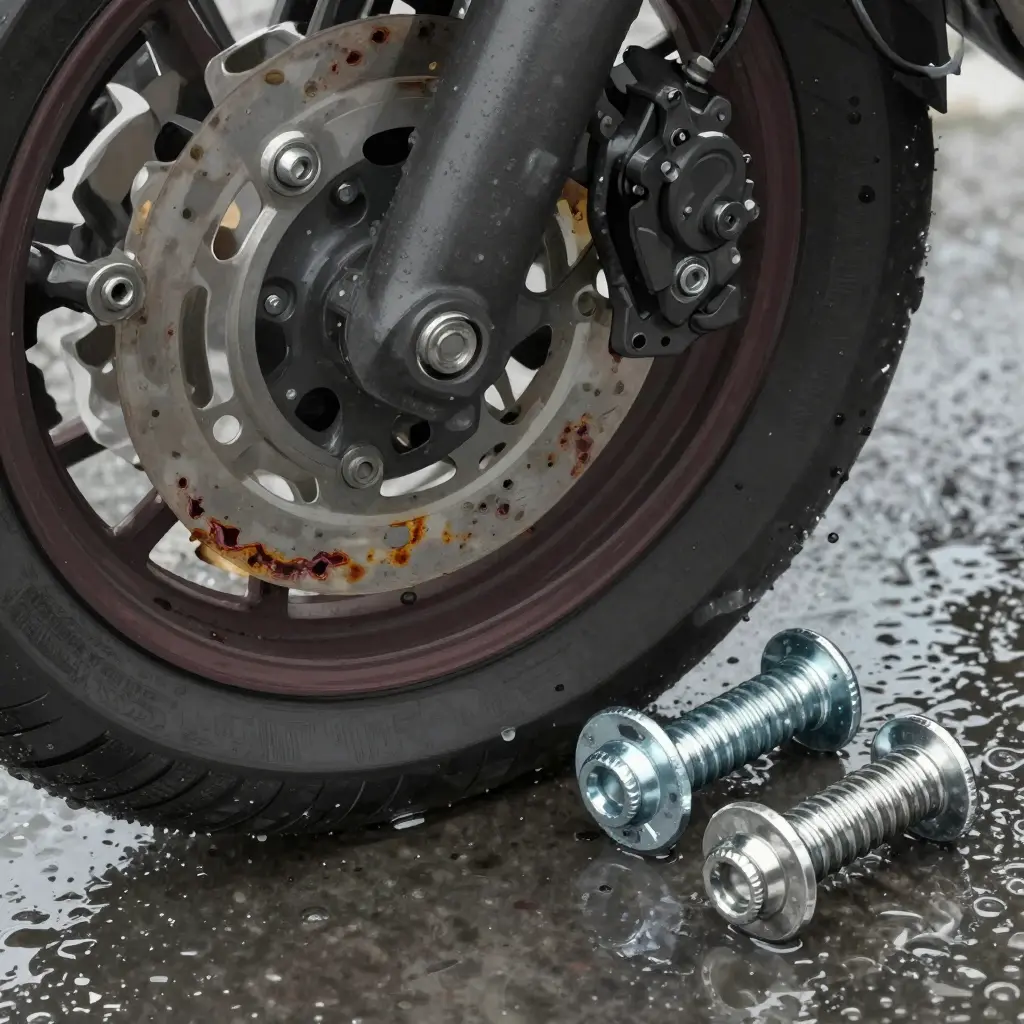
What Are Fairing Fastener Kits?
A fairing fastener kit is a bag of bolts, screws, washers, clips, and retaining hardware sized for one motorcycle’s plastic body panels. Instead of hunting down a single missing bolt, you get everything needed to mount, replace, or reinstall the fairings in one package. Because kits are built for a specific make and model, the thread pitch, diameter, and length match the bike, along with the grommets, rubber well nuts, and trim clips that keep hardware from chewing into painted surfaces.
Fairings do more than look good. They manage airflow, shield the rider from wind and debris, and house lights and instruments. All that plastic vibrates constantly at speed, so the fasteners holding it on take repeated load. A loose fairing bolt lets a panel flex, crack, or come off entirely, which puts the hardware quality directly in charge of whether your bodywork stays put.
Fastener material decides which of two problems you end up living with. Zinc plating is cheap and common on stock hardware, but it corrodes in rain and road spray. Stainless steel shrugs off water, then seizes and galls when you try to remove it. Neither is free, and choosing between them is what the rest of this article covers. The basics are in this fairing kits guide.
The sections below take both failure modes in turn: how zinc plating breaks down under moisture, why stainless threads gall and lock on removal, and how to pick and maintain hardware that balances corrosion resistance against serviceability.
Why Fastener Choice Matters
- Fairings come off regularly for maintenance, so the hardware has to survive repeated install and removal.
- Rain, salt, and humidity eat plated coatings, and rusted bolts stop turning.
- Stainless resists rust but can gall and bind, which complicates the next service.
- The right size and clip type keep panels from cracking and mounting points from stripping.
The Anatomy and Role of Fairing Fastener Kits
A fairing fastener kit is the small hardware set that holds a motorcycle’s plastic shell to its frame. Instead of tracking down loose screws one at a time, riders and shops buy a complete kit built for their model. To see where each piece actually seats, it helps to first understand how motorcycle fairings attach.
What’s Inside a Typical Kit
Every kit differs slightly, but most share the same lineup of motorcycle bodywork fasteners:
- Bolts and screws – the primary load-bearers, threading into the frame, subframe, or clip-on nut plates.
- Washers – flat metal washers spread clamping force, while rubber or nylon versions cushion the panel and protect paint.
- Clips and grommets – press-fit clips and rubber grommets act as receivers, letting a bolt bite into plastic without cracking it.
- Quick-release fasteners – Dzus-style or quarter-turn fasteners let you pull a panel trackside in seconds.
How They Hold and Protect Bodywork
Together, these parts clamp a panel at a fixed point while leaving it a little room to move. That flex is deliberate: it absorbs engine and road vibration so panels do not rattle loose or stress-crack over thousands of miles.
Serviceability is the other payoff. A matched fairing bolt kit means fewer stripped threads and less downtime, and quick-release hardware can turn a fifteen-minute job into a one-minute one.
Why Material Matters
Shape and size decide whether a panel stays put. The metal decides how long the hardware lasts, and that is where zinc plating and stainless steel part ways.
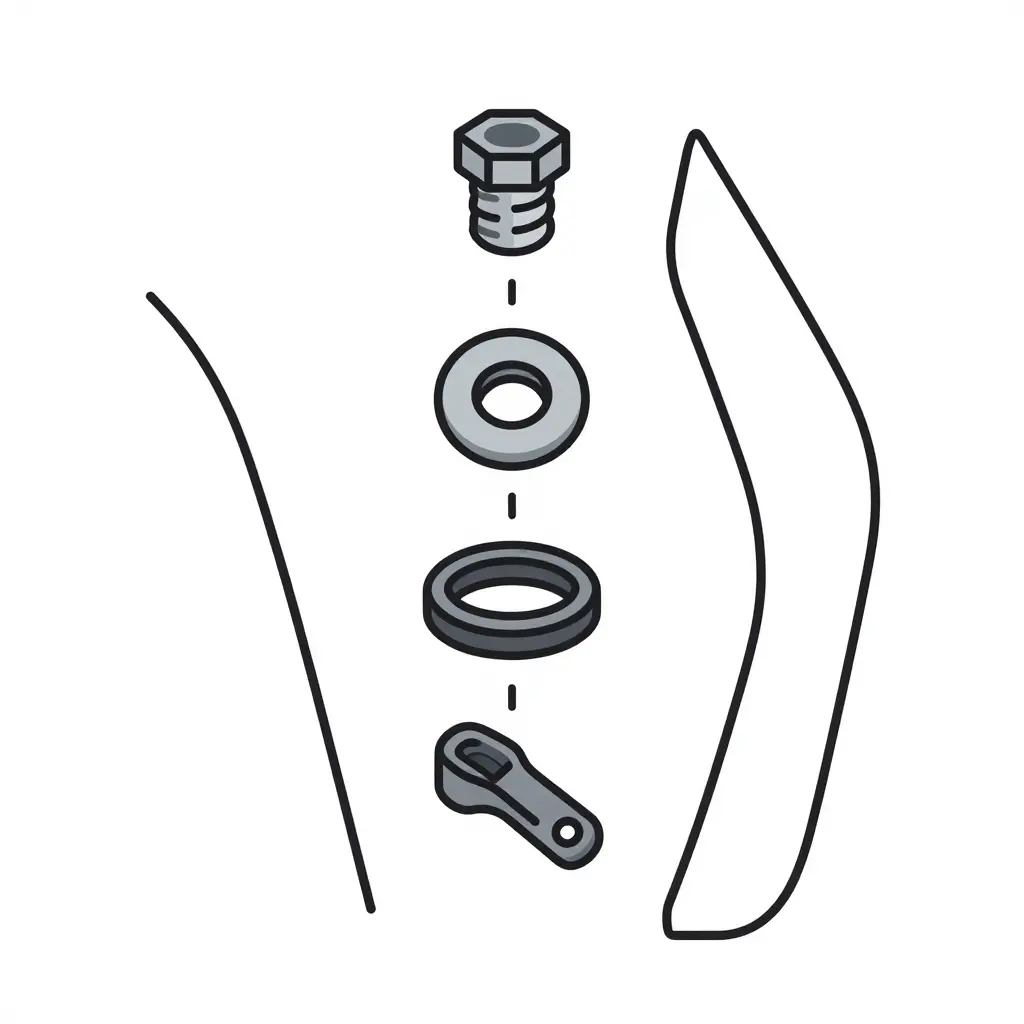
What Holds Your Fairing On: The Fastener Stack at a Glance
Before the corrosion chemistry, it helps to see what you are dealing with every time a panel comes off. Most factory attachment points are not a single bolt. They are a stack of parts working together to hold plastic securely without cracking it.
The diagram above breaks that stack down in an exploded view, top to bottom:
- The bolt – usually a shoulder or flange bolt that threads into a clip or boss. It provides the clamping force.
- The washer – spreads the load so the bolt head does not dig into or crush the panel.
- The grommet – a rubber isolator that absorbs vibration and lets the panel flex slightly without stressing the fastener.
- The clip – a spring or U-nut that grips from behind and gives the bolt something to bite into, often on a plastic tab that cannot accept a threaded insert.
Each part reacts differently to water and to removal torque. A zinc-plated bolt corroding in the rain fails in a completely different way than a stainless bolt galling as you back it out, and the grommet and clip are usually the silent casualties in between. For how these panels are built and mounted across different bikes, our motorcycle fairing kits guide covers the components in more depth.
Keep this stack in mind. Every corrosion and galling problem below shows up somewhere in these four parts.
Zinc Corrosion in Rain: How Fairing Fasteners Quietly Fail
Zinc plating is the most common protective finish on the bolts and screws holding motorcycle fairings together. It works on a simple trade-off: the zinc coating sacrifices itself so the steel underneath survives. But rain, road spray, and humidity constantly attack that protection, and the result is zinc corrosion that destroys the hardware long before you notice it.
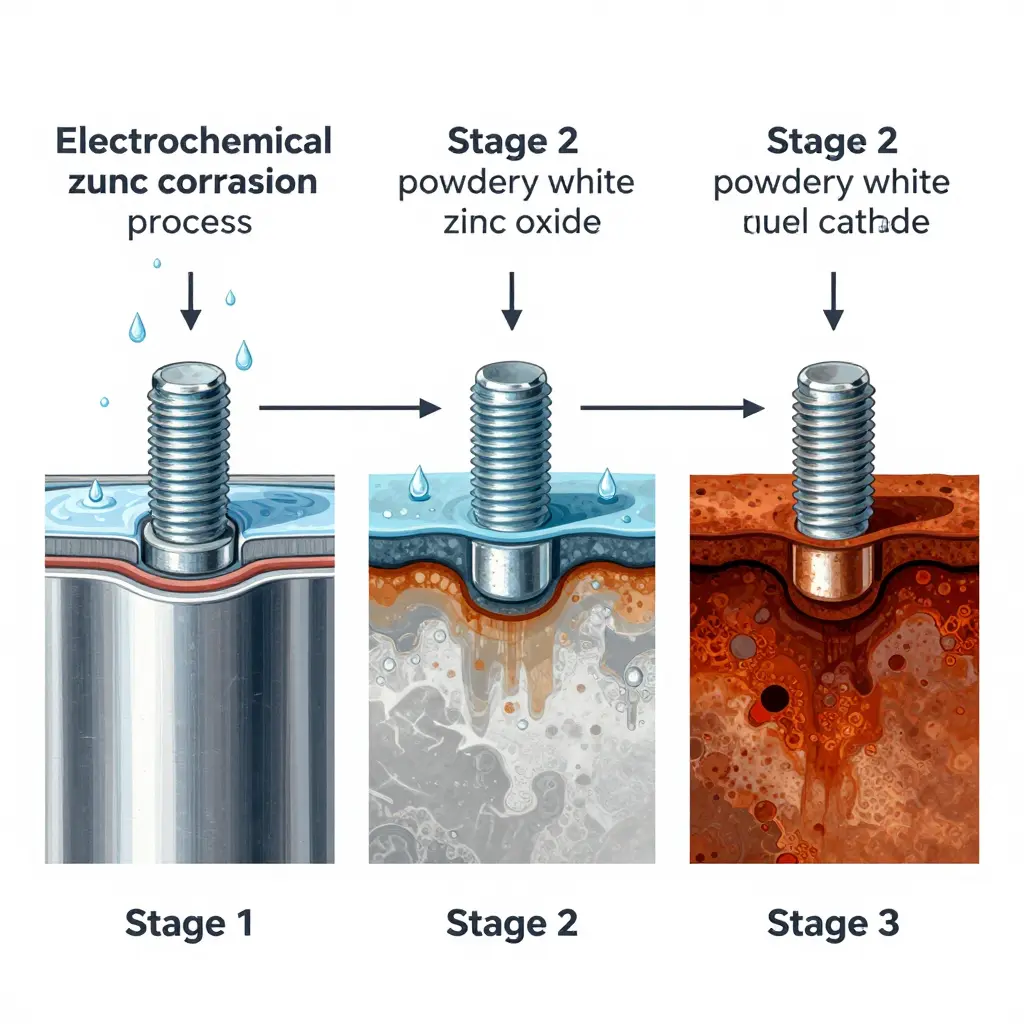
The Electrochemical Process
Moisture settling on a zinc-plated fastener forms a thin electrolyte film. Zinc is more reactive than steel, so it becomes the anode and gives up electrons, while oxygen dissolved in the water absorbs them at the cathode. The zinc corrodes first, exactly as intended. That sacrificial action slows fastener corrosion on the steel core, but only as long as the coating stays intact.
How the Protective Coating Wears Away
Every wet-dry cycle consumes a little more zinc. Wrenching, vibration, and abrasive road grit scratch the plating, exposing bare steel at high-stress points like bolt heads, washer faces, and threaded shanks. Once the zinc is gone in those spots, the steel core faces the same electrolyte that was once harmless.
White Rust vs. Red Rust
White rust appears first: a powdery film of zinc oxide and hydroxide that forms as the zinc corrodes. It looks cosmetic, but it signals that the coating is being eaten away. Red rust is iron oxide, which means the steel core itself is corroding. By the time red rust shows, the fastener has already lost strength.
Why Wet-Dry Cycles Accelerate Degradation
Repeated wetting and drying does more damage than constant submersion. Each dry-out concentrates salts and oxygen against the metal, then the next rain re-wets it and restarts the reaction. On fairings, water pools in recessed bolt pockets and behind panels where it evaporates slowly, so the cycle repeats day after day. That is why cheap zinc-plated fairing fastener kits often give out within a season or two in wet climates while the panels themselves still look fine.
Real-World Consequences for Shops and Owners
Rust expands inside the threads as corrosion progresses. Bolts seize in their clips and bosses, so removal takes enough force to snap heads or round out hex sockets. Drilling out a seized bolt often strips the threads in the fairing boss or threaded clip, turning a five-minute panel swap into a repair that needs inserts or new mounting points. That is the hidden cost of skipping an aftermarket fairing hardware upgrade before the rust sets in.
Zinc protects steel only until the plating is spent. Check fasteners for white rust early, keep threads dry where you can, and replace suspect hardware before it reaches the red-rust stage.
Why Stainless Steel Fasteners Gall on Removal
Stainless steel earns its place on fairings because it resists rust. The same alloy hides a less obvious weakness: it welds itself to other stainless parts. That is stainless galling, and it can turn a routine fairing bolt removal into stripped threads and rounded hex heads.
What Actually Happens
Galling is cold welding. Two stainless surfaces rub together under pressure, the thin oxide layer that normally keeps the metal slick tears away, and fresh metal is exposed. Stainless is soft and “sticky” under friction, so the surfaces bond at a microscopic level and the threads tear chunks out of each other.
Three conditions drive it:
- Friction – every turn of the wrench creates rubbing between the mating threads.
- Pressure – torque squeezes the threads together, increasing contact area.
- No lubrication – without anti-seize or grease, nothing separates the two stainless surfaces.
Why Removal Is the Worst Time
By the time you pull a fairing bolt, it has usually sat for months under vibration, heat, and tension. Dirt, dried thread locker, and road grit add extra drag. The first hard turn delivers friction and pressure at once, which is the recipe for seizure. A stainless bolt in a stainless insert is the classic worst case, because both sides are the same galling-prone material. As soon as one thread cold-welds, the next turn rips metal instead of sliding, and the bolt jams.
Galling vs. Corrosion
The two problems get blamed for each other, but they are different failures. Galling is a mechanical failure that happens in seconds; corrosion is a chemical failure that builds over weeks. Which one you have changes how you fix it.
| Aspect | Stainless Galling | Corrosion |
|---|---|---|
| Mechanism | Cold welding / material adhesion from friction and pressure | Electrochemical reaction, metal oxidation |
| Trigger | Friction, high pressure, no lubrication | Moisture, salt, oxygen, dissimilar metals |
| Symptoms | Seized bolt, torn or galled threads, rough silver smears | White or green powder, pitting, discoloration, brown rust |
| Timing | Instant, during tightening or removal | Slow, developing over time in the elements |
| Fix | Anti-seize, slow steady turning, correct torque | Coatings, seals, rinsing, dielectric grease |
If the bolt fights you from the first turn but the threads come out scratched and shiny, that is galling. Powdery buildup and pitting mean corrosion. For help picking hardware for the job, see this guide to custom motorcycle fairings.
Choosing bolts for your bodywork comes down to one trade-off: zinc fasteners rust in the rain, while stainless fasteners can gall and lock up on removal. The table below lays out that contrast.
Zinc-Plated vs Stainless Steel Fairing Fasteners
| Material Type | Corrosion Resistance in Rain | Galling Risk on Removal | Typical Cost | Appearance | Best-Use Case |
|---|---|---|---|---|---|
| Zinc-plated steel | Low – coating wears, white/red rust appears | Low | $ (cheapest) | Silver, dulls over time | Dry-climate street bikes, budget repairs |
| Yellow zinc | Moderate – chromate layer lasts longer in rain than clear zinc | Low | $$ | Gold/amber tint | Fair-weather riders wanting extra rust protection |
| 304 stainless steel | High – resists rain and road spray; long-term salt exposure can still pit it | Moderate to high | $$$ | Bright, polished silver | Year-round riders in wet or coastal areas |
| 316 stainless steel | Very high – marine-grade, resists salt and chemicals | High | $$$$ | Bright, polished silver | Coastal riders, marine/coastal exposure, salt-belt use |
No material wins outright. Zinc-plated bolts are cheap and come out easily, but the coating degrades in rain and leaves bare steel exposed. Stainless survives the weather beautifully and then fights you on removal, especially if it was over-torqued or left untouched for seasons. Riders who strip their plastics often can keep stainless and tame the galling with a light film of anti-seize. To match a setup to your bike, review this guide to motorcycle fairing kits.
Warning Signs and Symptoms to Watch For
Catching fastener corrosion before it spreads is the difference between a five-minute check and a weekend spent extracting bolts, whether you ride weekends or turn wrenches for a living. Look over the fairing fasteners during every wash, tire change, or pre-ride inspection, and treat any of these as a signal to act:
- White rust on zinc fasteners – a chalky, powdery white or gray film on plated bolts usually means the protective zinc coating has started to break down.
- Red rust staining – streaks or blooms of orange-brown discoloration around a bolt head or washer show that water has reached the base steel.
- Discolored or pitted threads – dark, rough, or cratered thread surfaces indicate deep corrosion that weakens clamping force and grip.
- Bolts that resist turning – a bolt that fights back or needs unusual force may already be galling or seized inside its insert.
- Squeaking or grinding during removal – audible friction as you back a fastener out is a classic early warning of thread damage or stainless galling.
- Rounded or chewed fastener heads – stripped hex or Phillips heads mean previous removal attempts have already started to fail.
Early detection matters because one seized fastener can crack the plastic around a mounting tab, strip a clip-on nut, or force you to drill out an insert, turning a panel swap into an expensive repair that leaves the bodywork weaker. For a deeper look at how these components fit together, see our motorcycle fairing kits guide.
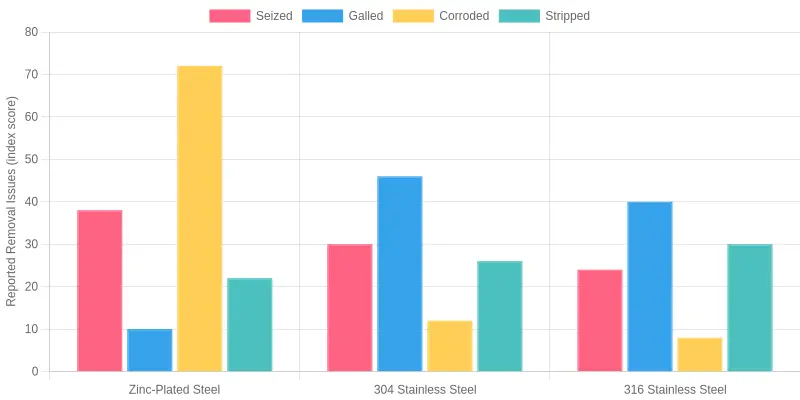
Figure 1. Reported fastener removal issues by material type, indexed across seized, galled, corroded, and stripped failures. Read each cluster of four bars left to right to see how the same removal problem shifts between materials: zinc-plated steel towers over the others on corrosion, while 304 and 316 stainless steel spike on galling and stripping. That inversion is the heart of the zinc corrosion versus stainless galling story. The fairing bolt that fights you because it rusted in place is nothing like the stainless bolt that seized because its threads cold-welded together on removal.
What Shops and Riders Actually Report
Talk to enough mechanics and riders about fairing hardware and the same stories surface again and again, even from people riding different machines in different climates.
Rain-Exposed Zinc Bolts Seize
Shops that service bikes stored or ridden outdoors treat zinc corrosion as a slow, quiet problem. Zinc-plated bolts look fine right up until they don’t. Moisture, road salt, and repeated wet-dry cycles eat into the coating, and the once-crisp threads start to fuse with the surrounding material. A bolt that spun freely a season ago now refuses to budge. The evidence is hard to miss: white powdery residue, flaking plating, and rounded hex heads from too much persuasion. Most techs conclude that zinc is a reasonable factory compromise but a poor long-term choice for anyone who parks in the rain.
Stainless Bolts and Galling on Removal
The fix seems obvious, so riders swap in stainless. That brings a different headache. Stainless hardware resists rust beautifully, but it is prone to stainless galling, where threads cold-weld to one another and lock tight during removal. A bolt that went in smoothly can screech and bind coming out, and sometimes snap entirely. Stainless is not maintenance-free, and treating it like it is invites stripped threads.
Anti-Seize as the Common Denominator
Anti-seize comes up no matter which camp you ask. Experienced shops keep a jar within reach and apply a thin film to fairing threads before reassembly; riders who adopt the habit snap far fewer bolts, and those who skip it tend to learn the lesson the hard way. Quality fairing fastener kits help here too, since a matched set with proper coatings removes much of the guesswork. Riders replacing plastic and hardware together often pair the two, and browsing solid aftermarket motorcycle fairings gives useful context on what fits and lasts.
The Practical Takeaway
No single metal wins. Zinc corrodes easily but comes apart cleanly; stainless survives weather and demands anti-seize. What decides whether fairing hardware comes off in one piece is preparation, not the bolt itself.
Choosing the Right Fairing Fastener Kit: A Practical Guide
Fasteners feel like an afterthought until one seizes, strips, or rusts. If you pull motorcycle fairings often – a shop doing routine service, or an owner chasing a cleaner look – the kit you install sets the tone for every job after it.
What follows is how to pick a kit based on where you ride and how often you wrench.
Match the Kit to Your Riding Conditions
Riding conditions matter more than anything else. A bike that lives in a dry garage sees far less moisture than one parked outside near the coast or ridden through salted winter roads.
If your machine rarely sees rain and comes apart once a season, budget hardware is genuinely fine. If it commutes through downpours, that same hardware can weld itself into threaded bosses over time.
When Zinc-Plated Fasteners Are Acceptable
Zinc-plated steel is the value pick: decent tensile strength, much better galling resistance than bare stainless, and a lower price. The plating also acts as a sacrificial coating that corrodes before the base steel does.
Zinc-plated is a reasonable choice when:
- The bike is stored indoors and ridden mostly in dry weather.
- Fairings come off rarely, so corrosion has little time to take hold.
- You are building on a tight budget and want an affordable base to work from, the same logic as buying budget bodywork and upgrading the hardware around it.
The weakness is exposure. Once the plating scratches or chips, rust moves in fast, especially in wet, humid, or coastal air.
When Stainless Steel Fasteners Win
Stainless is the better investment for wet climates, coastal garages, winter riding, and any bike whose panels come off often. Its chromium oxide layer resists rust far longer, and clean threads mean fewer snapped bolts.
The catch is galling: stainless-on-stainless threads can cold-weld under friction, so a bolt that went in easily may fight you on the way out. Anti-seize is what keeps that from happening.
Coatings, Finishes, and Anti-Seize
Coatings affect both durability and looks. Common options include:
- Zinc plating – economical, sacrificial protection, duller finish.
- Black oxide or DLC coatings – a dark finish; black oxide adds little corrosion protection on its own, while DLC is hard-wearing.
- Passivated stainless – factory-fresh protection that can be refreshed.
- Anodized aluminum – light and available in colors, but aluminum threads are much weaker than steel; reserve it for low-stress trim.
Always apply a thin film of anti-seize to stainless threads, especially where they thread into aluminum or steel inserts. Nickel-based paste is the safer pick around aluminum, since copper-based anti-seize can worsen galvanic corrosion there. The paste keeps dissimilar metals from bonding, prevents galling, and makes removal easier. Reapply it whenever panels come off.
If you are refreshing bodywork while the fasteners are out, our guide on how to paint motorcycle fairings pairs well with a hardware upgrade.
Quick Selection Checklist
- How often do fairings come off? Frequent removal favors stainless plus anti-seize.
- What is the climate? Rain, salt, and coastlines push you toward stainless steel fasteners.
- What is your budget? Zinc-plated kits fit low-cost builds and fair-weather bikes.
- Are dissimilar metals touching? Add anti-seize to prevent galvanic corrosion.
- Does appearance matter? Choose a coating that matches your build’s finish.
Get the material and finish right and a fairing fastener kit stops being a headache on service day.
A Quick Visual Path to the Right Fastener
Choosing between zinc-plated and stainless steel fairing fasteners usually comes down to two real-world questions: Will these bolts get wet? and How often will I take this fairing off? Zinc fights corrosion with a sacrificial coating that wears away in constant rain. Stainless shrugs off moisture but galls when it comes out.
The decision flow below maps that out.

How to Read the Flow
- Start at the top node – the moment you are picking hardware for a fairing job.
- Left branch (rain exposure) – if your bike lives outdoors, commutes in wet weather, or gets washed frequently, moisture is the deciding factor, and stainless steel is the safer bet.
- Right branch (frequent removal) – if you wrench on the fairing often, you want a fastener that resists galling, which is where zinc or anti-seize-treated stainless shines.
- The wrench icon marks removal frequency, while the rain cloud marks moisture exposure.
If both problems apply to you, the practical fix is stainless hardware paired with a thin coat of anti-seize: you keep the corrosion resistance and tame the galling risk. For a walkthrough of how the panels and their hardware work together, our motorcycle fairings overview covers the components before you start turning bolts.
Maintenance and Prevention
Stopping zinc corrosion and stainless galling before they start is far cheaper than drilling out a seized bolt. A little routine care keeps fairings easy to remove for years.
Lubricate With Anti-Seize
Anti-seize is your first line of defense. Put a thin, even coat on every threaded fastener, particularly where steel bolts meet aluminum subframes or other dissimilar metals. On stainless hardware, a copper- or nickel-based anti-seize prevents galling, the cold-welding that seizes bolts on removal. A dab on the shank is enough; more just collects grit.
Torque to Spec Every Time
Over-tightening crushes threads and strips soft alloys; under-tightening lets fairings vibrate loose and crack. Use a calibrated torque wrench set to the manufacturer’s specification, and tighten plastic bodywork in a crisscross pattern. If you are unsure how the panels come apart, review this broader overview of motorcycle fairings first.
Use the Right Tools
Match the socket or driver to the fastener head exactly. Worn or mismatched tools round off heads and force you into destructive removal. A torque wrench, a proper bit set, and thread-restoring taps belong in the drawer.
Inspect Periodically
Check fasteners at every service or wash. White zinc oxide powder, rust streaks, and loosened clips are early signs of fastener corrosion. Clean the threads and reapply anti-seize as needed.
Replace Damaged Fasteners Promptly
A stretched, rusted, or stripped bolt is a weak link. Swap it right away, ideally with a complete fairing fastener kits set so grades and lengths stay consistent. One bad bolt left in place damages the panel around it.
Quick Reference
| Practice | Why It Matters |
|---|---|
| Apply anti-seize | Blocks galvanic corrosion and galling |
| Torque to spec | Prevents stripped threads and cracks |
| Use matched tools | Avoids rounded heads |
| Inspect regularly | Catches corrosion early |
| Replace damaged bolts | Stops panel damage and failures |
Frequently Asked Questions About Fairing Fasteners
Is stainless steel always better than zinc?
No. Stainless resists rust and road-salt staining far better than zinc plating, but it is not trouble-free. Zinc is cheaper and less likely to seize, though its plating wears away in repeated rain and leaves white powder and rusty bolts over time. For wet climates stainless is usually the better long-term choice, but only when it is installed correctly.
Why do stainless bolts gall?
Stainless galling happens when two stainless surfaces rub together under pressure and the protective oxide layer breaks down, so the threads weld and tear instead of sliding. Fairing bolts are prone to it because the bolt and the threaded clip or nut are often the same alloy. Heat, vibration, and over-tightening make it worse; a lubricant on the threads greatly reduces the risk.
How do I remove a seized or galled fairing bolt?
Soak the fastener in penetrating oil and let it sit before applying force. Use a well-fitting socket or hex key so you do not round the head, and push steadily rather than jerking. If it still will not move, gentle heat on the nut or a thread-cutting tool can help. Patience prevents snapping the bolt, which usually means drilling and extracting it.
Should I use anti-seize on fairing fasteners?
Yes. A thin coat of anti-seize or a suitable thread lubricant, especially on stainless hardware, reduces galling, keeps water out of the threads, and makes the next removal easier. Do not overdo it: excess paste collects grit and can stain painted panels.
How often should fairing fasteners be replaced?
Inspect them at every service and replace any bolt that is stripped, rusted, or has damaged threads. A common interval is a full set every two to four years, and sooner in wet, coastal, or winter road-salt conditions. Complete fairing fastener kits with matched hardware make the job quick and keep every panel secure. For help choosing the right set, see this motorcycle fairing kits guide.