
Introduction
Motorcycle fairing windshields are more than cosmetic upgrades; they define aerodynamics, rider fatigue, and safety across on-road conditions. For business owners in OEM, aftermarket, or repair, choosing materials, designs, and supply partners determines installation success, customer satisfaction, and repeat revenue. This comprehensive guide examines four essential angles: the technical backbone of design and materials; the market and pricing ecosystem; regulatory and geopolitical considerations shaping supply chains; and the societal impact—including rider comfort and safety outcomes. Chapter 1 explains why material thickness, coatings, and mounting geometry matter for real-world performance. Chapter 2 surveys brands, fitment, and price bands that drive demand in diverse markets. Chapter 3 maps regulatory requirements and cross-border sourcing realities that affect timelines and costs. Chapter 4 connects windscreen performance to rider well-being and safety, translating engineering choices into tangible customer benefits. Together they offer business owners a holistic framework for stocking decisions, partnerships, and product development that align with rider needs and market dynamics.
Tables of Contents
Chapter 1: Chapter 1: Motorcycle fairing windshield — Technical Design and Materials
- Chapter 1: Motorcycle fairing windshield — Technical Design and Materials: From Laminate Precision to Aerodynamic Geometry That Shapes the Ride
- From Raw Material to Road: The Economic, Geopolitical, and Social Footprint of Windshield Materials in Motorcycle Fairings
Chapter 1: Chapter 1: Motorcycle fairing windshield — Technical Design and Materials
1. Chapter 1: Motorcycle fairing windshield — Technical Design and Materials: From Laminate Precision to Aerodynamic Geometry That Shapes the Ride
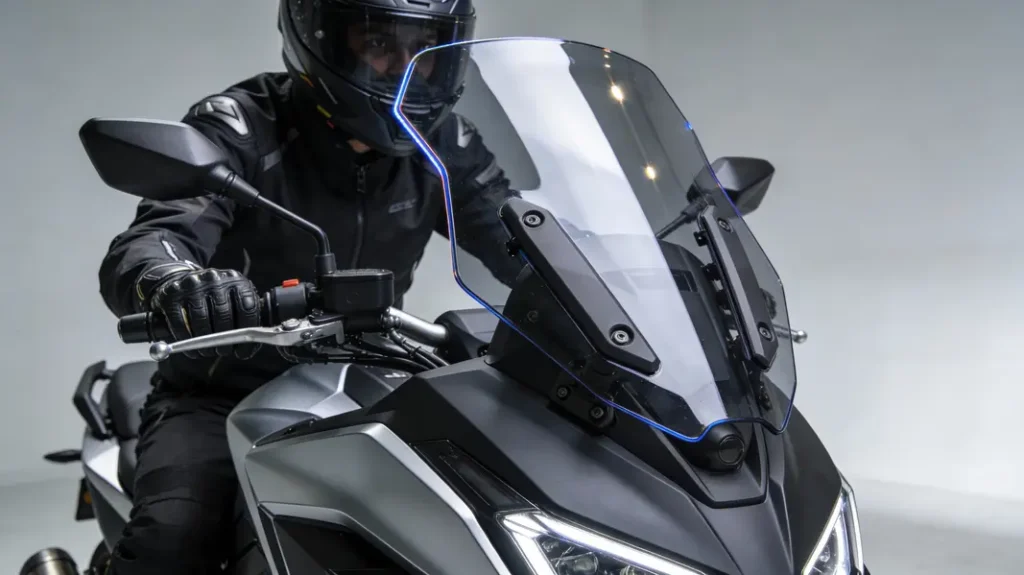
A motorcycle fairing windshield functions as more than a protective screen; it is the leading edge of an integrated aerodynamic system that defines comfort, control, and endurance on long rides. The modern windshield emerges from a convergence of laminated materials, reinforced structures, and carefully contoured fairing geometry. Each layer and curve is chosen not only for clarity or strength but for how it interacts with wind, debris, and the rider’s posture. The result is a shield that reduces fatigue, minimizes buffeting, and preserves visibility at speed across a range of riding styles, from aggressive sport touring to relaxed grand-touring. In this synthesis, laminates form the backbone of optical and mechanical performance, while reinforcement strategies and air-directing shapes translate those properties into real-world ride quality. The conversation moves beyond simple material choice to a holistic design approach that accounts for weight, durability, and the subtle, sometimes invisible, ways wind behaves as it encounters a rider and a machine in motion. \n\nLaminates used in windshields are not generic glass substitutes; they are engineered composites built from optical-grade polymers with a clear emphasis on transparency, resilience, and long-term stability. Polycarbonate and acrylic remain the dominant families, but the most successful designs push closer to the ideal of distortion-free vision and minimal glare under a wide spectrum of lighting and weather. Optical-grade polycarbonate offers outstanding impact resistance and flexibility, which helps a windshield resist chips and cracks from road debris without becoming brittle or delaminating over time. Thicker laminates—ranging from roughly 0.135 inches up to 0.236 inches—provide additional stiffness and a more stable optical surface, reducing flutter and micro-vibrations that contribute to blurred vision. While some stock configurations compromise flexibility for cost, premium laminates prioritize a balance of light transmission, scratch resistance, and UV stability. The thickness advantage is not just about strength; it also softens the wind’s pressure pulses, pruning buffeting that can travel up the torso and into the helmet. \n\nIn parallel, the advent of bio-based plastics and advanced, recyclable blends has begun to influence the material palette. These bio-based options aim to deliver high optical clarity and gloss without the need for painting or coating, while delivering robust scratch and UV resistance and a more favorable environmental footprint. The shift toward recyclable, lower-emission production aligns with broader sustainability goals in the industry and mirrors a growing preference among riders for materials that can be responsibly recycled at the end of life. The practical upshot for windshield laminates is a set of materials that maintain clarity across years of exposure to sun, heat, rain, and road debris, while also delivering the environmental and weight advantages that modern riders increasingly expect. \n\nReinforcement techniques accompany laminated surfaces to address durability and edge integrity. A windshield’s edges are in constant contact with impact, temperature fluctuations, and cleaning practices, so edge reinforcement becomes a critical design criterion. Three-millimeter sheets of polycarbonate or thicker variants are commonplace in higher-end assemblies because they offer superior flex resistance and crack arresting properties. The reinforced edge often features carefully polished contours and sometimes discrete geometric treatments that prevent stress concentrations where the material meets mounting hardware. This not only improves long-term durability but also contributes to a cleaner, more precise appearance in factory or aftermarket installations. In practice, reinforcement translates to a windscreen that can deform slightly during a heavy gust or a piece of airborne grit without catastrophic failure, thereby maintaining a consistent line of sight for the rider. \n\nThe aerodynamic geometry of the fairing and windshield is the third pillar of performance. Recurve designs—where the windshield bends away from the rider’s line of sight and redirects airflow over the shoulders and torso—are a focal strategy for reducing buffeting, especially for riders who adopt tall or upright riding positions. The geometry matters as much as the material, because wind interacts with the windscreen in complex ways. A recurve with appropriate height and width can shepherd air above the helmet, reducing the oscillatory forces that contribute to fatigue and helmet lift. This is particularly important on motorcycles with tall bars or upright stances where the rider’s helmet would otherwise encounter a strong boundary layer of turbulent air. In a well-executed combination, a recurve reduces the wind pressure felt on the helmet and chest while preserving a clear, distortion-free field of view. \n\nIntegrated windscreen kits—where a single fairing assembly includes the shield as a factory-fitted component—demonstrate how material choice and geometry can be harmonized with mounting interfaces. These systems emphasize compatibility, weight distribution, and aerodynamics as a package rather than as discrete, later-added parts. The result is a smoother ride across highway speeds and better wind management at cruise conditions, all while maintaining a visually cohesive aesthetic with the bike’s overall lines. \n\nThe interplay between laminates, reinforcement, and geometry also informs practical trade-offs that riders encounter. Thicker laminates improve resistance to debris and reduce flex, but they contribute extra weight, which can influence handling and front-end feel. Polymers with higher glass-transition temperatures and superior UV resistance help preserve clarity under prolonged sun exposure, yet some blends may demand production processes with tighter tolerances. Edge reinforcement adds resilience but can complicate mounting and serviceability if not designed with accessibility in mind. Finally, aerodynamic geometry must accommodate a rider’s height, posture, and typical riding speeds, balancing the need for wind protection with the desire for a natural, uneventful field of view. \n\nIn a landscape where aftermarket and factory options coexist, the best outcomes arise from an integrated design philosophy rather than a single-material triumph. Riders benefit when laminates offer clear, glare-free vision; reinforcements preserve structural integrity and mounting precision; and aerodynamics deliver a calm, controlled wind environment that minimizes fatigue over time. A practical takeaway is the recognition that materials and geometry are not independent choices but collaborative design decisions that together shape the overall riding experience. For readers seeking a concrete touchpoint on how recurve windscreen geometry can influence ride feel in a real-world setup, a representative design example of a recurve windscreen illustrates how height, curvature, and width interact to manage airflow without introducing look-through distortion. recurve windshield design example. \n\nAs this subchapter closes, the thread connecting laminates, reinforcements, and aerodynamic geometry becomes clear: each layer of the windscreen and each curve of the fairing is chosen to choreograph wind in a way that preserves visibility, reduces fatigue, and respects the rider’s preferred posture. The result is less glare, more confidence at speed, and a windscreen that remains steadfast through years of riding, seasons of sun, and the occasional road challenge. In the broader arc of Chapter 1, these technical decisions set a baseline for understanding how design choices cascade through cost, availability, and even regional manufacturing practices, foreshadowing the forthcoming discussion of the economic and geopolitical dimensions that influence material selection and supply chains for motorcycle fairing windshields.
2. From Raw Material to Road: The Economic, Geopolitical, and Social Footprint of Windshield Materials in Motorcycle Fairings
Material choice for a motorcycle fairing windshield does more than shape the rider’s view; it anchors the entire value chain from raw feedstock to end-of-life. In this subchapter, we examine how economic forces, geopolitical realities, and social dimensions steer what materials are used, how they are manufactured, and how responsibly they are managed across markets. The journey from resin to shield is not just about clarity and strength; it is a negotiation among cost, supply reliability, regulatory expectations, and environmental responsibility that varies by region, time, and technology. The most visible consequence is price, but price itself emerges from a web of factors: raw-material costs, processing energy, tooling, coatings, and the capacity of manufacturers to scale production while maintaining quality. Polycarbonate and PMMA (acrylic) remain the core options, each offering different blends of impact resistance, optical clarity, and weathering performance. Laminated or multi-layer configurations add protection layers and coatings, but they also introduce additional processing steps and material interactions. Coatings for scratch resistance, anti-fog performance, UV stabilization, and hydrophobic action extend the windshield’s life on the road, yet they demand adhesives and surface treatments that can complicate manufacturing and long-term maintenance. Every material choice thus imposes trade-offs that ripple through cost structures and service life, and those trade-offs shift with market conditions and regulatory landscapes. In parallel, the economic calculus is not fixed. Demand for aftermarket windshields tends to be more price-sensitive and fragmented than OEM supply, while scale effects, supplier concentration, and regional distribution networks shape lead times and pricing power. End-of-life disposal and recycling add another layer of cost and strategic consideration. A robust windscreen program must account for how scrap and recycling streams align with local waste policies and incentives, which differ markedly across North America, Europe, and Asia-Pacific. To illustrate the ecosystem, consider the aftermarket landscape as an arena of diverse design intentions—thicker shields for durability, lighter transparencies for agility, multi-coated surfaces for visibility in glare-prone conditions, and specialized shapes tailored to fairing geometry. The breadth of options is a direct reflection of supply-chain resilience and regional preferences. A practical touchpoint for readers is to survey category catalogs that reveal the spectrum of materials, thicknesses, and coatings available at different price points. A notable example is the UltimateMotorX product category C61, which highlights how vendors segment offerings by material and feature set. UltimateMotorX product category C61. This glimpse into an active marketplace underscores that the choice is rarely about a single property; it is about a bundle of performance criteria aligned with regional practice and rider expectations. Material selection also interacts with manufacturing pathways. Thermoforming polycarbonate or acrylic sheets, bonding them with fairing plastics, and adding laminated layers demands precise process control and equipment investment. The presence of multi-layer configurations can improve shock absorption and optical performance, but they require careful edge finishing and adhesion strategies to prevent delamination under UV exposure or thermal cycling. Higher-end coatings extend wear life and reduce maintenance, yet they can add cost and complicate repair—an important consideration for fleets, rental operations, and long-distance riders who rely on consistent performance under varied climates. Beyond cost and performance, geopolitical factors shape material availability and pricing. Raw-material supply chains for resins and coatings traverse multiple regions, exposing windshield programs to fluctuations in feedstock markets, currency movements, and trade dynamics. Tariffs or export controls on specialty polymers can ripple through both OEM programs and aftermarket supply, potentially altering the mix of materials used in a given region. Regional disruptions—whether from natural disaster, labor constraints, or transportation bottlenecks—translate into longer lead times and higher safety stock requirements. In such environments, manufacturers may favor materials with broader sourcing footprints or simpler processing chains, even if those choices slightly compromise niche performance gains. Societal considerations round out the economic and geopolitical picture. Accessibility and affordability of windshields influence rider safety by widening or narrowing options for riders with different incomes and in varied regulatory contexts. Standards and testing regimes vary, affecting the perceived reliability of windshields when they are deployed in different climates or road networks. Environmental considerations also matter. The environmental footprint of windshield materials includes raw-material extraction, energy used in forming and coating, durability in service, and end-of-life handling. Designers increasingly balance weight savings against longer-term recycling potential, seeking formulations that can be disassembled or reprocessed with reduced energy input. In practice, this manifests as a push toward recyclable laminates, standardized bonding methods, and coatings that preserve performance without imposing difficult recycling steps. The societal dimension also encompasses access to repair and replacement services. Regions with robust aftermarket ecosystems may offer a wider range of materials and thicknesses at lower costs, enabling riders to tailor windshields to climate and riding style. Conversely, regions with tighter regulatory or supply constraints may experience slower adoption of advanced coatings or laminated structures, reinforcing a gap between performance aspirations and practical availability. Looking ahead, material science and global logistics will continue to shape the economics and equity of windshield options. Emerging recyclable laminates, biobased polymers, and modular fairings could alter both cost structures and geopolitical risk profiles. Innovations in surface science—improved scratch resistance, easier repair, and durable anti-fog performance—will influence maintenance costs and rider satisfaction. As the next subchapter moves from macro implications to detailed design choices, the thread linking economics, geopolitics, and society remains clear: the windshield is not only a shield against wind, but a material system whose life cycle is inseparable from the markets, policies, and values that define modern motorcycle mobility.
Final thoughts
Across design, market dynamics, regulatory realities, and rider outcomes, motorcycle fairing windshields emerge as a core business lever. Strong material choices and precise fabrication reduce buffeting and extend component life, while a robust aftermarket ecosystem enables model-specific fits and accessible pricing. Navigating regulatory and geopolitical factors is essential to maintain resilient supply chains and on-time delivery. Most critically, the link between windscreen performance and rider comfort translates into safer rides, higher customer satisfaction, and repeat business. For business owners, a strategic focus on tested materials, reliable partners, and clear value messaging around comfort and safety can differentiate brands in a crowded market.
Upgrade your ride with UltimateMotorX’s premium motorcycle fairings—durably crafted, precision-fitted, and stylish. Meeting OEM standards for easy installation, our collection suits upgrades or replacements. Shop now for fast shipping, secure checkout, and expert support. Give your bike the ultimate quality it deserves!
About us
At UltimateMotorX, we’re rider-founded experts in top-tier motorcycle fairings. We source premium materials, partnering with trusted manufacturers for perfect fits and durability. Enjoy expert advice, hassle-free returns, and seamless shopping. Ride with confidence—style and quality guaranteed!