
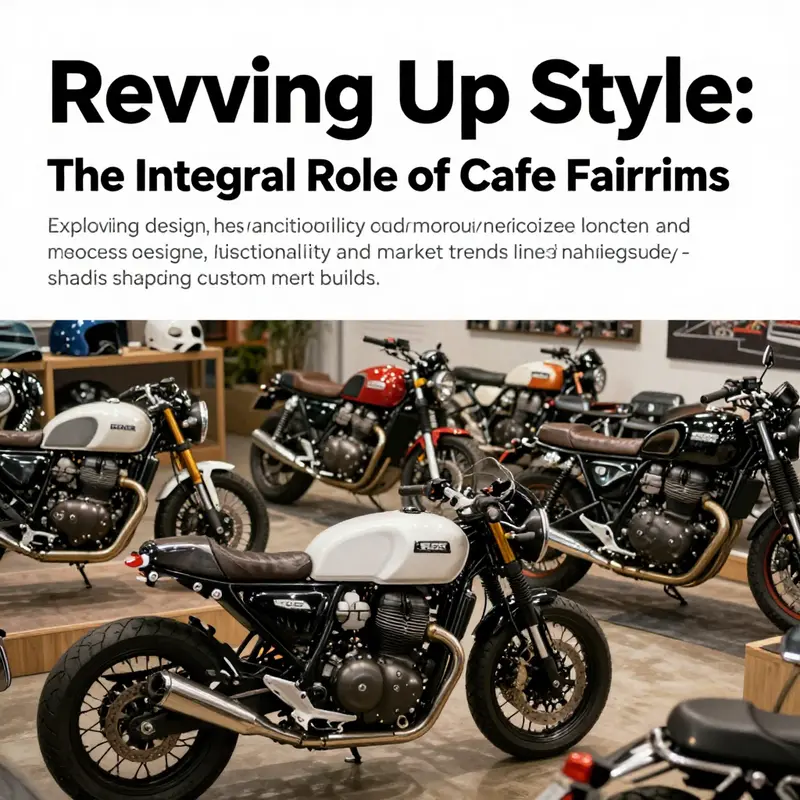
The motorcycle cafe racer fairing stands as a captivating blend of form and function, capturing the essence of vintage motorcycle culture while fulfilling modern needs. This article delves into the core components of cafe racer fairings, exploring their design principles, functional benefits, material choices in manufacturing, market sourcing trends, and their aesthetic impact on custom bike builds. As business owners, understanding these elements not only provides insights into product development but also aids in meeting customer demands for style and performance effectively.
Sleek by Design: The Design Language of the Café Racer Fairing
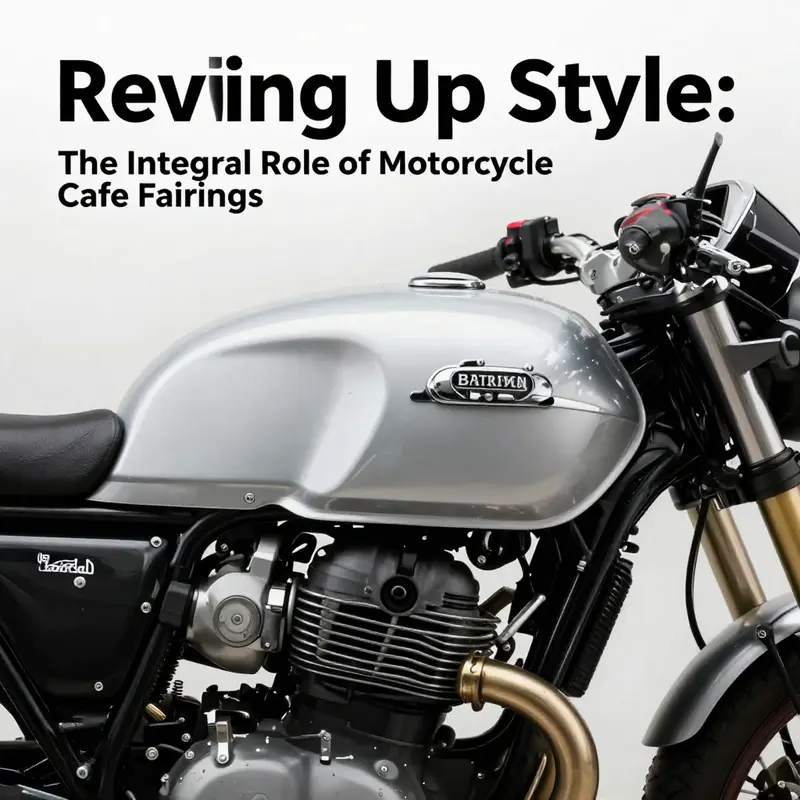
To understand the design principles of the motorcycle café racer fairing is to trace a compact philosophy of motion. It begins with a commitment to minimalism, but not in the sense of emptiness. The café racer fairing embodies a precise economy of form, where each contour, edge, and opening exists to reduce drag, manage wind, and sharpen the rider’s connection to the bike. The result is not a bulky shield but a purposeful frame that folds into the motorcycle’s silhouette. In this light, the fairing becomes an extension of the rider’s intent—an instrument that channels speed without sacrificing the bike’s raw, unadorned character. The visual impact is as important as the moment the wind meets the rider’s chest; a well-executed fairing communicates a devotion to speed, yet speaks in a language of restraint rather than excess. The café racer aesthetic favors a low, narrow profile that hints at the machine’s capability while leaving the engine and chassis exposed enough to tell a story of mechanical honesty. This is not merely about looking fast; it is about feeling focused, with the world reduced to the essential sightline between hands on the bars and eyes on the road ahead.
The core of the fairing’s design lies in a minimalist silhouette. A true café fairing sits low and tightly against the front end, covering only the portion above the headlight and the upper fork. In doing so, it minimizes frontal area and wind pressure, letting the rider remain unmistakably connected to the bike’s geometry. The narrow profile preserves the honesty of the engine’s lines and the bike’s naked, mechanical honesty—qualities that riders chasing the café racer vibe prize above all else. This restraint extends to the windscreen, which is often reduced to a small, nearly invisible shade or omitted altogether. The absence of an imposing shield keeps the rider’s vision broad and unfettered, reinforcing the sense that speed is a conversation between rider, machine, and environment, not a defensive march against the air.
The fairing’s ergonomics are inseparable from its silhouette. The café racer position is distinct: low, forward-leaning bars encourage a compact torso angle, while rear-set foot controls push the hips back and the knees in toward the tank. The fairing must harmonize with this stance, guiding airflow around the rider without forcing a new posture. In practice, this means shaping the sides and the intake area to cradle the rider’s chest and shoulders, directing air away from the torso while amplifying the rider’s sense of control. When the rider leans forward, the fairing helps to disrupt the oncoming breeze in a way that reduces buffeting, stabilizes helmet trim, and keeps the upper body feeling supported rather than overwhelmed by wind pressure. The alignment between fairing and handlebars, pegs, and seat height matters as much as the material choice. A well-integrated fairing doesn’t feel like an add-on; it feels like an extension of the bike’s chassis, a natural continuation of its lines.
From an aerodynamic standpoint, the café fairing achieves a balance between efficiency and purity. It is not a full-coverage shield designed for long-haul comfort, but a weather-savvy, rider-focused component that tends to improve airflow around the rider and the engine. The shaping around the headlight area and the side panels helps redirect air toward the engine bay and over the cylinders, aiding cooling where needed while preventing unnecessary turbulence. The result is an airflow pattern that feels clean and directed, reducing drag without inviting the massiveness that characterizes many modern sport fairings. In this way, the design stays faithful to the café racer ethos: speed is a feeling of momentum, not a chase for aerodynamic perfection at any cost.
Material choice further defines the fairing’s character. Modern café fairings lean toward lightweight, durable options such as ABS plastic, fiberglass, and carbon fiber composites. Each material has trade-offs in terms of stiffness, impact resistance, and weight. ABS is forgiving and economical, offering smooth finishes that can be shaped with relative ease. Fiberglass fibers add stiffness with a modest weight penalty, while carbon fiber brings a premium, high-strength-to-weight ratio that preserves agility and balance. The overarching principle is to avoid adding mass that would dull the bike’s perceived nimbleness. A café racer’s virtue is its responsive feel; heavy fairings can dull that immediacy, dull the lines, and obscure the rider’s ability to sense the machine’s tiny shifts in balance. The result is a calm, purposeful look of efficiency rather than a loud assertion of power.
There is also a matter of heritage and aesthetic discipline. The café racer lineage borrows from vintage racing bikes that prized clean surfaces, crisp lines, and a minimal approach to instrumentation. Sharp edges and careful line breaks give the fairing a sense of motion even when the bike is stationary. The design emphasizes the purity of the frame’s geometry—angles that read as purposeful and confident. To maintain this heritage while delivering modern performance, designers often incorporate small touches that nod to the past without compromising the bike’s contemporary capabilities. This might be achieved through subtle chrome accents, precise junctions, or a deliberate lack of clutter around the headlight area that keeps the eye focused on the bike’s forward stance.
A well-designed café fairing also respects the bike’s identity. It should amplify the machine’s personality rather than erase it. If the bike in question is a bare-bones, stripped-down performer, the fairing should feel like a companion that enhances that character. It should not pretend to be something it is not; it should reveal the rider’s intent to ride fast, with style, and with a sense of sport that is immediately legible. This integration extends to how the fairing connects with other components in a build. The fairing is most convincing when it acts as part of a cohesive whole—the tank, the seat, the exhaust routing, and the exhaust note all speaking in a single, confident voice. For builders and riders, this means selecting fairings that spring from the same design language as the rest of the bike, rather than forcing a mismatch of eras, lines, or materials. A harmonized ensemble looks more authentic on the road and in photos, which is a central aim for café racer aesthetics: to convey purpose through a unified, clean silhouette.
The practical aspects of sourcing and mounting a café racer fairing are equally telling of design sensibilities. Builders often favor kit options that offer straightforward installation, universal fit, and repeatable alignment. The idea is to preserve balance and maintain the rider’s control without requiring a heavy toolkit or invasive modification. Lightweight, easy-fit kits that can be trimmed or adjusted to the bike’s geometry are highly valued because they maintain the bike’s sensitivity to rider input. Even when a kit is tailored to a specific frame, the most successful implementations leave room for minor refinements, allowing the rider to tune the fairing’s height, angle, and side coverage to suit personal preferences and riding styles. In this way, the café racer fairing becomes less a fixed object and more a responsive element of the machine. The goal remains clear: to create a visual statement that never overwhelms the hands, the wrists, or the view ahead, while still delivering a tangible sense of performance and purpose.
For readers who want to explore the broader landscape of fairing options and how they align with the café racer philosophy, a practical gateway is the dedicated fairings category that gathers options in one place. This resource helps situate the café racer fairing within a wider ecosystem of designs, materials, and fitments, making it easier to compare how different shapes and finishes relate to the rider’s posture and the bike’s chassis. Triumph fairings category offers a representative view of how a heritage-inspired look can be adapted to modern performance needs while preserving the essential minimalism and rider-forward ergonomics that define the café racer look. The chapter’s aim is to illuminate how form follows function in a way that honors the rider’s connection to the road and the machine’s geometry, not merely to create a glossy exterior.
External reading can deepen this understanding by foregrounding the broader conversation about what makes a motorcycle a true cafe racer. A modern guide discusses how intention, proportion, and restraint come together to define this movement, helping riders and builders think more clearly about why a certain fairing choice matters as much as the engine’s tune or the seat’s position. For a thoughtful perspective, see the discussion at https://www.bikeexif.com/what-makes-a-motorcycle-a-true-cafe-racer-a-modern-guide/.
Wind, Weight, and the Lean Look: The Functional Heartbeat of the Café Racer Fairing
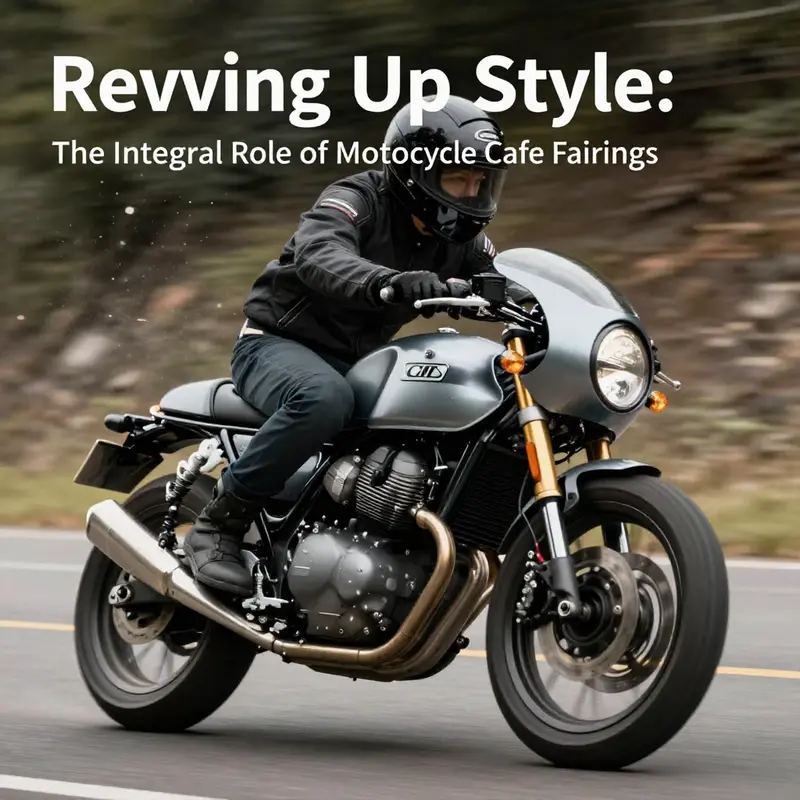
The cafe racer fairing is often imagined as a nod to nostalgia, a slim shield that hints at steam and speed while preserving a rider’s sense of being unfettered by mass. Yet its value runs far beyond the memory of chrome and clever lines. A cafe fairing, usually a quarter or small windscreen arrangement, is a practical tool as much as a stylistic statement. It tames the air enough to reduce fatigue on long rides and to keep the torso from meeting a curtain of rushing wind. The effect is subtle but cumulative: with the air deflected away from the rider’s chest and face, breathing remains easier, eyes stay focused, and arms stay less tense after miles of highway. The result is not just comfort; it is control. When the rider is less fatigued, the hands stay light on the bars, and the bike becomes a more forgiving partner at speed. In that sense, the fairing’s function is a quiet kind of empowerment, enabling a more confident, composed rhythm over varied road textures and weather conditions.
A pivotal element of its utility lies in aerodynamics. The cafe design seeks to smooth the transition of air from the front of the bike to the sides, guiding flow around the headlight cluster and up toward the rider’s lines of sight without creating large pockets of turbulence. The effect is twofold: drag is reduced and stability improves, especially in gusty crosswinds or when the machine is leaning into a corner. This is not about turning the bike into a wind tunnel; it is about shaping the wind so that it behaves more predictably. The rider’s posture, often a forward-leaning stance with compact upper body positioning, works hand in hand with the fairing. The silhouette that emerges is lean and purposeful, a deliberate counterpoint to the exaggerated, fully faired sport bike. The aim is a balance between speed and soul, a look that is both modern and timeless, a reminder that performance can ride light and clean without surrendering a café racer’s essential spirit.
The practical envelope of protection extends beyond wind. A café-style fairing can keep rain, dust, and debris off the instrument cluster and the upper dash of the bike, reducing the need for frequent wipe-downs and potentially preserving critical visibility on damp days. This is not about full-body weather sealing; it is about targeted shielding where riders most appreciate it. The small windscreen or quarter fairing shields the eyes and the upper chest from direct exposure, a benefit that feels especially tangible on open stretches where wind pressure can bite into skin and gear. Materials chosen for these parts—ABS plastic, fiberglass, or lightweight composites—are selected for durability and stiffness without introducing significant weight. A well-made fairing can resist flex under pressure and resist cracking from flying gravel or minor impacts, preserving the bike’s design language and the rider’s comfort over the long haul.
Beyond the physical mechanics, the cafe fairing contributes to the bike’s character. Its lower, more aggressive contour is often paired with clip-on handlebars, nudging the rider toward a sportier, more engaged riding posture. This posture change is not merely aesthetic; it affects how the bike steers, how quickly the rider can respond to changes in balance, and how the machine communicates through the hands and seat. The visual grammar—clean lines, minimal ornamentation, and carefully placed chrome or metal accents—speaks to a lineage of lightweight, purpose-built machines that valued rider feedback and direct connection with the road. In this way, the fairing becomes a conduit for the café racer ethos: a blend of performance focus and stripped-down simplicity. For riders who want a balance between retro charisma and current-day practicality, the fairing offers a gateway that does not require surrendering the minimalist look.
As the market evolves, some modern cafe fairings integrate advances in electronics and safety. Rather than a purely mechanical shield, contemporary iterations can support more sophisticated handling aids that respond to the rider’s lean and speed. In practice, this means smoother integration with sensors and control logic that support safer cornering at speed and in variable conditions. The result is not a jarring upgrade but a natural extension of the bike’s overall safety and ergonomics package. The idea is to enhance confidence when the road tilts, while preserving the essential, pared-down aesthetic that defines café culture. For riders who value a practical upgrade that does not erase the bike’s historic vibe, the modern cafe fairing presents a compelling compromise: a hint of electronics, a lot of restraint, and a look that remains faithful to the original ethos of agile, pared-back machinery.
On the sourcing side, the practical realities of building or upgrading a café-styled machine matter just as much as the design. The fairing industry has grown around a global network of tooling and supply chains. China remains a dominant hub for manufacturing motorcycle fairings, with industrial clusters in provinces where advanced tooling, cost-efficient production, and export infrastructures converge. For buyers and builders seeking to source components, platforms that connect buyers with manufacturers offer access to a spectrum of options, from universal-fit covers to more specific, model-oriented panels. The appeal of these sources lies in the ability to tailor the fit and finish to a project without the overhead of bespoke work. A practical approach to shopping means weighing material thickness, mounting hardware compatibility, and the potential for paint and finishing to match an existing aesthetic. The result is a bike that looks clean and cohesive, with a fairing that feels engineered to perform rather than merely to decorate.
For those curious about the breadth of options currently available in the aftermarket, one can explore the broader catalog of fairings in dedicated categories. A quick reference point is the Kawasaki fairings collection, which demonstrates how manufacturers and custom shops segment designs toward riders who crave a clean, performance-oriented look. This catalog serves as a useful benchmark for evaluating how the café aesthetic translates across different platforms and chassis philosophies. See it here: Kawasaki fairings. The dialogue between retro inspiration and contemporary engineering continues to shape what a cafe fairing can be, inviting riders to experiment with proportions, mounting, and finish while sustaining a sense of purpose and speed.
The broader picture, then, is not a single feature but an orchestration of wind, weight, and restraint. A well-chosen cafe fairing respects the bike’s fundamental geometry, complements the rider’s posture, shields the essentials, and carries a lineage of design that values simplicity over spectacle. In practice, it is an accessory that earns its keep through the daily friction of riding—glancing through a narrow gap in the air, feeling the bike settle into a clean line, and noticing how the fore-aft balance changes as speed builds or weather shifts. The fairing’s job is to help the rider stay present, enabling a steadier rhythm of steering input, throttle control, and line selection. It is a small piece of hardware, yet it anchors a larger philosophy: that speed and style do not have to shout to be effective. They can quietly converge in a machine whose form follows function and whose function, in turn, celebrates form.
External reading provides another layer for those who want to connect practice with performance. For a deeper look at contemporary cafe-inspired performance features from a major manufacturer, the official technical specifications and features can be explored here: https://www.kawasaki.com/motorcycles/z900rs-cafe/2026/.
Material Alchemy in Cafe Racer Fairings: How Choices Shape Form, Function, and Heritage
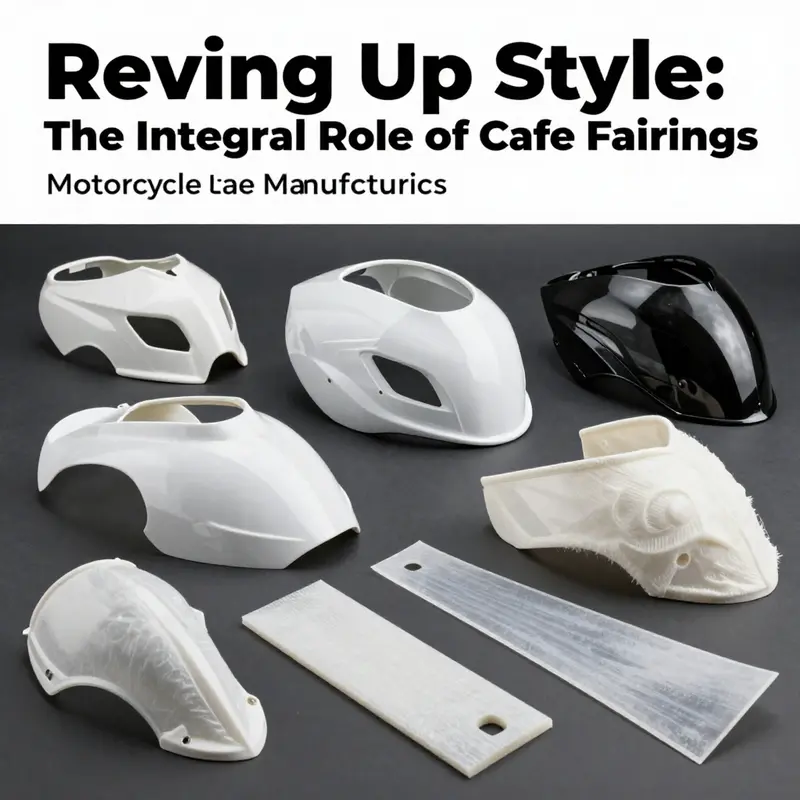
The half-fairing that defines a cafe racer is more than a silhouette; it is a negotiation between past and present. The curved face around the headlight, the way the upper lines meet the rider’s shoulders, the hint of chrome in the trim—each element relies on a material story as much as a design sketch. The choice of material sets a boundary around what the fairing can be, what it can endure, and how it will age. In the café culture of motorcycle customization, the material palette is a language that communicates intention, budget, and a respect for heritage while embracing modern production realities.
ABS plastic is usually the first word in that conversation. Its plastics know-how makes it easy to cast the graceful, shallow bends that give cafe racer bodies their iconic, almost breathing curvature. It accepts paint with a glassy finish, or it can be finished in a more deliberate, subdued sheen to echo vintage machinery. The cost is a practical virtue: ABS is forgiving for both OEM-scale production and aftermarket, meaning more riders can get that half-fairing look without breaking the bank. Yet ABS is not just cheap romance. The panels must be designed with precise thickness, edge reinforcement, and robust joint strategies to resist impact at speed and to stay true to the rider’s silhouette under gusty crosswinds. For the builder, this translates into straightforward tooling, predictable results, and the ability to repair or tweak without resorting to exotic materials. ABS is the starter chord in the cafe racer orchestra, but it is by no means the only instrument.
FRP, or fiberglass reinforced plastic, takes the stage when a more sculpted front end is desired without forcing the project into carbon fiber’s price tier. FRP can be laid up to capture complex radii, subtle hollows, and textured surfaces that mimic aged metal or a hand-finished look. This material’s flexibility is a boon for small-batch runs or limited-edition builds where the designer wants a strong presence but cannot shoulder carbon’s cost. The trade-off comes in weight and in the labor required to finish and seal every seam so that the paint adheres uniformly and the fairing remains rigid after a season of riding and weather. For many cafe racer enthusiasts, FRP offers a compromise that maintains the period feel while delivering durability in a way ABS cannot always guarantee at the same visual weight.
Aluminum enters the conversation as a craftsman’s material. Hand-formed or pressed aluminum fairings carry a tactile, almost artisanal aura. The metal’s natural reflectivity, its edge crispness, and the possibility of visible seams or rivets fit perfectly with the vintage ethos that many builders chase. Aluminum is lighter than FRP in some configurations and stiffer in others, which helps keep the front end steady at speed and gives the rider a sense of direct connection to the bike. But this beauty comes with a cost in labor, tooling, and precise aluminum work. The result, when executed with care, is a fairing that looks as if it belongs to a workshop finished in a time-worn glow—a piece that carries its own story of fabrication and measurement.
Carbon fiber represents the apex of modern lightweight performance. In the cafe racer world, carbon fiber fairings promise dramatic reductions in weight and a rigidity that translates into a more precise wind deflection and a clean, taut silhouette. The weave plays with light in a way that makes the bike seem both delicate and engineered for speed. The downside is price and production complexity. Carbon requires specialized tooling, expensive resins, and meticulous quality control. It is most common on higher-end builds or limited editions where the rider seeks an uncompromising blend of minimal mass and high stiffness. When carbon fiber is used, it often marks a rider’s willingness to invest in performance while honoring the era-appropriate aesthetics that characterize cafe racers.
Polycarbonate occupies a quieter, but equally important, niche. It is most visible in windshields or headlight guards, where impact resistance and clarity matter. Polycarbonate can endure dozens of hours of sun and weather with coatings that resist yellowing, ensuring that the fairing’s face remains readable and appealing through years of exposure. This material’s role is less about making the fairing lighter than about making the face of the bike safer and more legible, preserving a rider’s line of sight and confidence. The choice to pair polycarbonate with another shell material is a frequent theme: a sturdy ABS or FRP base with a polycarbonate shield that offers the best combination of clarity and toughness.
These material choices do not exist in isolation; they unfold within a bustling global supply chain that presses, molds, and finishes components to meet a growing appetite for retro-styled, modernized bikes. The region’s tooling and manufacturing ecosystems—especially in Guangdong, Zhejiang, and neighboring provinces—have built up expertise in rapid tooling, consistent paint finishes, and quality control that supports both mass production and boutique builds. A manufacturer can sculpt a fairing in ABS for affordability, reinforce it with FRP for sculptural detail, or skin it in carbon for performance variants without abandoning the iconic lines that define cafe racers. The trick lies in aligning a design’s aspirations with the throughput and tolerances that the chosen material enables. A half fairing must hug the rider’s front, deflect the wind efficiently, and not transform into a loose, rattling shell at highway speeds. The material and the joinery behind it determine how faithfully the design translates to the road.
Beyond the engineering, there is the tactile and visual story—the way light dances across a surface with chrome accents, the subtle ripple of a hand-formed edge catching a low sun, the way a paint job settles into the fairing’s creases. The grade of the surface finish—gloss, satin, or matte—interacts with the material’s inherent reflectivity, shaping the perceived weight and presence of the bike. A classic cafe racer look often leans on polished edges and clean, minimal lines. ABS lends itself to a high-gloss finish that reads as new and well-kept, while carbon’s natural sheen and the mechanical truth of aluminum edges read as a more artisanal proposition. The craft, then, is not simply about choosing a material. It is about orchestrating how that material communicates the rider’s identity while maintaining mechanical integrity and user comfort.
In practice, the selection becomes a negotiation with the market and with the rider’s priorities. The mass-market approach prizes predictable performance, ease of repair, and a credible vintage line at a price point that invites widespread adoption. The mid-market strategy leans toward a blend—FRP shells with careful finishing and perhaps a touch of aluminum detailing for that bespoke lift. The premium path uses carbon fiber or advanced composites to deliver lightness and a punchy, refined finish that elevates the entire build. Throughout, the half-fairing design remains the same—a sculpted front that frames the headlight and slides along the frame—yet the material gives it a different voice. It is a clear reminder that in motorcycle customization, the skin is not just a cover; it is a partner in performance and storytelling.
To connect these ideas with practical discovery, consider a quick path through the modern marketplace. Builders seeking a reliable, widely available entry point can explore a general heritage-fairings catalog to understand how vintage cues translate into contemporary fabrication choices. A neutral reference can illuminate how design, tooling, and finishing interact across materials, without anchoring to a single brand. This approach keeps the focus on the craft and the decision logic rather than on a single product line.
For readers seeking a broader, authoritative guide on selecting and finishing fairings, a detailed external resource can help illuminate the nuanced choices involved in the process: CarInterior’s Motor Bike Fairings Guide. It offers a practical frame for balancing strength, weight, and aesthetics across the materials discussed. https://www.carinterior.com/motorbike-fairings-guide
This material palette—ABS, FRP, aluminum, carbon fiber, and polycarbonate—thus serves as both a toolbox and a language. It enables builders to articulate a bike’s heritage while shaping a performance envelope that remains grounded in the rider’s experience. In the cafe racer tradition, where minimalism and precision coexist, the skin of the machine is as important as the engine spinning behind it. The material choices are not merely technical decisions; they are the chapters of a story about speed, skill, and the enduring romance of the open road.
Sourcing Speed: Market Trends Steering Cafe Racer Fairing Production
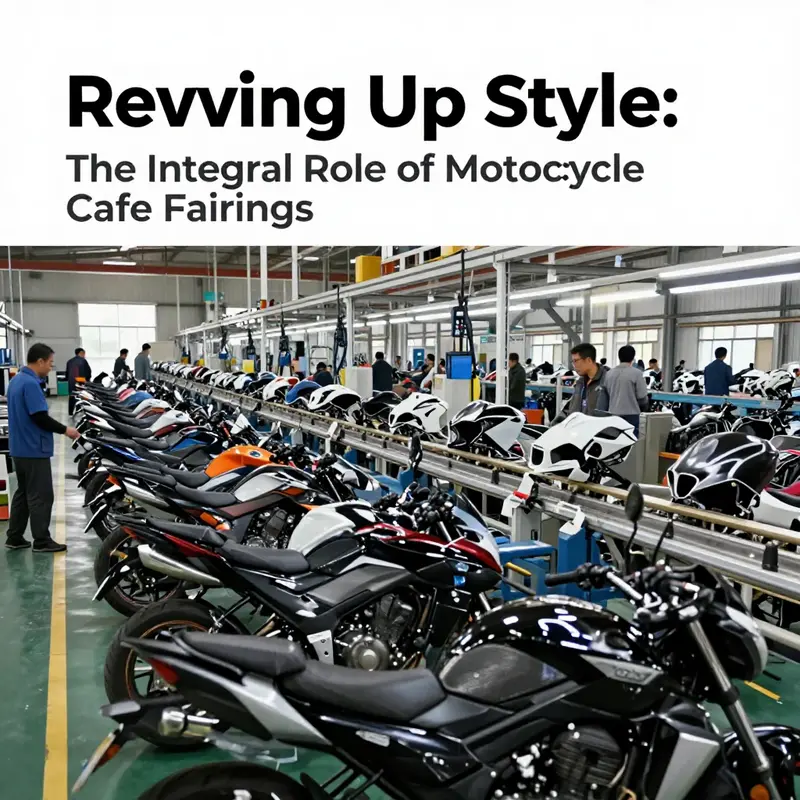
Market watching for cafe racer fairings reveals a market in motion as designers and manufacturers chase a blend of retro charm and practical performance. The café racer look, with its lean lines and minimalist fairings, has evolved from a hobbyist’s badge of identity into a demand-driven niche that sits between artisan craft and high-volume production. In this space, sourcing strategies matter as much as design choices. Buyers seek not just a shield from wind but a visual statement that can be reproduced reliably across a range of base bikes. This intersection of style and scale is shaping how suppliers shape their capabilities, moving from one-off builds toward flexible, semi-modular production ecosystems that can scale small batches without sacrificing consistency.
Customization and neo-retro aesthetics drive the most visible shifts. Small brands want fairings that echo vintage silhouettes while accommodating modern electronics and new composites. The result is a growing appetite for semi-modified production runs and full custom cafe racers, where fairings may be handcrafted or semi-handmade with computer-assisted refinement. For suppliers, this means flexible manufacturing, rapid prototyping, and design-for-manufacture thinking that lets a single run morph into a family of variants. The market rewards speed, tighter tolerances, and repeatable finishes, which in practice translates into adaptable tooling, modular mold sets, and standardized mounting interfaces that fit a spectrum of frame geometries without labor-intensive bespoke work.
Beyond looks, the line between aesthetics and aerodynamics has blurred. Modern cafe fairings are designed with performance as a credible priority. Even in a niche that favors a lean, minimalist style, airflow management matters at sustained speeds and in variable wind conditions. Advanced materials—lightweight composites and reinforced plastics—enable stiffer, crash-tolerant shells without excessive weight. Design teams rely on computational fluid dynamics to explore how fairings channel air, how brims deflect debris, and how venting affects engine cooling. The manufacturing response follows suit: vacuum forming, multi-stage injection molding, and precision trimming ensure that the final product matches digital models to within a millimeter. In practice, Guangdong and Zhejiang have the tooling sophistication to deliver these capabilities at competitive costs, reinforcing their position as the global hub for fairing production.
From a sourcing perspective, buyers increasingly demand global-market readiness. Certification programs and regulatory compliance are no longer afterthoughts; they are gatekeepers of access to EU, UK, and North American markets. Suppliers are expected to present documentation for CE or EEC marks, RoHS compliance, FCC suitability for electronics, and, for electric cafe racer configurations, IP67 waterproofing, fatigue testing, and battery longevity data. Third-party audits—conducted by recognized bodies—provide further assurance. The emphasis on quality control translates into longer but more predictable lead times and a stronger reputation for reliability. For buyers, a supplier with a track record of meeting international standards is less risky than a vendor who can offer only cost advantages. The combination of robust testing, traceable processes, and transparent supply chain documentation is becoming the baseline for serious partnerships in this market.
Market forecasts reinforce the strategic importance of these sourcing decisions. The global fairing market remains on a growth trajectory, with analysts projecting a double-digit CAGR through the early 2030s. The size and speed of this expansion reflect a broader shift in rider culture—the desire for personalization, the willingness to invest in parts that balance heritage with modern performance, and the appeal of simple, easy-to-install upgrades. For buyers who want OEM-friendly cafe fairings, the advantage goes beyond price. It is about access to experienced production lines, reliable capacity planning, and the security of a vertically integrated workflow that can expand with a brand’s ambitions. Lead times can shorten when suppliers keep bonded warehousing near major ports and offer flexible shipping terms that reduce days in transit and customs friction. The result is a more agile value chain that can respond to trends in customization as quickly as the market demands.
As the market matures, the element of compatibility remains a practical priority. Builders and retailers look for fairings that fit common mounting standards while preserving the bike’s geometry and riding stance. A broad but cohesive approach to interoperability helps cafés and enthusiasts avoid the friction of bespoke jigs and repeated fit checks. Within this context, exploring the Honda fairings category—an illustrative benchmark for OEM-compatible interfaces—offers a practical glimpse into how modern fairings align with the backbone of frame mounting, headlight housings, and edge protections. The right supplier can deliver a line that respects those interfaces while still allowing for distinctive detailing—polished chrome, brushed aluminum accents, and vintage-inspired contours that trust the rider’s eye as much as the wind. This balance of compatibility and character defines the value proposition for buyers who want to scale from a single customized build to a small collection with a recognizable family look.
The sourcing geography reinforces the logic of specialization. Chinese manufacturers, particularly in the technical clusters around major coastal hubs, have built a capability stack that blends toolmaking, rapid prototyping, and efficient mass production. The advantage lies not simply in price, but in the speed at which a factory can move from a CAD model to a finished part, from a first article to a certified production run. Logistics advantages—shorter lead times, bonded warehousing, and DDP shipping—help boutique brands stay responsive to customer demand without tying up capital in inventory. This productive efficiency, paired with a willingness to collaborate on customizations, makes Guangdong and Zhejiang natural focal points for cafe fairing programs that aim to serve a global audience while maintaining a local, craft-friendly spirit. The market rewards partners who combine technical rigor with a shared sense of design history, translating heritage cues into repeatable manufacturing outputs.
Ultimately, buyers must navigate a landscape where quality control, regulatory compliance, and a flexible production footprint are as important as aesthetics. The rise of neo-retro designs does not reduce the need for performance-driven engineering; it elevates it. Modern fairings must shield riders from wind with minimal drag, endure weather and debris, and carry electronics that meet evolving safety and environmental standards. The best suppliers respond by combining robust R&D, compliant production lines, and agile supply chains. They cultivate relationships with auditors and certification bodies, maintain transparent documentation, and offer options for small-batch programs that can grow with a brand. In this sense, market sourcing for cafe fairing production is not merely a procurement exercise; it is a strategic partnership that underwrites a rider’s confidence in both the machine and the team behind it.
Looking ahead, the arc of growth is as much about governance as it is about glassy curves and gleaming edges. The cafe racer fairing story hinges on a careful choreography of design intent, manufacturing discipline, and distribution logistics. As tastes continue to shift toward customization, producers that invest in flexible tooling, credible testing regimes, and scalable operations will be best positioned to translate retro appeal into durable, globally accessible products. The sell is not just a part; it is a system that supports a rider’s dream of a machine that looks classic, rides smoothly, and can be maintained with professional assurance. In that light, the market for cafe fairings is less about a single style and more about a robust ecosystem that makes heritage-inspired engineering practical for crowds who value both nostalgia and performance.
Honda fairings category — a practical benchmark for OEM-compatible interfaces demonstrates how common mounting standards and repeatable finishes can scale with a brand’s evolving aesthetics. For an external perspective on market dynamics and future growth, see the following resource: LinkedIn article on motorcycle fairing market trends.
Silhouette of Speed: How the Cafe Racer Fairing Defines Character
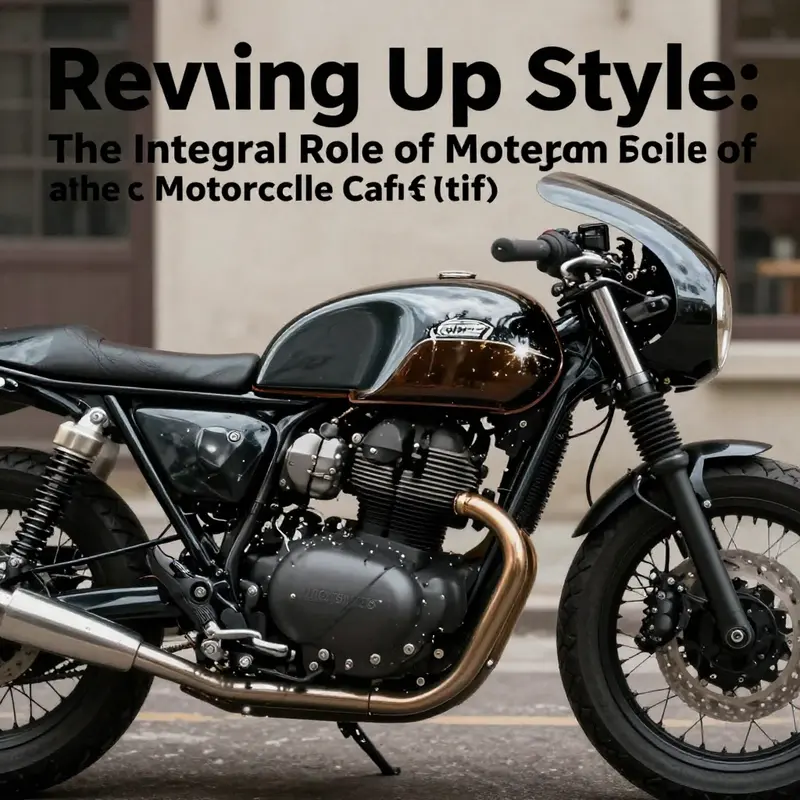
The cafe racer fairing is more than a piece of plastic grafted onto a frame; it is the defining gesture that gives a bike its soul. In custom motorcycle culture, the fairing the rider chooses signals a deliberate shift in emphasis—from raw mechanical spectacle to streamlined, purposeful elegance. The classic cafe racer look rests on a minimalist philosophy: reduce ornament, expose the essentials, and let the silhouette carry the story. A half or single piece fairing, carefully sculpted to hug the headlight cluster and the upper curves of the frame, creates a visual arrow that points straight ahead. It signals a rider who seeks speed in mind as well as at the clock, and it carries a long history of British ingenuity and clipped aerodynamics that still feels alive today.
The impact of this design choice lies not only in the eye but in how the bike breathes. A cafe fairing trims away excess chrome and bulk, inviting the eye to follow clean lines that start at the headlight and sweep back along the bike’s slim profile. The result is a machine that reads as lean, even in a showroom or on a city street, because the eye travels along a single, uninterrupted arc rather than bouncing across a mosaic of radiators, panels, and subassemblies. This reduction of ornamentation doesn’t merely make the bike look lighter; it signals a philosophy of riding that prizes immediacy and intent. The rider becomes part of that line, bending with the machine as the fairing channels wind into a controlled kiss of resistance that keeps the bike alert and responsive at speed. The aesthetic is not about hiding the machine’s inner workings but about presenting them with confident restraint.
This visual language resonates with the cafe culture—the idea of a machine built for short, spirited stints through urban canyons and open roads. The fairing acts as a stage for the bike’s personality, complementing stripped down frame, exposed engine, and minimal instrumentation. When paired with a careful selection of materials—matte or polished paint, brushed metal accents, and selective chrome—the cafe fairing becomes a centerpiece rather than a garnish. The narrative is one of restraint and precision: a rider and machine sharing a compact, efficient dialogue about weight, balance, and the art of minimizing distraction while maximizing character.
From a construction standpoint, the fairing also redefines the bike’s proportions and sensations without imposing heavy aerodynamic ambitions. It deflects wind around the upper chest and head, contributing to a focused riding posture at higher speeds while preserving the freedom central to the cafe racer ethos—the rider remains connected to the front wheel, able to feel the road, and ready to respond to subtle changes in tension or steering input. The wind blast is reduced, improving comfort on longer sessions, but the real gain is the sense that the rider is piloting a purpose built instrument rather than a showroom remnant. This is how a fairing earns its keep as a design feature: it reinforces how the bike moves as much as how it looks.
Authenticity matters in a build rooted in history. Builders seek well fitted fairing kits that integrate cleanly with the bike’s geometry, requiring minimal modification while delivering a convincing vintage feel. The choice between a universal kit and something tailored to a specific model is less about fit and more about how faithfully the kit preserves the bike’s lines. A half fairing that sits neatly over the headlight and flows into the tank area can preserve the machine’s original stance while adding that unmistakable cafe racer cadence. When done well, the fairing doesn’t feel like a cosmetic add on; it feels like the bike was designed around it from the outset. It becomes, in effect, the hinge on which the entire build rotates, guiding choices about seat upholstery, exhaust routing, and instrument clusters toward a cohesive, high impact look.
The material choice—ABS, fiberglass, or lightweight composites—affects more than cost or weight. It shapes the sculptural language of the fairing and how crisply it holds its edge under stress and time. A well crafted cafe fairing carries a quiet confidence in its fit—its joints sit flush, the windscreen or eye protection is clear without distortion, and the sweep from headstock to tank reads as a single, confident line. In retro inspired builds, those lines are the living memory of the machine’s heritage. They speak of a time when riders tuned bicycles by hand, when the rider and the chassis together were the technology, and the fairing was the visible promise that a design could be as functional as it was beautiful.
For builders who want to connect modern riding with that historical aura, sourcing becomes a story of balance. A cafe fairing kit should integrate with the bike’s geometry without forcing drastic changes to the frame or mounting points. It should offer protection from weather, a measure of wind deflection, and the right proportions to preserve the bike’s cadence when viewed from the side. A fairing’s presence also subtly reshapes the bike’s silhouette, making room for a cleaner cockpit and a sense of speed even when the machine is at rest. In practice this means choosing a kit whose lines align with the engine’s character and whose mounting points respect the headstock rake and trail. The result is a bike that looks as if it was designed to be ridden fast from the moment it rolled out of a workshop.
Beyond aesthetics and fit, the cafe fairing carries a practical and cultural value. It signals appreciation for the era that gave birth to the cafe racer, a culture of late night tuning and early morning rides that prized speed without sacrificing personality. This is why the fairing’s influence often extends to resale value: a well executed cafe aesthetic can elevate a bike’s desirability, making it stand out in a crowded market of modern sport bikes and nostalgia flavored replicas. When the fairing harmonizes with a stripped back frame, a carefully chosen exhaust note, and minimalist instrumentation, the entire build reads as a deliberate statement. It communicates taste, patience, and a hands on approach to customization that modern manufacturing sometimes overlooks.
For readers curious about authentic sourcing and the broader ecosystem that supports these builds, a practical entry point is the catalog of fairing options that focuses on compatibility and craft rather than trend alone. Fairings designed for compatibility with a range of frames and classic styling cues can be a gateway to realizing a cohesive look without sacrificing reliability. A well chosen fairing, together with the right headlight treatment and a restrained dash of chrome or satin metal, can transform a standard motorcycle into a vintage speed sculpture, one that invites admiration for its lines as much as for its speed.
Final thoughts
Understanding the multifaceted aspects of motorcycle cafe fairings—from their thoughtful design and functional advantages to material selection and market trends—enables business owners to adeptly navigate the evolving landscape of motorcycle customization. As the demand for stylish, performance-oriented motorcycles continues to rise, embracing these elements will empower businesses to deliver products that not only meet but exceed customer expectations. This fusion of functionality and aesthetic appeal continues to drive the allure of cafe racers in today’s motorcycle market.