
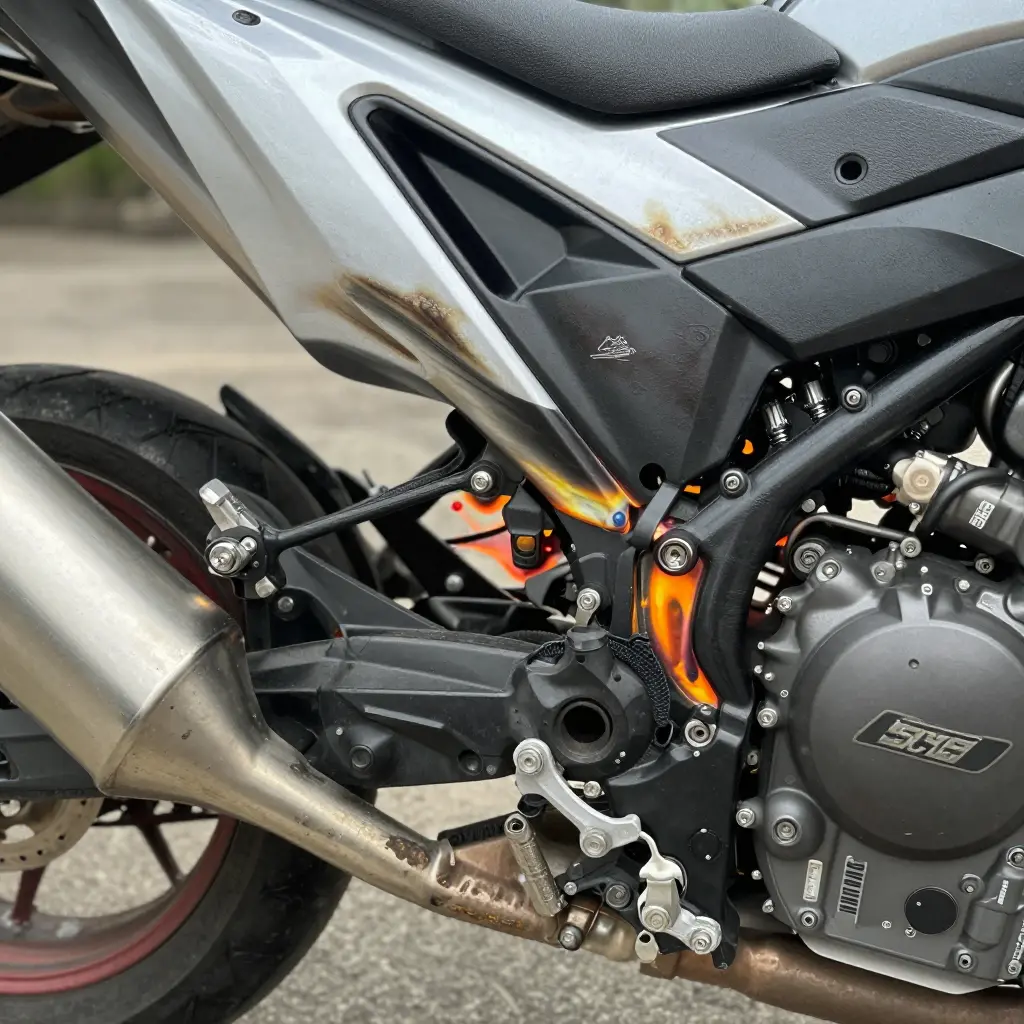
What Lower Fairing Heat Warp Actually Means
Lower fairing heat warp is the permanent deformation of the panel that sits below a motorcycle’s engine and exhaust. Heat softens the plastic past its designed tolerance, and the panel keeps whatever shape it takes. It does not warm up and spring back. It bends, sags, or ripples, and it holds that shape once it cools.
“Exhaust radiant heat” is thermal energy that exhaust parts throw off as infrared radiation through the air, with no metal-to-plastic contact required. A “heat shield” is the reflective or insulating barrier between the exhaust and the bodywork; it reflects or dissipates that energy before it reaches the plastic.
During normal riding, the shield absorbs or redirects most of the exhaust radiant heat. When the pipe produces more than the shield can handle, the surplus reaches the plastic and the panel loses its rigidity. That imbalance is what warps a lower fairing.
The problem turns up for riders, owners, and repair shops alike, and it is usually written off as cosmetic damage. It is not. The same thermal physics that stress one panel can stress another, so it helps to see where these parts sit in a bike’s structure. Start with what a fairing actually is on a motorcycle and how a front fairing is assembled.
A warped panel is a material failure, not a blemish. Once the polymer softens it loses its shape memory, and mounting tabs, screw holes, and trimmed edges can crack or pull free of their fasteners. Repainting it fixes none of that.
Mechanics of Exhaust Radiant Heat Transfer to the Lower Fairing
A motorcycle exhaust is a hot metal pipe running close to plastic bodywork, and energy crosses the gap between them even when the two never touch. That exchange is why a lower fairing can soften, gloss over, or distort with no sign of contact.
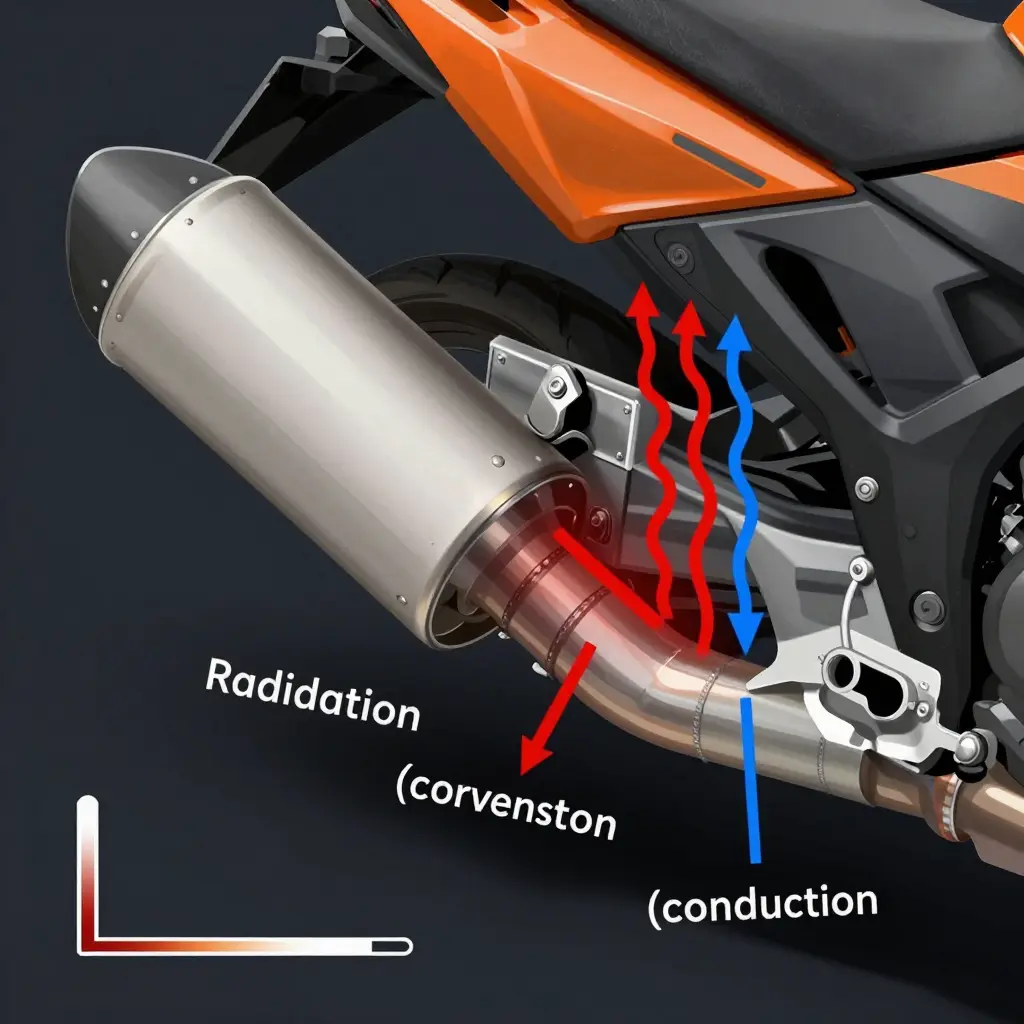
Three Heat Transfer Pathways
Heat reaches the fairing by three routes. Only radiation needs neither contact nor airflow:
- Conduction – direct contact. Heat moves through solid material from a hotter region to a cooler one. If the fairing or its mounting hardware touches the exhaust, heat flows straight into the panel.
- Convection – heat carried by moving air. Air passing over the hot pipe warms, rises, and hands its energy to nearby surfaces. This happens whether the bike is moving or idling in traffic.
- Radiation – energy emitted as infrared waves. It needs no medium and no contact: the pipe radiates across the gap to any surface in line of sight. This is the pathway that does most of the fairing damage.
Typical Exhaust Temperature Ranges
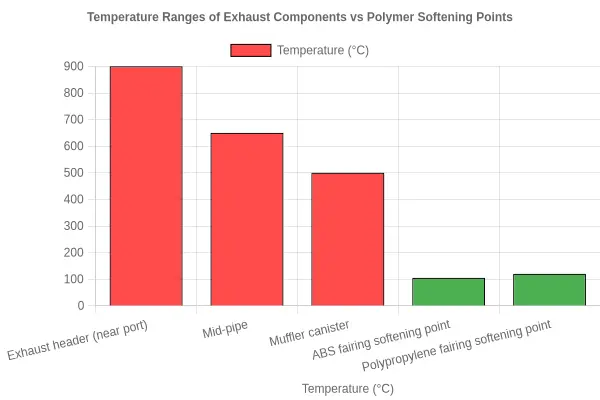
Exhaust surface temperature varies sharply along the system:
| Component | Typical surface temp (idle/cruise) | Peak (hard load) |
|---|---|---|
| Header (near port) | ~300-500 C | 600-900 C |
| Mid-pipe | ~250-400 C | 400-650 C |
| Muffler canister | ~150-300 C | 300-500 C |
Fairing thermoplastics sit far below those numbers. ABS starts to soften around 100-110 C, and polypropylene holds out a little longer. The pipe still runs several hundred degrees hotter than the point where either material loses its rigidity.
Why Radiant Heat Warps Polymers
Below its glass-transition temperature, a thermoplastic holds shape because its long polymer chains stay locked in place. Push the material past that threshold with exhaust radiant heat and the chains begin sliding past one another; the panel turns soft and pliable. Keep the heat on and the damage becomes permanent: chains break down, volatiles escape, the surface discolors, and the material weakens for good. Warping is what that breakdown looks like from the outside.
Distance, Area, and Radiative Intensity
As a rule of thumb, radiative intensity falls off with the square of the distance, so doubling the gap cuts the exposure to roughly a quarter (1/d^2). A few extra millimeters of clearance buy more than they look like they should. Surface area matters too: a larger, flatter section of fairing intercepts more radiated energy, and any area facing the pipe directly receives the highest flux. The exchange also depends on view factor and emissivity, since darker, matte surfaces absorb more infrared than reflective ones. A heat shield works by inserting a lower-emissivity or reflective barrier plus a standoff air gap, which cuts the energy that actually reaches the plastic.
For how the panels themselves are built and cooled, see the complete motorcycle fairings guide, or compare materials and fitment in the overview of aftermarket motorcycle fairings.
Heat Shield Materials and Thermal Performance Comparison
| Material | Maximum Continuous Service Temperature | Typical Thickness | Reflectivity | Common Fairing Applications | Durability Notes |
|---|---|---|---|---|---|
| Aluminized fiberglass | ~1,000 F (538 C) | 0.010-0.040 in (0.25-1.0 mm) | High (~90%) | Inner fairing liners, under-seat panels, belly-pan shields | Excellent radiant reflection; edges fray when cut; adhesive-backed versions can peel with heat cycling |
| Aluminum sheet | ~400-500 F (204-260 C) | 0.020-0.063 in (0.5-1.6 mm) | Moderate to high (~70-80%) | Rigid under-fairing panels, mounting brackets, closeouts | Inexpensive and formable; anneals and warps near exhaust, conducts heat to nearby plastic, dents easily |
| Stainless steel | ~1,400-1,600 F (760-870 C) | 0.010-0.030 in (0.25-0.76 mm) | Moderate (~40-60%) | Exhaust-side shields, header closeout panels, heat tunnels | Corrosion resistant and long lasting; heavy and costly, needs air-gap standoff to manage conduction |
| Ceramic-coated fabric | ~1,000-2,000 F (538-1,093 C) by grade | 0.030-0.125 in (0.76-3.2 mm) | Low to moderate | Pipe wrapping near plastic, flexible shields, contoured gaps | Flexible and lightweight; coating flakes with abrasion, offers more insulation than reflection |
| Titanium | ~1,000-1,200 F (538-650 C) | 0.010-0.020 in (0.25-0.5 mm) | Low to moderate | Premium heat shields, race-fairing closeouts | Very light and strong; expensive, and because it conducts heat poorly, hot spots stay localized instead of spreading; tricky to weld in the field |
| Carbon-fiber composite | ~300-400 F (150-200 C) matrix limit | 0.040-0.120 in (1.0-3.0 mm) | Low | Cosmetic fairing panels, inner covers with reflective backing | Strong and light; resin degrades above limit, requires a separate barrier and standoff |
Warning Signs of Lower Fairing Heat Warp
Heat warp rarely shows up all at once. Exhaust radiant heat works on the plastic gradually, and the damage tends to follow the same order every time. Read it early and the fix is a heat shield; miss it and you are replacing the panel.
Each symptom tracks how much heat the panel has absorbed, so catching it early keeps the repair cheap. For a refresher on what these panels are made of and how they behave under load, see the guide to motorcycle fairings explained.
On a sportbike, cruiser, or tourer with full lowers, watch for the following, listed from mildest to most severe.
- Discoloration – A dull, yellow, or chalky patch means the panel has been cooking at low heat for a while. Pigment and surface resin break down before the shape changes.
- Softening – Press the panel and it feels pliable or leathery. The plastic has reached its glass-transition range and is losing rigidity.
- Rippling – Wavy distortion across the belly of the panel points to uneven heating, usually where exhaust pulses concentrate in one spot.
- Edge lifting – Fastener tabs and trimmed edges curl away from the frame. The deformation is permanent, and the mounting points begin to misalign.
- Cracking – Hairline fractures radiating out from a hot spot mean repeated thermal cycling has embrittled the material and cost it flexibility.
- Melting near the exhaust – Blistered, dripping, or charred plastic above the header or muffler means the heat shield has failed or gone missing and radiant heat is running unchecked.
Every step up that ladder costs more to undo. Discoloration usually calls for a reflective barrier and a proper air gap; melting means a new panel. Either way you will likely be refinishing, so read how to paint motorcycle fairings before you rebuild the lower.
How Radiant Heat Reaches Your Lower Fairing
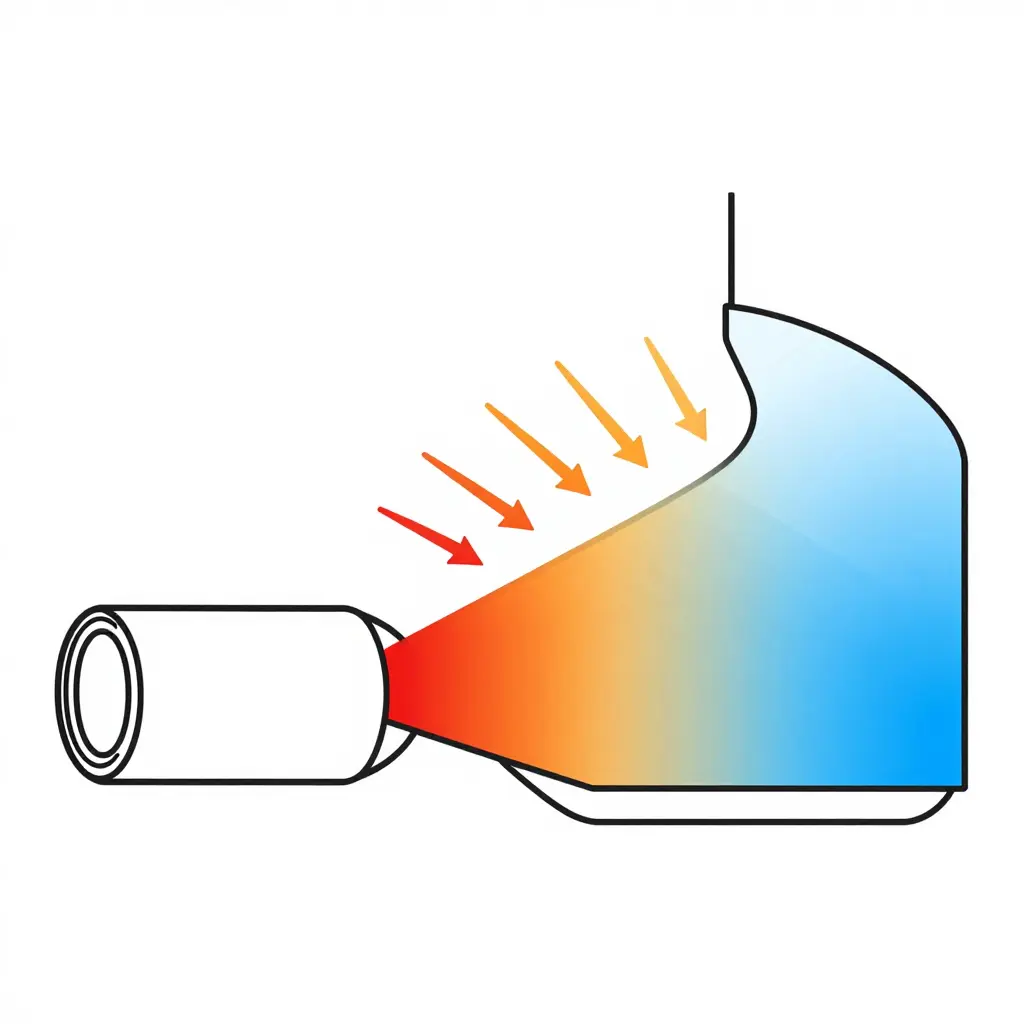
Radiant heat needs no wire or hose to travel. It crosses empty space as invisible energy and warms whatever it lands on. The diagram below shows the three parts involved:
- The exhaust pipe is the heat source, still radiating after every combustion cycle.
- The heat shield sits between the pipe and the plastic, blocking, absorbing, and re-radiating energy instead of letting it pass straight through.
- The lower fairing’s inner surface is the target. When radiant energy outruns what the shield can deflect, that surface is the first thing to heat up, soften, and eventually warp.
The arrows show energy leaving the pipe in every direction, with the temperature gradient running from intense (deep red) at the header to mild (cool blue) at the painted panel. When a shield is undersized, mounted too far from the pipe, or already heat-soaked in stop-and-go traffic, that gradient tilts toward the plastic. It is how a panel warps even when a shield is technically present.
With that flow in mind, the fixes are easier to see: reposition or upgrade the shield, add a reflective barrier, or give the trapped heat a way out through better airflow beneath the fairing assembly.
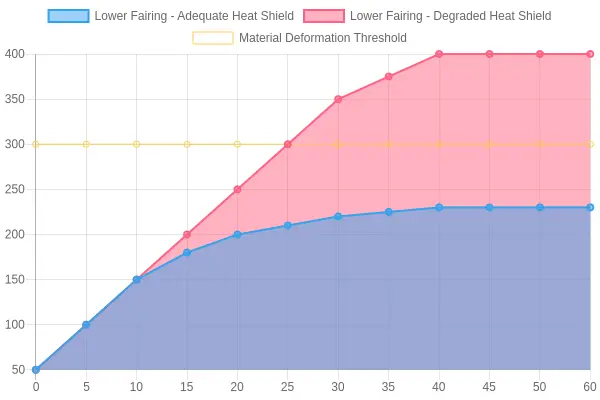
Lower Fairing Surface Temperature Over Time. With a working heat shield, surface temperature climbs and plateaus around 230 F, at the upper edge of the range where ABS starts to soften. With a degraded shield, radiant heat outruns it: the surface passes 300 F at roughly 35-40 minutes of riding and settles near 400 F, well inside the zone where the panel warps and distorts.
How to Prevent and Manage Heat Warp
It costs far less to prevent heat warp than to replace a melted set of bodywork. Every fix comes down to the same goal: keep exhaust radiant heat off the plastic, or give it somewhere else to go.
- Upgrade the heat shield material. Stock shields are often rated only for mild street use. Ceramic or aluminized shields raise the failure threshold and keep reflecting heat long after the factory part gives up.
- Keep a real air gap. A shield only works with air behind it. Touch it to the exhaust and it conducts heat into the fairing instead of deflecting it.
- Move air across the inside of the panel. Vents or ducting turn a sealed pocket of hot air into a steady flow, which is the simplest barrier you can add.
- Wrap the hot sections. Reflective wrap on headers and mid-pipes lowers surface temperature at the source, so less radiated energy reaches the surrounding motorcycle fairings.
- Check exhaust-to-fairing clearance. Even a good shield fails if the pipe sits a few millimeters from the panel. Measure during installation and after any exhaust swap, before contact points turn into scorch marks.
These steps work best in combination rather than one at a time. For replacement panels and upgrades, see these Airtech motorcycle fairings and explore custom motorcycle fairings that let you set fitment and spacing from the start.
Reading the Diagram
The cross-section reads from bottom to top, hottest layer to most heat-sensitive:
- Exhaust pipe – the heat source. The wavy radiant arrows show it throwing invisible heat upward in all directions, with no contact needed.
- Air gap – the buffer. Cool air enters the gap on one side and sweeps through, carrying heat away before it can build up.
- Heat shield – a reflective barrier that bounces radiant heat back and blocks conduction from the pipe.
- Lower fairing – the painted outer panel you actually see. It should only ever feel warm, never hot enough to sag or warp.
The arrows matter more than they look. Air does not have to be forced directly onto the fairing; it only needs a clear lane through the gap. Clog that lane, pinch it, or shrink it too far, and radiant heat stops being carried off and starts soaking into the panel. That is when the plastic begins to distort, blister, or wave.
For more on how these outer panels are built and why spacing matters, the motorcycle fairings explained overview breaks down the construction layer by layer.
What Heat Warp Adds Up To
Heat warp is not bad luck or a random defect. When exhaust radiant heat outruns what the shield can deflect or absorb, the panel takes on thermal energy faster than it can shed it, and deformation follows. The process is consistent and measurable, which means it can be managed.
What Actually Matters
- Heat moves toward equilibrium. Every degree the shield fails to block ends up in the fairing, and repeated heat cycles add up.
- A shield is only as good as its layers. Reflect it, insulate it, and space it correctly, and it keeps the heat off the plastic. Skip a layer and it does not.
- Airflow decides the outcome. Without moving air, even a well-shielded panel can bake. Cooling paths matter as much as the shield.
Three Things Decide the Outcome
Material choice, layering, and airflow cover the whole problem. Pick materials that tolerate sustained heat, build shields in deliberate layers instead of a single barrier, and route airflow so radiant heat leaves instead of lingering. Get those three right and the panel holds its shape.
For riders and shops weighing replacements, UltimateMotorX supplies motorcycle fairings sourced from trusted manufacturers, with fit and durability built to hold up under real heat. Its aftermarket motorcycle fairings reflect the same emphasis on fit, material integrity, and long-term reliability. Understand the contest between exhaust radiant heat and the heat shield, stay inside the material’s limits, and heat warp becomes something you plan for instead of something you find.