
Why Fairing Material Matters When the Bike Goes Down
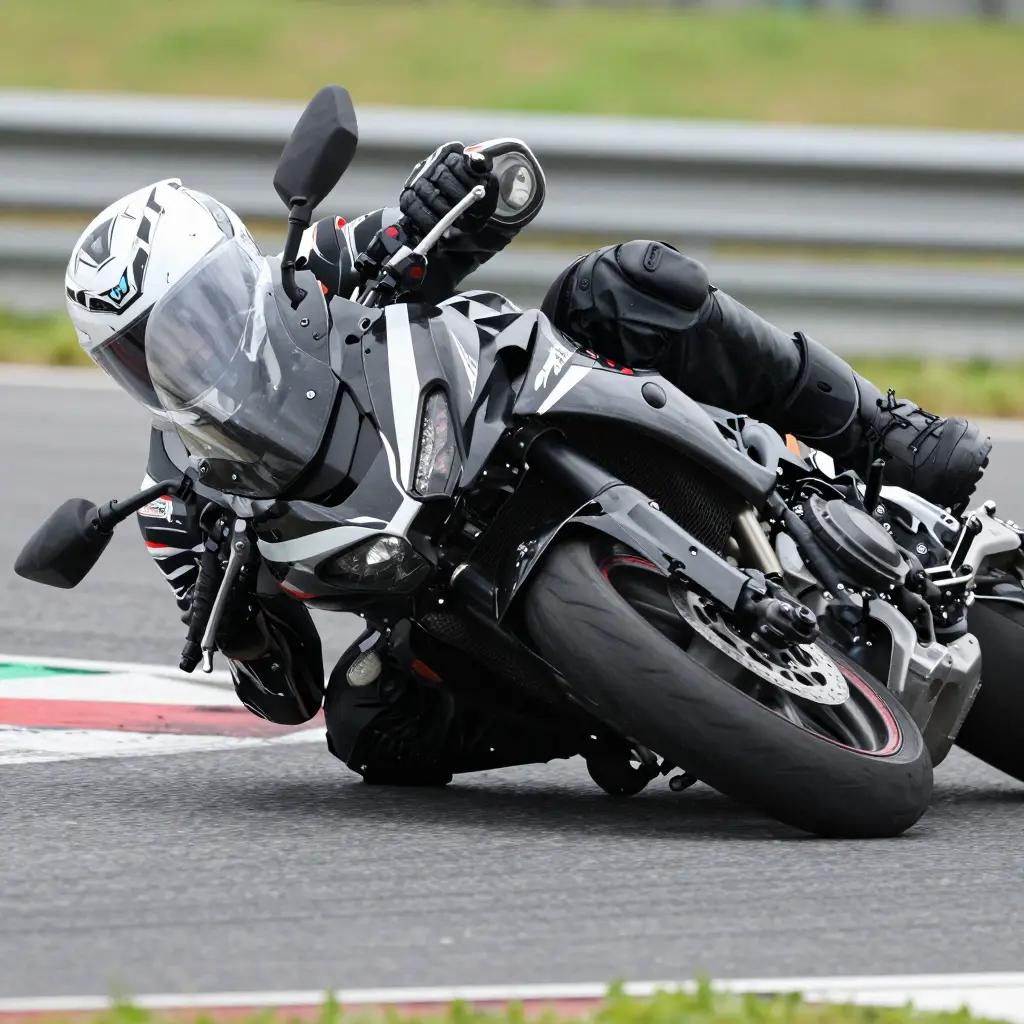
Motorcycle fairings are the molded panels that wrap the front, sides, and often the tail of a bike. They cut drag and lift, block windblast, rain, and road debris, and give the machine its shape. They are not just cosmetic. Knowing what they do is the first step toward understanding why they fail the way they do. If you want the basics first, this overview of motorcycle fairing design and function covers them.
Two materials dominate the market: ABS fairings and fiberglass fairings. ABS (acrylonitrile butadiene styrene) is a thermoplastic that is injection-molded or vacuum-formed into shape, valued for flexibility, low cost, and factory-consistent fit. Fiberglass fairings are hand-laid from woven glass cloth and resin, and racers and custom builders favor them for strength, light weight, and repairability.
The two materials behave differently in a low-side crash, the common slide where the bike drops and skates on its side. ABS flexes and cracks at the impact points but can often be repaired locally. Fiberglass resists puncturing better, but it spider-webs, delaminates, and grinds away under friction.
This article compares them head to head: the material differences, how each survives a low-side slide, and what repairs are realistic afterward. The goal is to help you pick the fairing that matches your riding, budget, and tolerance for repair work.
ABS Fairing Composition and Properties
What ABS Fairings Are Made Of
ABS is a terpolymer, meaning it bonds three monomers into one material:
- Acrylonitrile adds rigidity, chemical resistance, and heat stability.
- Butadiene adds rubbery, impact-absorbing toughness.
- Styrene gives a hard, glossy surface that is easy to process.
Those three components are why ABS behaves so differently from fiberglass or metal.
How ABS Fairings Are Produced: Injection Molding
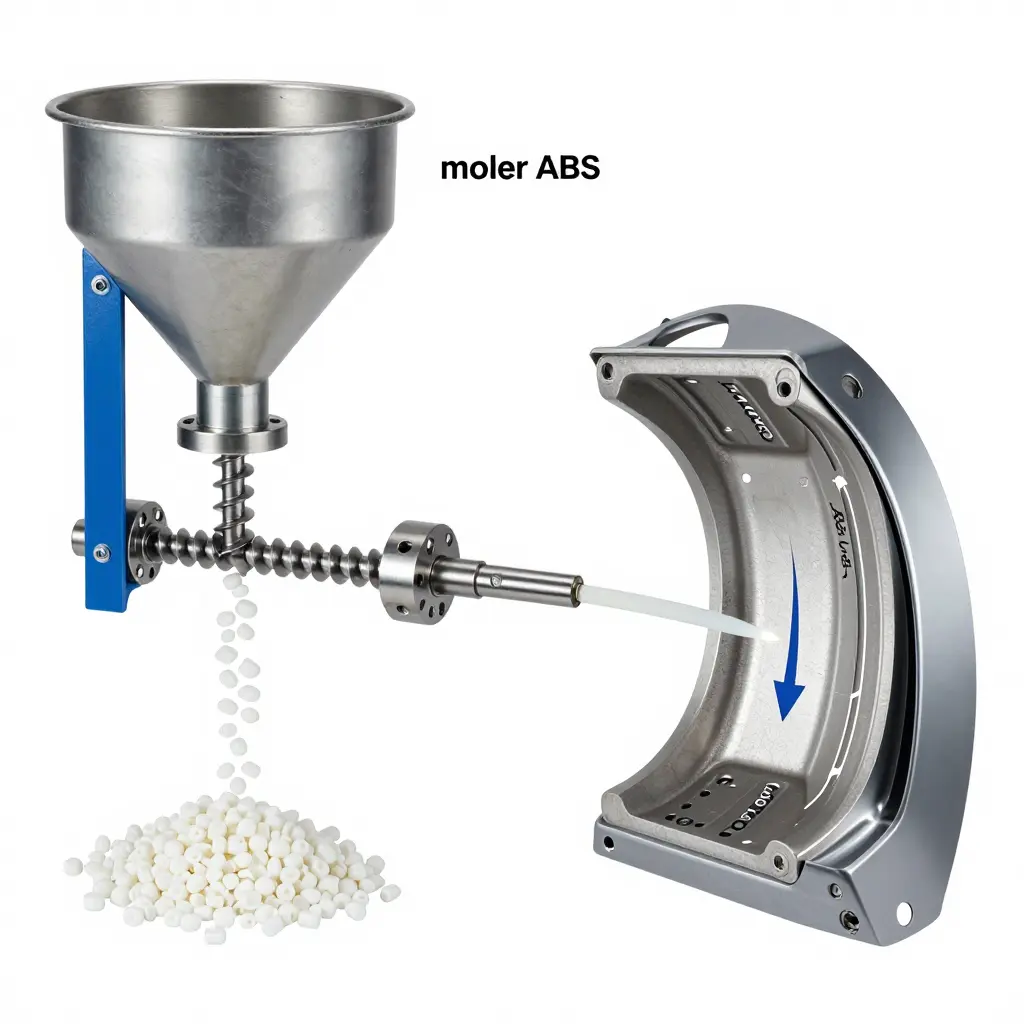
Production starts with raw ABS pellets. They are fed into a heated barrel, melted at roughly 200-260 degC (390-500 degF), and forced by a rotating screw through a nozzle into a steel mold shaped like the panel. The plastic fills the cavity, cools under pressure, and is ejected as a finished part. This lets manufacturers – including makers of aftermarket motorcycle fairings – mass-produce thin, uniform panels with integrated mounting tabs.
Material Properties
Here are the measurable traits of ABS:
- Weight: low density (about 1.04 g/cm3), so ABS is lighter than fiberglass at equal thickness.
- Surface finish: naturally smooth and glossy; takes primer, paint, and clear coat readily.
- Impact resistance: the butadiene rubber phase absorbs energy by stretching rather than shattering.
- Cracking resistance: flexes under load and spreads stress instead of concentrating it at one point.
- Repairability: as a thermoplastic, ABS softens when reheated (around 100 degC / 212 degF), can be reshaped, and can be fused with ABS welding rod, a hot-air welder, or acetone.
- Recyclability: it can be remelted and reprocessed, unlike thermoset fiberglass.
Why This Matters in a Low-Side Crash
ABS does not cure into a rigid, locked structure. In a low-side crash the bike slides and the fairing scrapes the ground, concentrating stress on the contact edges. ABS flexes and absorbs that energy – the butadiene phase stretches – so panels often scuff, scratch, or crack at a single bolt point instead of breaking apart. A crack or gouge can be plastic-welded and refinished, which means you can often save the panel instead of replacing the whole set. To compare replacement and upgrade options, see aftermarket motorcycle fairings.
Fiberglass Fairings: Composition and Properties
Fiberglass fairings are composite motorcycle fairings built from two ingredients: woven glass fiber cloth (the reinforcement) and a thermosetting resin (the matrix). The glass carries the load and resists stretching. The resin binds the fibers, transfers stress between them, and cures into a smooth, paintable skin. Neither ingredient is strong alone, but together they form a stiff, load-bearing shell.
How the Hand-Laid (Layup) Process Works
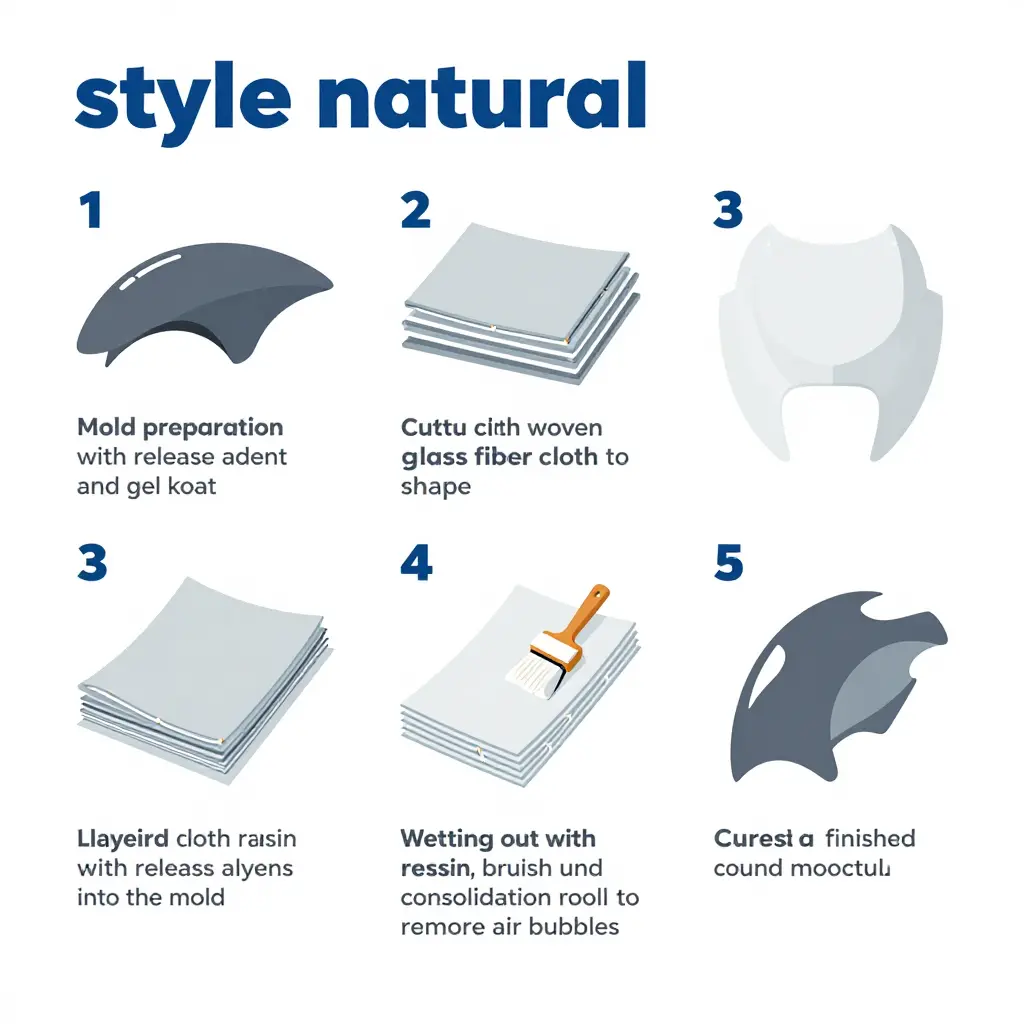
The process starts with a mold coated in release agent and a gel coat, which becomes the visible surface. Workers cut the glass cloth to shape, press each ply into the mold, and saturate it with catalyzed polyester, vinyl ester, or epoxy resin using brushes and rollers. A consolidation roller squeezes out trapped air so the laminate bonds tightly. The part cures at room temperature or in an oven, and plies are stacked to reach the wanted thickness. It is labor-intensive, but builders can add extra layers where stiffness matters most.
Key Material Traits
The resulting material has a few traits that explain most of how these panels behave on the road:
| Trait | Typical Behavior |
|---|---|
| Stiffness | High; the cured laminate resists flexing and holds its molded shape |
| Strength-to-weight | Good, but lower than carbon fiber at equal stiffness |
| Thermal stability | Moderate; fine in normal riding heat, not designed for extremes |
| Impact response | Brittle; shatters, cracks, or forms spider fractures instead of bending |
That last trait is the main weakness. The resin is rigid and the glass fibers do not stretch, so impact energy has nowhere to go but into fracture. Fiberglass panels do not dent or deform; they crack, splinter, and spread fine “spider” cracks outward from the strike point.
What This Means After a Low-Side Crash
When a bike slides, the fairing scrapes along the pavement. Abrasion and shock hit a rigid, brittle shell, so damage is rarely confined to one scuff. A fiberglass fairing often ends up with a shattered impact zone where material is missing or broken into fragments, plus spider fractures radiating into areas that still look intact. Those cracks travel and weaken neighboring panels, and because the material is laid up in layers, a delaminated section usually has to be cut out and rebuilt rather than patched. Owners who compare materials often weigh this against the other trade-offs in a broader motorcycle fairings guide before deciding between repair and replacement.
The rigidity that gives fiberglass fairings their stable shape is the same property that makes them unforgiving in a slide. Stiffness and brittleness come from the same material, so a low-side tends to produce fractures and cracks rather than a shallow dent, and more repair work than an ABS panel would need.
ABS vs Fiberglass Fairings: Material Comparison
Before you choose replacement skins, it helps to set ABS fairings and fiberglass fairings side by side. The table below covers how each behaves, how it survives the pavement, and the kind of rider it suits. For a deeper look at construction, see our motorcycle fairings guide.
| Feature | ABS Fairings | Fiberglass Fairings |
|---|---|---|
| Material type | Thermoplastic (injection-molded plastic) | Thermoset plastic reinforced with glass fiber cloth |
| Production method | Injection molding | Hand lay-up or vacuum bagging over a mold |
| Weight | Lower density; light at equal thickness | Denser, but thin race layups often weigh less |
| Flexibility | High, flexes under load | Low, stiff and rigid |
| Impact resistance | Absorbs energy and often springs back | Cracks instead of bending |
| Typical failure mode after a low-side crash | Scuffs, chips, and snapped mounting tabs | Cracked or shattered panels with chipped gel-coat |
| Repairability | Moderate, plastic welding is possible but cosmetic repair is fussy | Easy, new resin and cloth can be layered, sanded, and painted |
| Surface finish quality | Smooth and uniform, paints easily | Excellent once prepped, needs more sanding and priming |
| Cost | Generally lower for mass-produced sets | Higher due to labor-intensive production |
| Best suited for | Daily riders and budget builds | Racers and custom show bikes |
ABS fairings tend to forgive a low-side with bends and scuffs, while fiberglass fairings crack more readily but are easier to rebuild by hand.
Low-Side Crash Dynamics: What Really Happens to Your Fairings
A low-side does not usually announce itself with a bang. The front or rear tire loses grip mid-corner, the bike drops toward the inside of the turn, and the asphalt becomes a grinding surface. Whether your fairings survive comes down to the physics of that slide.
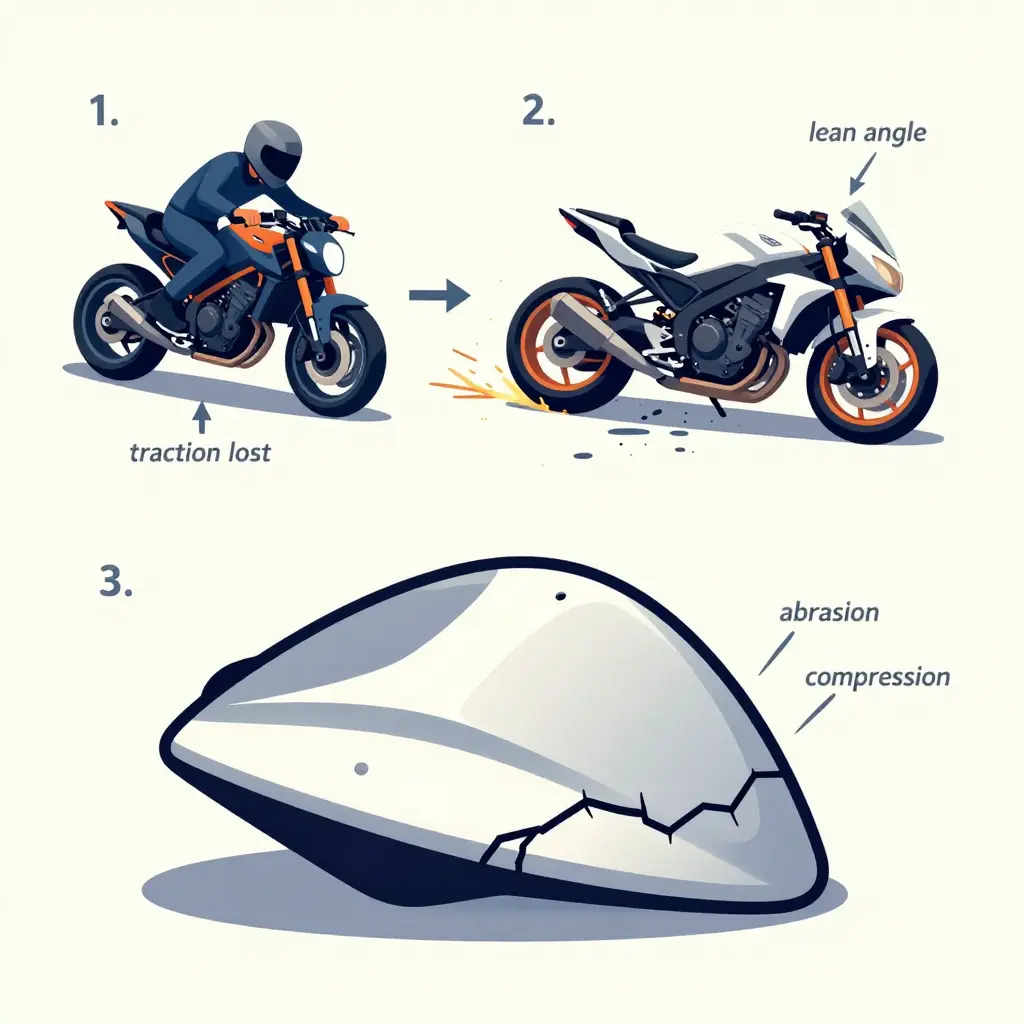
Stage One: Loss of Traction
Low-sides begin the moment available grip is exceeded. A cold tire, a painted crosswalk, an oil film, or too much throttle mid-lean all cut friction. Once lateral grip fails, the motorcycle rotates around its contact patch and falls on its side. The rider usually slides clear; the bike becomes a spinning mass of several hundred pounds.
Stage Two: The Slide and Its Forces
When the bike meets the ground, three forces hit the fairing panels at once:
- Abrasion – continuous scraping as the panel rides along the surface, generating heat and grinding material away.
- Compression – the panel bends where the ground presses it against the frame and engine.
- Impact – short, violent spikes when the bike lands hard or tumbles onto a fixed point.
Slide distance and surface decide how bad the abrasion gets. Smooth tarmac grinds steadily; coarse chip-seal acts like sandpaper; gravel concentrates force into tiny contact points. Every extra meter of slide adds wear.
How Materials Respond: ABS vs Fiberglass
ABS is thermoplastic: it softens, flexes, and stretches under load, then holds the deformed shape. That flex lets it soak up crash energy instead of passing it through, so it tends to scuff and crack locally rather than shatter.
Fiberglass is a thermoset composite. Its cured resin cannot yield, so energy goes into cracks and delamination, and one hard contact can spiderweb a whole panel. Fiberglass does resist abrasion a little better and can be sanded and re-glassed, but it fails in sudden, brittle bursts.
Why Mounting Points Matter
Fairings attach to the frame through bolts, brackets, and rubber grommets, and those points quietly decide the outcome. A rigid mount sends crash load straight into the panel, tearing cracks outward from every bolt hole. Isolated, rubber-damped mounts allow controlled flex, letting the panel pivot and shed energy before it fractures.
The table below sums up the mechanical behavior behind the survival comparison:
| Property | ABS Fairings | Fiberglass Fairings |
|---|---|---|
| Failure mode | Flex, dent, local crack | Brittle fracture, delamination |
| Energy absorption | High (plastic deformation) | Low (sudden fracture) |
| Abrasion resistance | Moderate | Moderate to high |
| Repairability after crash | Good structurally; cosmetic blending is fussy | Good; layers can be rebuilt |
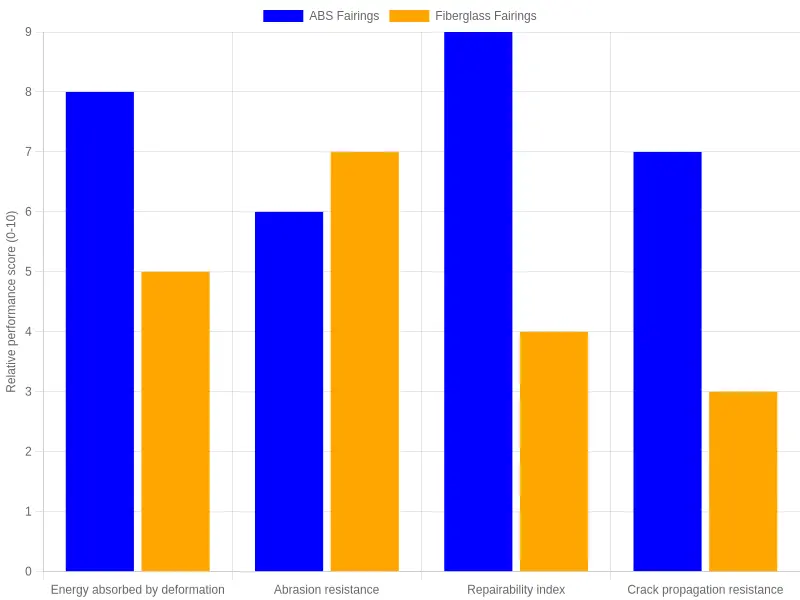
The same low-side leaves two different signatures: thermoplastic ABS bends and absorbs, while thermoset fiberglass cracks and shatters.
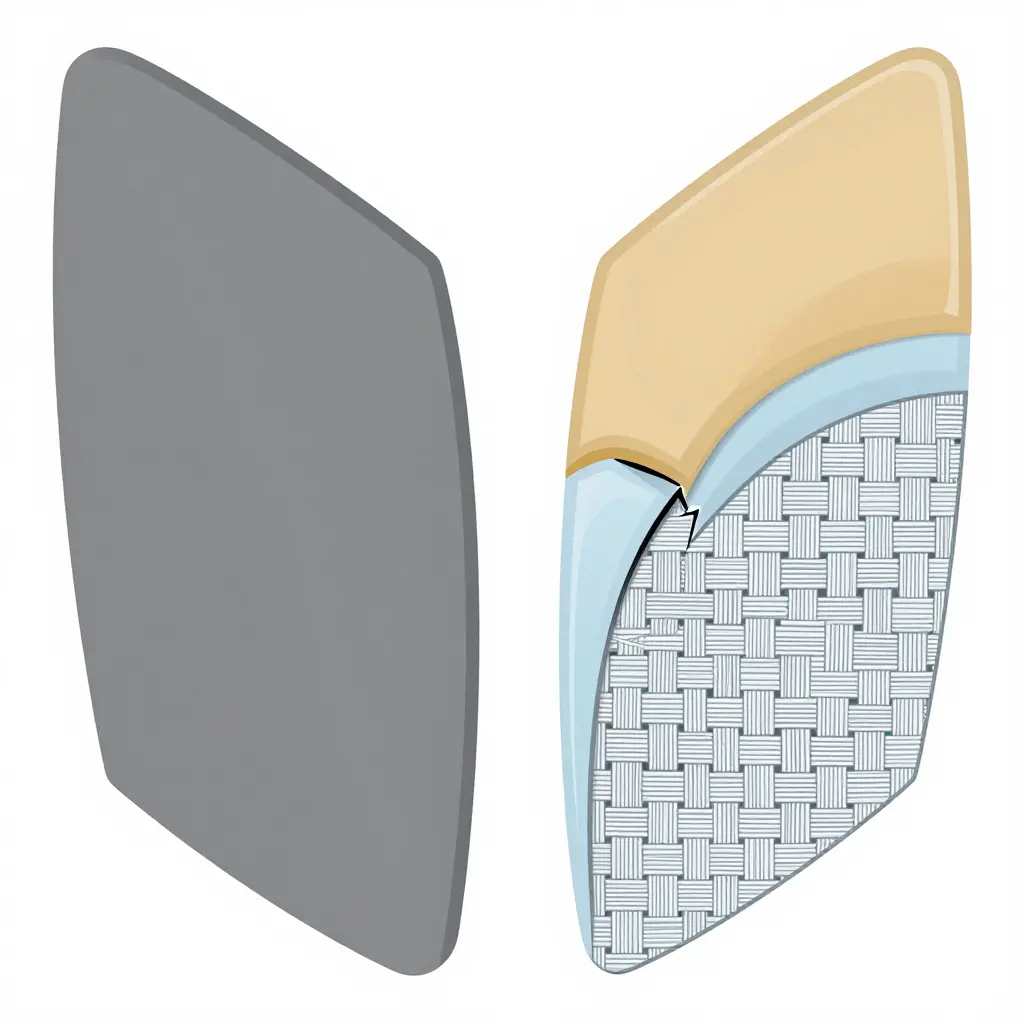
What This Diagram Shows
The cross-section cuts both fairing types open to show why they behave differently after a low-side.
- Left – ABS panel: One uniform layer of thermoplastic. With no internal structure, it bends, flexes, and dents on impact instead of shattering. In a low-side it often springs back, which is why many riders find ABS forgiving on a slow slide.
- Right – fiberglass panel: A layered composite, with resin laid over woven fiber strands. That reinforcement gives fiberglass its stiffness and strength-to-weight edge, but a hard hit spreads through the layers and causes cracks and delamination – the layers separating – instead of a clean flex.
Why the Structure Matters
The cross-section explains the durability difference. ABS absorbs energy by deforming; fiberglass resists it by staying rigid. That one difference decides how each panel fails, how repairable it is, and what it costs to get back on the road.
For a deeper walk-through of these materials and how to choose between them, see our motorcycle fairings guide.
Factors That Determine Fairing Survival After a Low-Side Crash
A low-side is a chain of stresses, not a single event, and these variables carry the most weight. Knowing how motorcycle fairings are constructed helps you read the evidence that follows.
- Material elasticity. ABS flexes and rebounds under load, so it absorbs impact energy rather than transmitting it. Rigid fiberglass has almost no give and cracks once it passes its flex limit.
- Impact speed. Low speeds produce glancing contact that favors ABS; higher speeds multiply kinetic energy and push even flexible panels past their breaking point.
- Slide surface friction. Gravel and coarse asphalt grind material away and generate intense heat; smooth pavement lets the bike slide with less abrasion and preserves more of the panel surface.
- Fairing mounting design. Brackets that flex or break away release energy harmlessly; rigid mounts transfer shock into the shell and concentrate stress at bolt holes.
- Panel thickness. Thicker sections resist puncture and gouging, but the extra mass and rigidity can make fiberglass more brittle, so thickness alone does not guarantee survival.
- Existing cracks or prior repairs. A previous fracture, poor filler work, or mismatched resin creates a weak point that splits under stress, so undamaged panels almost always outperform repaired ones.
- Temperature. Cold plastic gets stiff and brittle, making ABS more likely to snap in winter; warm conditions keep it pliable. Fiberglass loses some toughness when chilled, though less dramatically.
Those factors are why identical fairings can survive one crash and shatter in another. Material, speed, surface, mounting, thickness, condition, and temperature work as a system.
Numbers tell the story faster than a spec sheet. The grouped bar chart earlier compares ABS and fiberglass on the four things that matter after a low-side: how the material survives the hit, how easily you can fix it, how much weight it adds, and what it costs to put right.
The trade-off is built into each material. ABS flexes and absorbs the initial impact, so it tends to walk away from a low-side with scuffs rather than shredded panels. Once it does crack, though, patching it cleanly takes patience. Fiberglass is close to a mirror image: often lighter and easier to repair, but brittle enough that a slide can send gel coat spidering and cracks running across a panel. Sourcing and refinishing a fiberglass set also costs more than swapping ABS panels.
If you are still working out which panels do what, our beginner’s guide to motorcycle fairings covers the basics before you commit to a material.
Repair or Replace? Making the Right Call After a Low-Side
A low-side rarely destroys a bike, but it often chews up the motorcycle fairings. Whether to repair or replace those panels comes down mainly to what they are made of. Thermoplastic ABS and thermoset fiberglass fairings respond to impact differently, so the right fix depends on the material.
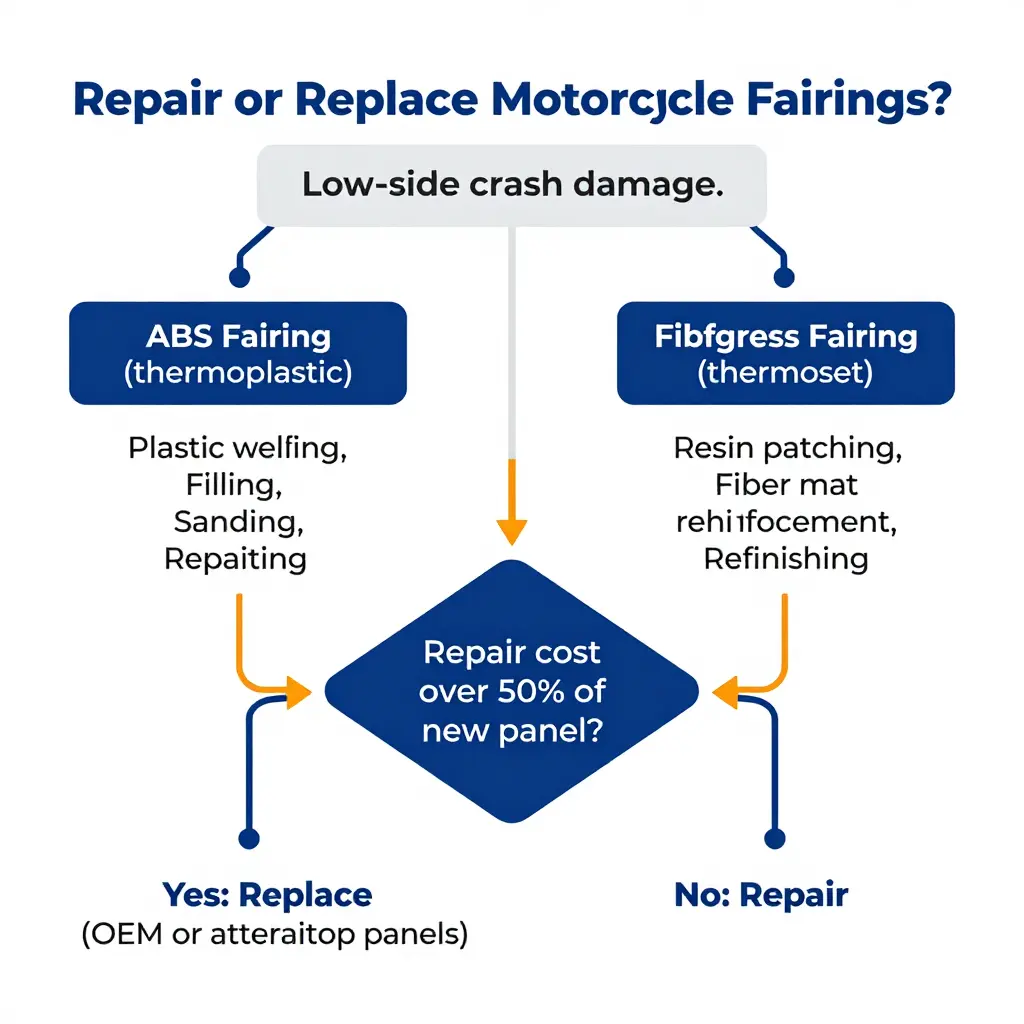
ABS fairings: weld, fill, and refinish
ABS is a thermoplastic, so it can be melted and re-bonded. Minor scuffs, hairline cracks, and cracked mounting tabs are all repairable:
- Plastic welding melts a matching ABS rod into the crack to restore strength.
- Filling smooths gouges and deep scratches with flexible filler.
- Sanding levels the surface for paint.
- Repainting blends the repair into the original finish. If that step feels intimidating, this walkthrough on how to paint motorcycle fairings breaks it down.
Fiberglass fairings: patch and reinforce
Fiberglass is a thermoset composite, so it cannot be welded. Repair is built up in layers instead:
- Resin patching rebuilds missing material and fills cracks.
- Fiber mat reinforcement adds strength across cracks and high-stress points.
- Refinishing restores the gel coat and topcoat so the repair disappears.
Cost thresholds and structural integrity
A common rule of thumb: if repair costs more than about 50% of a new panel, replacement usually wins. Cost is not the only factor, though. Structural integrity matters more. Panels that carry load – mounting points, frame-adjacent sections – should not be trusted after a severe hit. Cracks that keep returning, shattered tabs, and twisted panels all point to hidden weakness.
When replacement is the safer choice
If a panel is cracked in several directions, missing chunks, or sits crooked, replace it. Good aftermarket motorcycle fairings are often cheaper than OEM and can be an upgrade.
| Factor | ABS Fairings | Fiberglass Fairings |
|---|---|---|
| Repair method | Plastic welding, filling, sanding | Resin patch, fiber mat reinforcement |
| Best damage for repair | Scuffs, cracks, broken tabs | Cracks, holes, missing sections |
| Replace if | Repair over 50% of new panel | Repair over 50% of new panel |
| Watch for | Re-cracking at repaired tabs | Delamination and hidden fractures |
The bottom line
Light damage on either material is usually worth repairing; heavy structural damage is not. Judge by material, cost, and load path, then choose the fix that keeps the rider safe. Owners should set aside a rough repair-or-replace budget so a crash does not catch them off guard. Shops that offer both options keep customers riding and earn trust that outlasts any single invoice.
Frequently Asked Questions
Are ABS motorcycle fairings stronger than fiberglass fairings?
Not necessarily stronger, but they behave differently. ABS is a flexible thermoplastic, so it bends and absorbs impact energy in a low-side instead of shattering outright. Fiberglass is stiffer, so it resists small dents well but can crack or splinter under a hard hit. In short, ABS flexes and fiberglass fractures.
Can fiberglass fairings be repaired after a low-side crash?
Yes, and that is one of their main advantages. Because fiberglass is a layered composite, damaged sections can be sanded, re-laid with new resin and cloth, and refinished to look nearly new. Many riders and shops prefer fiberglass for this reason, since a cracked panel does not automatically mean a full replacement. ABS can be repaired too, but heat-welding and filling are fussier.
Which material is more cost-effective to replace?
It depends on the crash. ABS is usually cheaper to buy new and widely available as complete aftermarket kits, so swapping one cracked panel is quick and affordable. Fiberglass costs more up front, but its repairability can save money over time if you are willing to put in the labor. For a one-off low-side, replacing ABS is typically cheaper; for repeat damage, fiberglass pays off. For more on panel options and materials, see this motorcycle fairings guide.
Do ABS fairings crack more easily than fiberglass?
ABS rarely cracks from a simple tip-over because it flexes instead of breaking. In cold weather or under a sharp, focused impact it can still crack, and older or sun-baked panels get more brittle over time. Fiberglass cracks more readily at stress points but fails in a more predictable, localized way. Either material can crack, so crash conditions matter as much as construction.
Which fairing material is better for everyday riding?
For most daily riders, ABS is the practical choice. It is lightweight, resists minor scrapes and vibration, and is easy to replace after a parking-lot drop. Fiberglass suits riders who want a stiffer feel, custom shapes, or the ability to repair and repaint panels themselves. The best pick comes down to your budget, climate, and how much maintenance you want to take on.
The Verdict: Which Fairing Material Wins After a Low-Side?
When a bike goes down, the winner depends on what you value. ABS fairings handle a slide better in most real-world riding because they flex instead of cracking outright. That flex absorbs the hit, keeps panels intact, and makes scuffs and dents easier to live with.
Fiberglass fairings are stiffer, and race panels are often lighter, which helps on the track – but the same rigidity works against you in a low-side. They fracture, splinter, and shatter at impact points, often needing full panel replacement instead of a quick fix. There is no single champion, only the material that fits your priorities.
- Durability: ABS flexes and resists cracking, making it the tougher choice for street riding and frequent tip-overs.
- Appearance: Fiberglass offers a cleaner, more precise finish out of the mold, which suits show-quality builds.
- Budget: Aftermarket ABS fairings are typically more affordable, while premium fiberglass kits cost more up front.
- Repair convenience: Fiberglass is easier to rebuild by hand; ABS welding is simple enough, but blending the repair into the finish takes care.
So the honest verdict: choose ABS fairings for everyday durability and easy panel swaps, and fiberglass fairings when appearance and track performance top your list. Either way, quality motorcycle fairings protect your bike and your wallet. If you are weighing concrete options, the best aftermarket motorcycle fairings can help you match material to riding style before your next ride.