
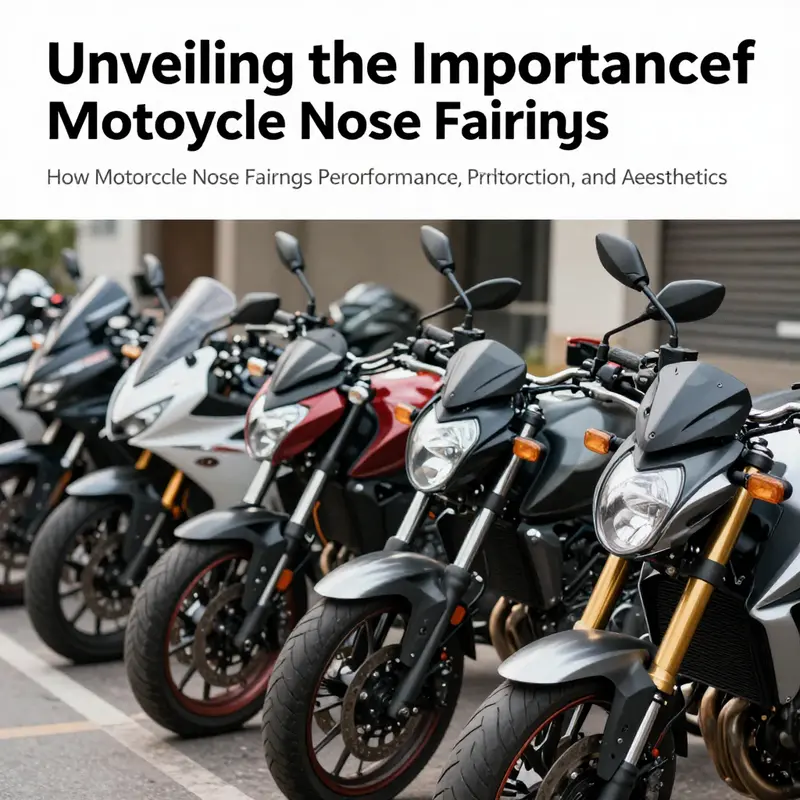
Motorcycle nose fairings are often overlooked yet play a pivotal role in the overall functionality and aesthetics of a motorcycle. These components are meticulously designed for aerodynamic performance, protection against environmental elements, and to integrate seamlessly with the motorcycle’s overall design. By guiding airflow efficiently, motorcycle nose fairings not only enhance stability and fuel efficiency during high-speed rides but also protect critical components of the bike from debris and harsh weather conditions. This article delves into the significance of motorcycle nose fairings through four essential chapters, which explore their aerodynamic capabilities, protective functions, material selections, and aesthetic contributions, providing business owners in the motorcycle industry with insights to enhance product offerings and customer satisfaction.
Nose First: The Nose Fairing as the Silent Engineer of Motorcycle Aerodynamics

The nose of a motorcycle is more than a pointed shield at the front. It is a carefully carved interface between the rider, the machine, and the air that rushes toward it at every acceleration. In the language of aerodynamics, the nose fairing stands as the first line of air management, a deliberate shape that shapes how air meets the machine, where vortices form, and how pressure is distributed across the chassis. Its influence extends far beyond a cleaner look or a few extra miles per gallon. When designed with intention, the nose fairing smooths the oncoming flow, delays flow separation, and creates a stable, predictable air environment around the rider. When designed poorly, it becomes a source of drag, noise, and fatigue. The channel of air that enters the rider’s space, cools critical components, and interacts with the front suspension and wheels is partly determined by this small but mighty piece that sits at the very front of the bike.
From a materials and construction standpoint, the nose fairing is typically molded from high-strength engineering plastics or composites, chosen for a combination of lightness, weather resistance, and impact tolerance. The same design ethos that governs a car’s aerodynamic shell—smooth curves, gentle transitions, and minimal protrusions—applies here with equal rigor. The fairing is not a single, standalone shell; it is part of an integrated ecosystem that includes half fairings or full fairings, brackets, mounting points, and the headlight assembly. At its most refined, the nose is sculpted to work in harmony with the rest of the bodywork, the wheel, and the engine bay behind it. A well-integrated nose reduces the likelihood that the air will detach abruptly from the surface, which would otherwise spawn turbulent eddies and a higher drag coefficient. The role of this component becomes especially pronounced at highway speeds where minor deviations in shape ripple into measurable effects on performance.
A central principle guiding nose fairing design is the management of flow around the front of the bike. Air approaches from the rider’s posture, the curve of the tank, and the edge of the nose itself. A smoothly contoured nose creates a more laminar boundary layer that hugs the surface, encouraging the air to follow the bike’s silhouette rather than breaking away. In practice, this means rounder transitions, a carefully designed leading edge, and a front profile that minimizes abrupt geometric changes. The consequence is not simply reduced drag, but improved stability. At speed, air pressure acts against the bike from multiple directions. If the nose fairing directs air in a balanced fashion, the resulting pressure distribution can help dampen nose lift, manage the flow over the front wheel, and reduce buffeting around the rider’s helmet. When the pressure is uneven or the flow becomes turbulent, the front end can feel unsettled, and the rider may be buffeted by gusts or wind noise that erodes focus and comfort.
The performance benefits extend beyond the purely aerodynamic. Modern noses are designed with cooling and ventilation in mind. They can channel air toward critical systems, like the radiator or brakes, ensuring that high-speed or long-distance riding does not push components toward overheating. This functional versatility is possible only when the nose is treated as part of an integrated thermal strategy rather than a decorative shell. In this sense, the nose fairing becomes a passive, efficient organizer of air flow and heat exchange, working in concert with the engine cover and the upper fairing panels to deliver a coherent thermal and aerodynamic picture. The idea is straightforward: guiding air where it can do the most good while reducing what it does not need to touch. The result is a motorcycle that feels not only faster in terms of acceleration but calmer in its response at high speed, with steadier steering and a calmer cockpit environment for the rider.
Within the broader tradition of fairing design, the nose is frequently paired with various stylistic and functional families. A standard nose cowl emphasizes practicality and clean integration, offering a modest, balanced interaction with the wind. A more aggressive family—often called a sport or touring variant—uses a longer, more pointed front edge to influence the point where flow detaches from the surface. A shark-nose-inspired concept, a reference point in aerodynamic design discussions, emphasizes a longer, sharper front with a refined leading edge to push the flow further along the surface before it separates. While such concepts lean into high-performance application, the underlying physics remains the same: minimal turbulence, smooth transitions, and a firm grip on stability. When designers talk about minimizing mass and unsprung weight, they are touching on a core principle that the nose fairing is not merely a cosmetic cap; it is a strategically engineered element whose mass, stiffness, and attachment impact handling and inertia at the front of the bike.
The manufacturing story behind nose fairings is one of precision and repeatability. For most mass-produced motorcycles, injection-molded ABS or PC/ABS blends are the standard due to their balance of stiffness, toughness, and ease of production. These materials offer good impact resistance, resistance to weathering, and a favorable surface finish that can be replicated across thousands of units with consistent tolerances. For higher-end or performance applications, carbon fiber composites provide a lightness advantage and a stiffness-to-weight ratio that can translate into tangible improvements in handling when paired with appropriately tuned suspension geometry. The shaping process—whether it is an injection-molded part or a hand-laid composite—must hold tight tolerances to ensure an even gap with adjacent panels and a seamless transition with mounting points. The final shape is often a blend of computational design and physical prototyping, where wind tunnel or CFD analysis informs the sculpting of curves, edges, and radii. In the digital age, these fairings are optimally designed with fluid dynamics tools that allow engineers to visualize how air flows around the whole motorcycle, not just the nose in isolation. The aim is to create an uninterrupted stream that preserves momentum, delays flow separation, and reduces the drag that would otherwise siphon power from the engine.
The engineering narrative surrounding the nose fairing also embraces the rider’s experience. A yacht-like calm at speed—where the air feels massaged into a steady, low-noise wake—translates into reduced fatigue on long journeys. The fairing helps shield the rider from direct wind pressure and wind noise, particularly in the helmet zone, where gusts can produce a distracting howl. By shaping the stream of air, the nose fairing decreases buffeting, a phenomenon caused by turbulent flow interacting with the rider’s helmet and upper body. The result is not only a more comfortable ride but a safer one, because the rider can maintain accurate head positioning, gaze, and line through long sweeps of highway. This integration of comfort, control, and efficiency captures the real essence of the nose fairing: it is a quiet, persistent contributor to performance that often goes unnoticed in overt speed talk but is felt in throttle response, heat management, and calm handling.
In theory and in practice, there are trade-offs. At some speeds and bike geometries, the marginal gains from further refining a nose shape can be small, especially if the rest of the chassis is not harmonized with the fairing’s aerodynamic footprint. A nose that is well optimized for a particular frame, wheelbase, rake, and rider position may underperform if fitted on a different model with a distinct geometry. Poor fitment or ill-fitting edges can introduce wind noise or vibrations that negate the theoretical drag reductions. It is thus critical to approach nose fairing design as an ecosystem, not a standalone piece. The interplay with the front wheel, the fork guards, the radiator intake, and the rider’s position all matter. Even the materials choice can shift the feel of the front end, because stiffer or lighter panels alter the natural vibration modes and the way air interacts with the surface under different weather conditions. The modern nose fairing is a multidisciplinary product of fluid dynamics, materials science, mechanical design, and human factors engineering.
Computational tools have become essential in this discipline. Advanced CFD workflows allow engineers to simulate air movement with high fidelity, iterate on shapes quickly, and quantify drag reductions, lift, and side-force interactions. They can also model how the nose fairing contributes to the thermal and acoustic environment of the bike. In the hands of skilled designers, these tools transform a concept into a reliable physical form that works across a spectrum of speeds and riding styles. This systems-thinking approach ensures that improvements in aerodynamic performance do not come at the expense of structural integrity, rider comfort, or serviceability. As a result, the nose fairing stands as a practical testament to how modern motorcycles blend performance and practicality into a single, cohesive package.
To connect theory with practice, consider the way fairing geometry influences a bike’s overall drag coefficient and stability at highway speeds. When the nose gradually guides air away from the rider and the engine’s intake path, it preserves momentum as the bike travels through the fast lane. Slight differences in the leading edge curvature or the angle of attack can shift the point of flow separation along the fork crown or the side panels, changing the wake behind the front wheel and the pressure distribution over the radiator grille. The consequences ripple through the bicycle’s ride: the rider encounters less wind pressure, less noise, and more confident steering on long routes. When designers discuss a shark-nose-inspired approach, they are referencing a particular strategy to extend the effective frontal length without adding appreciable mass, an approach that tames the buffet of high-speed air by shaping the stagnation pressure and delaying separation. While the particulars of each implementation vary, the shared objective remains clear: to create a front-end that behaves like a well-taired wing, offering steady lift management and minimal drag across a broad envelope of speed and rider posture.
For readers who want to explore this ecosystem further, consider looking into catalogs that present a broad spectrum of fairing options and configurations. For example, a catalog that highlights BMW fairings demonstrates how a company tailors its front-end variants to different riding goals, from commuting to sport touring. Such catalogs reveal how the same fundamental nose principle can be adapted to suit different chassis geometries, rider positions, and performance targets. You can explore this kind of resource here: BMW fairings catalog. This internal reference helps illustrate how a designer might approach a nose cowl as part of a broader fairing strategy rather than as an isolated piece.
In sum, the nose fairing is a small but potent engineer of performance. Its impact sits at the intersection of drag reduction, stability, noise reduction, and rider comfort. When integrated with the rest of the bodywork, it becomes a cooperative element that helps the motorcycle slice through air with less resistance, manage heat and airflow efficiently, and present a cohesive, purposeful silhouette that communicates intent even when the rider is not looking down the road. The science behind it is robust, and the craft of its execution is meticulous. The nose fairing embodies the idea that aerodynamics is not simply about going faster; it is about being more deliberate with how air meets the machine and how that meeting shapes the entire riding experience.
External resource: For a deeper dive into how fairings influence aerodynamics, see this external resource: https://www.motorcycle.com/motorcycle-fairings-aerodynamics/
Nose as Nerve Center: Protection, Aerodynamics, and Seamless Integration in Motorcycle Fairings

The motorcycle nose fairing is often perceived as a small, utilitarian shell that merely tucks into the evolving silhouette of a modern bike. Yet when you look beyond the surface, the nose cowl is a thoughtful conductor of air, a shield for vital mechanical and electrical components, and a precise anchor for the bike’s visual language. In this chapter, we explore how the nose fairing functions as protection and as an integration hub, linking front-end engineering with rider comfort, performance, and the long arc of a motorcycle’s design story. What begins as a simple piece of plastic or composite material becomes a carefully engineered system that governs airflow, blocks debris, houses essential elements, and reinforces the rider’s sense of control at speed. Understanding this convergence illuminates why the nose fairing, though small in size, can be a decisive factor in a bike’s behavior on the road and its character in the showroom.
Protection sits at the heart of the nose fairing’s purpose. The front end of a motorcycle is a direct line of attack for wind, rain, stones, dust, and road spray. A well-shaped nose deflects and channels that oncoming flow away from the rider’s torso, reducing buffeting and creating a more comfortable riding experience on long stretches. This deflection is not just about wind in the rider’s face; it’s about energy management. As air travels over the rider, the fairing’s shape helps smooth the transition of flow around the torso, shoulders, and helmet. In doing so, it lowers the abrupt pressure changes that can cause fatigue and distraction. Weather protection, though not as comprehensive as a full or half fairing, is still meaningful. The nose fairing shields the most delicate areas at the bike’s front, guarding the headlamp and nearby electronics from rain-driven impact, wind-driven dust, and splashed moisture that can accelerate wear. While the nose cowl alone cannot turn a harsh storm into a warm day, its streamlined geometry contributes to a more predictable, stable flow field that minimizes the chance of moisture intrusion into sensitive cavities and connectors. The geometry also serves as a first line of defense against debris that could chip paint, nick plastics, or stress fasteners. The result is not only improved durability but also a reduction in maintenance for riders who cover long miles on mixed surfaces. The material choice matters here. Many noses are molded from high-strength engineering plastics, such as ABS or PC/ABS blends, chosen for impact resistance, weather resistance, and the ability to hold a precise contour. Carbon fiber variants exist, offering even lower weight and stiffness that can help maintain alignment of the nose with the rest of the bodywork under load. The decision between a rugged plastic and a carbon fiber nose is a question of balance: durability and cost versus weight savings and the potential for a sharper, more aggressive profile under load. Yet regardless of material, the protective function is inseparable from the nose’s role in the bike’s aerodynamic strategy.
The aerodynamic function of the nose fairing is the other side of protection, and it is where the tale of integration truly unfolds. The nose is the first wide surface that the air encounters as the motorcycle moves forward. A well-tuned nose cowl lowers drag by guiding flow toward the sides and rear of the bike, delaying separation and reducing the size of wake turbulence behind the front wheel. This translates into practical benefits: smoother air over the rider’s chest and helmet, reduced fuel consumption at highway speeds, and improved high-speed stability. Think of the nose as a shaping instrument in a larger orchestra of air management. It is rarely a standalone solution; it works in concert with half and full fairings, air ducts, and the bike’s chassis geometry to shape a predictable pressure field around the front end. In high-performance configurations, designers push the nose toward a longer, more pointed profile to manage the flow more precisely, while in touring or travel-oriented designs, the nose may lean toward a more balanced, rounded shape to maximize comfort and mid-range stability. In either case, the goal is to minimize flow separation near the front, where any abrupt detachment can generate turbulent eddies that radiate rearward and affect tire grip and suspension behavior.
Beyond the immediate task of shedding wind and debris, the nose fairing serves as a crucial anchor for the motorcycle’s integrated systems. The nose’s form provides a natural home for lighting elements, instrumentation, and mirrors, and is often designed to accommodate wiring channels, housings, and mounting points with careful alignment to the frame and engine. This integration is not purely cosmetic. A nose cowl that harmonizes with the headlights, instrument panel, and handlebar geometry reduces harmonics and vibration transfer, preserving sensory clarity for the rider. When the fairing is designed with modularity in mind, service access becomes a practical virtue as well. Whether the nose is part of a standardized module or a bespoke, model-specific piece, the ability to remove and replace without disassembling other front-end components can shave hours off maintenance tasks and motor decisions during a season of rapid track-day shifts or long-distance tours. The alignment with the rest of the fairing system—whether a lightweight half fairing that couples to the frame or a full enclosure that wraps around the engine bay—demands careful tolerancing and joint design. The nose must not only fit physically but also interpolate aerodynamically with adjacent panels. Even small misalignments can ripple into increased drag, imperfect airflow around the radiator or intake, and a mismatch in the bike’s facial geometry that weakens its visual coherence.
In practice, nose fairings tailor their integration into three broad, interlocking roles: first, as a shield for front-end and engine-front components; second, as an air-guiding element that reduces drag and optimizes flow for stability and efficiency; and third, as a unifying canvas that houses essential visual and functional components while linking to the bike’s broader aesthetic language. These roles are not separate boxes to check; they are a continuous design dialogue, where the shape of the nose informs the placement of ducts and vents, and the positioning of headlights and mirrors shapes the nose’s form in return. In this sense, the fairing is not just a shell but a nervous system, translating forward energy into controlled motion and rider reassurance. The concept of an unsprung mass—often discussed in the context of suspension and wheels—gains a companion in the nose: the nose’s mass distribution and its attachment to the frame influence the dynamics of the front end, particularly at higher speeds and during rapid steering corrections. Reducing the nose’s weight without compromising stiffness and protection can contribute to lighter steering feel and quicker self-correcting tendencies, attributes that many riders value in sportier configurations. The design trade-offs are real. A lighter nose reduces inertial forces and can improve response, yet it must still resist impact, withstand the rigors of road grime, and preserve the structural integrity of what is, literally, the bike’s face. That balancing act—lightness without weakness, protection without bulk, form without sacrificing function—is the essence of nose fairing engineering.
One practical manifestation of this balance is the way nose fairings relate to the broader family of fairing configurations. In many bikes, the nose acts as a bridge between a more exposed front end and a larger, enveloping fairing that continues to the rider’s elbows. The choice between a standard nose, a more aggressive sharknose-style profile, or a modular, detachable system often reflects the rider’s priorities: sport-minded riders may favor the aerodynamic sharpness of a longer, pointed nose that tames flow separation and keeps the front-wheel wake tight; touring riders may prioritize a softer approach that minimizes wind blast and provides a more forgiving gust response. Regardless of the exact silhouette, the nasal section must integrate with the bike’s structural backbone and its thermal management strategy. Internal ducting and radiators, if located behind or near the nose, rely on precise gaps and channels across the nose’s inner skin to maintain consistent cooling performance while minimizing noise and vibration. This is not mere craftsmanship; it is fluid dynamics translated into layman terms—how air is coaxed around a bike’s most exposed area and how the quiet hum of cooling and power delivery remains uninterrupted by turbulent eddies.
From a manufacturing perspective, the nose fairing embodies a spectrum of materials and processes chosen to meet the demands of protection, aesthetics, and integration. Injection-molded ABS and PC/ABS blends appear frequently because they can hold tight tolerances, tolerate UV exposure, and be formed into complex concavities that support integrated channels for wires and vents. For higher-end applications or performance models, carbon fiber variants offer exceptional stiffness-to-weight ratios, enabling a more confident alignment of panels under dynamic loads and a crisper, more aggressive face when the bike is pushed to the limit. The shaping process—whether through high-volume injection molding or bespoke composite layups—must contend with dimensional stability, weathering, and color or texture matching across multiple panels. A nose that warps, cracks, or mismatches with adjacent pieces undermines both protection and aerodynamics, because even a small seam can induce flow separation or collect road debris over time.
The design philosophy behind nose fairings also speaks to a broader narrative about how motorcycles express their purpose through form. A sport-oriented machine tends to favor sharper, more angular noses that cut cleanly into the air and present a sculpted, high-energy silhouette. A touring-oriented machine, by contrast, leans toward restrained lines and smoother transitions that whisper of comfort and endurance. In both cases, the nose serves as a visual anchor, a focal point that communicates intention just as clearly as it communicates function. It is a deliberate design decision to locate instrument clusters, controls, and lighting so that their geometry complements the nose’s curvature, reinforcing a sense of cohesion across the whole front end. That cohesion matters. When all components align in both function and style, the rider experiences a sense of confidence that transcends individual features. The bike feels predictable, controllable, and ready to absorb the variable rhythms of a ride—from a city roll to a highway sprint to a winding mountain pass.
In the practical realm of rider experience, the nose fairing influences ambient conditions for the torso and head, a factor that almost every long-distance rider notices. Even modest improvements in wind deflection can lead to measurable reductions in fatigue on multi-hour legs, while better aero balance helps the front end maintain grip and stability through gusts or lane changes. The nose’s interaction with the wind at slip angles—situations where the bike’s path is not perfectly aligned with the air—points to a broader truth: small, well-integrated components can prevent larger instability proactively. The rider’s feel through the handlebars, the sound of air rushing past, and the sense of a stable, planted front end all originate, in part, from this seemingly modest piece at the bike’s tip. As with many details in engineering, the most effective nose fairings are those that disappear in use—quietly performing their job while the rider concentrates on throttle progression, cornering lines, and the evolving rhythm of the road. That invisibility is, in truth, the mark of integration well executed.
For readers who want to explore how nose fairings lie within the ecosystem of a bike’s front-end design, consider the diverse options within fairing categories. The nose cowl is not an isolated accessory; it is part of a family of components that must work in harmony. The choice to search through a catalog of fairings for various brands or models can reveal patterns in how designers approach balance, protection, and aesthetics. When evaluating a nose fairing, riders and builders often weigh the trade-offs among weight, rigidity, and serviceability. A modular nose that can be removed without disassembling the entire front end may appeal to track-day enthusiasts who need quick access to the radiator or front suspension without a lengthy teardown. For the collector or the rider who values a clean, modern look, a well-integrated nose provides a polished transition from headlamp to windshield to side panels, reinforcing a consistent design language that lifts the overall impression of the motorcycle while maintaining functional integrity.
In this context, it helps to recognize a practical point about design choices. A nose fairing that is too aggressive in its aero profile can introduce lift and wind-induced instability at high speeds if the rest of the front-end geometry does not compensate. Conversely, a nose that is too conservative may offer less protection against debris and a more neutral, but less optimized, aerodynamic footprint. The best designs strike a balance: a nose that channels air efficiently, shields critical components, and reinforces the bike’s identity without sacrificing rider comfort or mechanical accessibility. Such a nose serves as a bridge between raw engineering and human experience, a small but mighty piece that helps the motorcycle speak with one uninterrupted voice of purpose.
For readers seeking a practical path through choices and trade-offs, it can be helpful to view nose fairings as a portfolio of possibilities rather than a single solution. The nose’s contour, the thickness of its shell, the presence of ducts or vents, and the way it meets the surrounding panels all contribute to its effectiveness. Selecting between a standard nose and a more angular, sharknose-inspired design is not merely about aesthetics; it reflects how air is directed to minimize separation points and how the opening lines around the headlights and instrumentation influence the rider’s perception of speed and precision. When a nose integrates with a bike’s electronic systems, its routing paths for sensors, cameras, or HUDs become elements of protection and reliability. In all, the nose fairing knits together protection, aerodynamics, and integration into a single, coherent system that defines the bike’s behavior on the road and its visual statement in motion.
As riders and builders continue to push for lighter weight, more efficient airflow, and better integration with electronics and controls, the nose fairing will remain a focal point of craft and performance. It is the earliest point where the rider’s experience begins—the first contact with air, the shield against the elements, and the canvas upon which the bike’s character is painted. And while it may not shout its importance from a distance, the nose fairing earns its quiet authority every time the bike rolls into its stride, the wind streams over the rider, and the road presents a long, winding invitation. For those who want to see how this principle plays out in a catalog of options, a closer look at the Yamaha fairings category can be an instructive, practical starting point that highlights how one brand’s family of fairings approaches nose integration and front-end protection. Yamaha fairings offers a window into how the nose cowl sits within a broader design language, showing how the same core goals—protection, aerodynamics, and cohesive aesthetics—manifest across models and riding philosophies. While choices vary, the underlying logic remains consistent: protect the front end, guide the air, and unify the bike’s identity in a way that enhances both performance and pleasure. In the end, the nose fairing reveals itself not as a lone component but as a crucial hinge between engineering discipline and rider experience. Its success is measured not by visibility alone but by the quiet confidence it lends to every mile traveled, every corner carved, and every weather window faced on the road ahead. For readers seeking a deeper, general technical reference on nose fairings, the following resource provides a comprehensive guide: https://www.motorcycle.com/motorcycle-nose-fairing-guide/.
Form, Material, and Flight: The Hidden Science Behind Motorcycle Nose Fairings

The motorcycle nose fairing is a small part with outsized influence. It sits at the very front of the machine, a sentinel that guides air, shields essential components, and frames the rider’s perception of speed and control. When you step back and study its role, you see a synthesis of material science, engineering method, and design philosophy. The nose fairing is not merely a cosmetic shell; it is a carefully engineered interface between the rider, the machine, and the air through which it slices. The materials chosen and the way they are manufactured determine how well this interface performs under a wide range of conditions, from the chill of dawn highway miles to the heat of a late afternoon climb. The balance among impact resistance, thermal stability, wear resistance, weight, and stiffness is the quiet core of this component, and it is achieved through a disciplined sequence of material selection and production steps that blend science with craftsmanship.
At the heart of material choice are four families that dominate modern fairing construction, each bringing its own signature advantages and compromises. Polycarbonate, a transparent yet protective option in many fairing applications, offers exceptional impact resistance. It behaves like a shield against gravel and pebbles that would otherwise threaten the fragile inner components or the surface finish during a throw of a stone or a rough road. Its toughness helps preserve rider visibility and helps prevent energy transfer to the rider in a collision or sudden impact. The second material in the field is polypropylene, a thermoplastic known for its robust heat resistance and chemical stability. In harsh environmental conditions, from road salt to fuel vapors and sun exposure, polypropylene resists degradation and retains its shape and surface integrity. This resilience is particularly valuable in hot climates or when the fairing endures long hours exposed to sun and wind gusts that can deteriorate a lesser polymer.
Then there is polyester, which stands out for wear resistance. The surface of a nose fairing in a high mileage build often takes the brunt of abrasion, from boot scuffs at a stop to exposure to airborne particles. A PET-based composition or PET blends deliver a surface that wears gracefully over time, maintaining a cleaner appearance after many miles and weather cycles. It is not merely about looks; wear resistance supports a smoother air flow interaction with the surface, reducing turbulence and preserving the intended aerodynamic profile as lines and edges age. While polycarbonate and polypropylene address impact and heat stability, PET-based materials reinforce the long term appearance and dimensional stability of the outer shell, a factor that matters when you consider both aerodynamics and rider confidence.
Carbon fiber stands apart in the material spectrum, offering an extraordinary strength to weight ratio. For high performance and premium models, carbon fiber raises the fairing into a different echelon of efficiency. The stiffness to weight advantage translates into less flexible deflection under gusts and dynamic loads, which helps the air flow remain predictable at speed. Carbon fiber fairings are typically produced with prepregs in controlled environments and cured under high pressure in autoclaves. The resulting skin is not only lighter but also extremely rigid, which improves aerodynamic consistency across a range of speeds and road conditions. There is also a strategic option in carbon fiber hybrids, where carbon is combined with glass fibers to balance stiffness with cost and ease of production. These layer configurations are not arbitrary; they are the product of careful engineering tradeoffs, tuned to a model’s power delivery, rider weight, and intended riding discipline.
The material story does not end with the fibers themselves. The manufacturing pathway chosen for a nose fairing interacts with every other design decision and shapes the final performance envelope. In the most advanced implementations, the design begins with computational tools that model airflow around the front of the bike. Computational fluid dynamics, or CFD, is paired with wind tunnel validation to confirm how the fairing guides air at a range of speeds and yaw angles. This virtual testing prevents costly surprises when the component is produced and installed on an actual motorcycle. The result is a design language in which curves, lines, and attachment points are not only about aesthetics or fit, but also about how air negotiates every corner of the shape. The process ensures that the air does not separate prematurely from the surface, that the streamlines glide over the front, and that the overall drag coefficient, a measure of resistance, is minimized where it matters most. The nose cowl thus becomes a living part of the vehicle’s aerodynamic system rather than a passive shell glued to the frame.
From the initial concept to the first physical prototype, mold development is a critical bridge. A fairing mold must capture the exact geometry that the aero engineers tested in CFD. The precision of the mold directly affects the surface finish, the micro texture of the outer layer, and the integrity of edge radii that influence airflow. The difference between a fairing that looks good in a studio shot and one that performs well on the street can hinge on the mold’s accuracy. Once a mold is established, the material layup begins. For carbon fiber work, this includes laying prepregs in precise orientations and stacking plies to achieve the desired balance of stiffness and resilience. For thermoplastic options, the layup involves shaping and forming a polymer sheet into the designed geometry, often aided by heat and pressure to ensure a near net shape. The curing step, especially for carbon based structures, is where the science of materials and process converge. Autoclave curing applies uniform heat and pressure, driving the resin to flow and bond while compressing the fibers into a compact, void-free matrix. The autoclave does not merely harden; it consolidates the fiber network into a robust skin with predictable mechanical properties. In many high end applications, full carbon frames the outer shell, while hybrid designs strategically place carbon where the gains in weight reduction are most impactful, paired with glass fibers or even polymer blends in other regions to reduce cost without sacrificing performance too aggressively.
Surface finishing then takes center stage. The outer layer of the nose fairing must resist weathering, UV exposure, and abrasion while offering the desired tactile feel and visual effect. A matte finish can reduce glare and emphasize the bike’s lines, while a gloss finish can enhance color depth and highlight the component’s form under showroom lighting. The choice of surface treatment is not merely cosmetic; it interacts with micro roughness, boundary layer airflow, and even the perception of speed. A well finished surface can mitigate minor imperfections that would otherwise become drag-inducing roughness in high Reynolds number regimes. Durability testing for the exterior includes exposure to salt spray, temperature cycling, and flexural fatigue to ensure the finish holds up through seasons and miles alike. Each of these stages—design, molding, layup, curing, and finishing—feeds back into the next, creating a loop of continual refinement that is unique to nose fairings as a functional aerostructural element.
The processes extend into production realities that influence both OEM work and aftermarket options. In modern manufacturing, large scale lines increasingly rely on digital databases and installation process packages tailored to specific vehicle platforms. These data-driven libraries help producers ensure that each nose fairing mates cleanly with the bike’s headlamp, steering geometry, and front suspension without introducing fitment surprises during assembly. For aftermarket and OEM suppliers, the availability of modular or modularly assembled nose components supports a faster path from design to marketplace, while preserving the precise tolerances demanded by complex headlamp assemblies and radiator inlets. The workflow is not just about making a single part; it is about ensuring the nose fairing integrates seamlessly with the broader aerodynamics and the protective envelope of the front end. A modular approach can allow riders to swap noses for different looks or to upgrade performance attributes while maintaining the integrity of the original air flow pattern that governs stability at speed. This is where the design philosophy of a sharknose inspired fairing comes into play. The longer, more pointed forward edge aims to postpone flow separation and keep the air attached for longer, translating into steadier steering input and a perceivable sense of control at high speed. The nose is thus a design lever that blends aesthetics with aero performance, rather than a cosmetic add-on.
The fabric of production also reflects a shift toward accessibility and customization. Materials that once lived behind a glossy encapsulation in a premium segment are now accessible in a broader spectrum of models, enabling riders to experience improved durability, reduced maintenance, and a consistent surface finish over time. The standard and extended life of a nose fairing rests on the chemical stability of the chosen resin systems, the thickness and distribution of material, and the quality of the surface layer that faces the wind. In practice, a well-conceived fairing will resist weathering, tolerate heat without embrittling, and endure repeated flex cycles without fracturing. The color and texture choices must be stable across environmental cycles, resisting fading and micro cracking that would otherwise escalate drag and alter the perceived quality of the bike. All of these factors, taken together, determine how a nose fairing ages and how its aerodynamic performance holds up through the rigors of real world riding.
The broader ecosystem of fairings supports the idea that the nose is not a standalone component but an integral element of the bike’s aerodynamic profile. Engineers consider how the nose interacts with the half fairing or full fairing that it anchors, how it affects the pressure distribution around the headlight and front fork, and how it influences the flow toward the radiator and intake systems. A nose designed with a sharknose inspiration tends to create a smoother separation point, which translates into more predictable flow and a more forgiving ride for riders who push their machines toward higher speeds or longer sustained cruse. All these considerations shape not only performance but the bike also how it feels when the rider stands at the edge of the throttle and senses the air pressing forward in a controlled, confident rush.
In practical terms, the material and process choices also have economic and lifecycle implications. Carbon fiber is not only about ultimate performance; its use implies careful cost management, production control, and a pathway to weight reduction that can make a meaningful difference in handling and fuel efficiency over long distances. Polycarbonate, polypropylene, and PET blends offer alternatives that balance performance and affordability, enabling more riders to benefit from improved aerodynamics without the premium price tag that carbon fiber often carries. For the manufacturer, the decision matrix includes the complexity of the mold, the speed of cycle times, and the reliability of the surface finish under the intended service conditions. For the rider, it translates into a fairing that remains visually appealing after years of exposure to sun and weather, while maintaining the shape that keeps air in predictable harmony with the bike’s front end. The result is a product that looks purposeful and performs consistently, a blend of science and style that becomes almost invisible when it performs as intended at speed.
The broader narrative here is one of coherence. The nose fairing is a product of deliberate material science, thoughtful manufacturing, and purposeful design. It demonstrates how seemingly small components can influence the entire system of a motorcycle. It shows how modern engineering uses a mix of resins, fibers, and forming techniques to optimize for strength, stiffness, and weight while preserving the surface finish and aesthetic lines that riders crave. It is a reminder that performance in speed machines is rarely the result of a single trick or a lone clever idea; it is the cumulative effect of many well aligned choices across materials, processes, and form. When a rider feels the handling stay steady, when the headlamp and front fork are protected with confidence, and when the bike presents a clean, purposeful silhouette on the road, that resonance comes from the quiet but decisive work done in the nose fairing. It is the point where design meets physics at the edge of the rider’s vision, where the material choice and the manufacturing discipline come together to make speed feel stable, predictable, and almost effortless.
For readers who want a tangible sense of how this piece fits into the broader ecosystem of fairings, the catalog of available nose components provides a spectrum of decisions. You can explore a range of forms and finishes that illustrate the same underlying material logic in different ways. A practical takeaway is that the nose fairing should be considered in concert with the entire front end of the bike, including how it connects to the half or full fairing, how it directs air around the lamps and forks, and how it contributes to the overall weight distribution and balance at speed. The design and material choices are not abstract concerns; they shape what a rider experiences as the machine slices through air. As speed increases, the fairing becomes less of a decorative shell and more of a tuned aerodynamic surface whose behavior under gusts, rain, and heat reflects the sum of all the materials and processes described above. The nose fairing thus emerges as a critical, understated engineer of stability and efficiency, a window into how careful material selection and disciplined manufacturing elevate the everyday experience of riding.
To connect these ideas back to practical considerations for riders and builders, one can look to how different fairing families create different flight profiles for the motorcycle. A carbon based nose, with its rigidity and lightness, will interact with the rest of the body to preserve a clean air path and reduce the energy lost to flutter and rough flow. A thermoplastic nose, with its durability and cost efficiency, yields a robust exterior that survives long miles with minimal maintenance while still delivering a respectable aero improvement. The polyester wear resistance helps the surface retain its finish after years of exposure, maintaining the fairing’s interaction with the incoming air as intended. And the polycarbonate layer acts as a shield, sustaining rider safety and maintaining clear light paths in the headlamp region. The engineering conversation is consistent across materials: reduce weight where it matters, preserve stiffness to keep the air path predictable, guard against environmental attack, and present a surface that remains true to the designed aerodynamic shape under real world conditions. That is the essence of the nose fairing as a finely tuned component rather than a generic shell. The result is a system that delivers both protection and performance while contributing to the distinctive character of the motorcycle in motion. For those who wish to further explore related catalog options and see how these principles translate in practice, you can navigate through the broad spectrum of fairings available in the market and observe how different materials and finishes are employed across brands and models, including options such as Kawasaki fairings.
External reading and deeper technical context can be found in a comprehensive material and manufacturing guide that examines carbon fiber prepregs, autoclave curing, and the practicalities of resin systems used in nose fairing production. This external resource provides a technical complement to the overview presented here and helps readers connect the dots between theory and factory floor reality. https://www.alibaba.com/product-detail/A-Complete-Guide-to-Suzuki-GSX-R1000-K5-Fairing_1600482795928.html?spm=a2700.157003.0.0.4f8c1b3dOuUZoH
Front and Form: How Nose Fairings Shape Speed, Style, and Story in Modern Motorcycling

The nose fairing sits at the very edge of a motorcycle’s personality. It is easy to overlook its quiet authority when one stands back to admire a bike’s silhouette, but up close this small aerodynamic piece is a masterclass in how engineering and aesthetics collaborate. A nose fairing is not just a shield for the rider or a housing for lights. It is a carefully sculpted surface that governs how air behaves around the machine, how the chassis feels at speed, and how observers read the rider’s intent. In modern sport-touring and fully faired machines, the nose is the first line of a complex conversation between performance and perception. It is where the physics of wind meets the psychology of style, and the resulting dialogue shapes how a bike is ridden, stood beside, and remembered.
From the rider’s vantage point, the nose fairing begins as a barrier against wind and weather. Its contours are designed to guide air smoothly around the front of the bike, reducing the pressure build-up that can buffet the rider at highway speeds. Engineers speak of drag reduction and flow separation as if they were two dancers in a long, synchronized waltz. The fewer gusts that reach the rider’s chest and helmet, the less fatigue accumulates on a long ride, and the longer a rider can stay focused on the road ahead. But this is not a purely functional reduction; it is a design constraint that steers the bike’s face toward a particular stance. A well-shaped nose suppresses turbulence, stabilizes the steering feel at high speed, and can even contribute to better wind protection without the rider having to crane their neck to see the horizon. In this light, the nose fairing becomes a quiet partner in the rider’s endurance and composure.
The aerodynamics at work extend beyond the rider’s comfort. The front end of a motorcycle is a primary source of drag, and altering even a few millimeters of curvature at the leading edge can shift how air reattaches along the sides and how the airfoil behaves around the fork and the engine’s cooling intakes. Designers think in terms of the flow’s pressure gradients, vortex formation, and the timing of flow separation. When air detaches too early from the leading edge, a turbulent wake grows behind the bike, creating buffeting that can destabilize the chassis under load. A nose with a deliberately sharp leading edge or a sculpted vent can reenergize the boundary layer and push the separation point farther downstream. The result is not simply a faster or more efficient ride, but more predictable handling and a more confident ride for the pilot at the edge of the envelope.
But performance is only one side of the coin. The nose fairing also houses a complex visual language. Its lines, edges, and surface treatments frame the bike’s overall character the moment a passerby’s gaze lands on the front end. A nose that features smooth, continuous curves tends to project refinement and elegance, especially when finished in a glossy or satin surface that catches light along a long, uninterrupted sweep. In contrast, a nose with sharper edges and sculpted vents can communicate aggression, precision, and a readiness to engage in fast laps or long, purposeful journeys. The way paint or decals kiss the fairing’s surface—contrast between color and shadow, the way a bend in the surface mirrors a rider’s stance—can reinforce a perception of speed even when the bike is stationary.
Throughout the industry, designers increasingly treat the front end as a signature element. A distinctive front profile can become a model’s calling card, a visual shorthand that riders associate with particular performance philosophies. A shark-nose-inspired profile, with a longer, more pointed forward line and a tapered leading edge, is often deployed to emphasize superior air management and a minimized frontal projection. Without naming specific models, this design idea signals intent: a bike built to carve through air with fewer distractions and a stronger sense of direction. The nose thus functions as a design beacon, guiding the eye along the bike’s length and suggesting how the rest of the chassis will behave once moving. In this sense, the nose fairing is not merely a protective shell but a narrative device that conveys who the bike is and what it is prepared to do.
Material choices play a crucial role in how a nose fairing achieves both form and function. The most common substrates—high-strength plastics such as ABS or ABS/PC blends, and increasingly carbon fiber for higher-end builds—blend stiffness with lightness and weather resistance. The injection-molded geometry must be precise enough to respect the aerodynamic contours while remaining resilient to road spray, stone impact, and UV exposure. The combination of resin, reinforcement, and finish determines whether the surface appears mirror-like in bright sun or velvety in shade. A glossy finish can heighten the perception of cleanliness and speed; a matte finish can emphasize rugged, purposeful character. In all cases, the surface texture interacts with light to sculpt the bike’s face, shaping how it sits in space and how it feels when the rider leans into the wind. The choice of finish also interacts with the color strategy. Color blocking, subtle gradations, or color-matched accents can pull a design together with the fairing’s lines, creating a sense of flow from the front to the sides and back toward the cockpit.
To speak in more concrete terms about the design ethos, many manufacturers pursue lines that gently cradle the rider’s sightlines and the rider’s breath of air. The nose’s upper edge and the windscreen pairing are crucial in establishing a clean, uninterrupted view ahead, while the fairing’s lower portions sweep toward the side panels to reduce wake behind the forks and engine. This careful orchestration of shape reduces not only drag and buffeting but also shadows and glare that can distract the rider. The result is a cockpit that feels both protective and exposed to speed in a controlled way—an atmosphere that invites the rider to lean into the ride rather than fight against the elements. It is a dance between enclosure and exposure, a master class in how design can give a rider confidence by shaping what is seen and what is felt.
Beyond the purely mechanical and visual dimensions, the nose fairing serves as a platform for branding and market differentiation. In a segment where performance is measured in tenths of a second and reliability, a unique front profile can become a model’s most recognizable fingerprint. The front shape—its proportions, the rhythm of its creases, the placement of sculpted vents or intakes—becomes a shorthand for the rider’s expectations. Where one bike might be read as sophisticated and refined, another might be perceived as aggressive and athletic. This is not about adornment alone; it reflects a philosophy of how the machine should move, how it should feel at speed, and how a manufacturer communicates its approach to engineering and aesthetics. As such, nose fairings carry weight in consumer choices, particularly among riders who prize both form and function and who seek a motorcycle that expresses a personal sense of style while delivering measurable performance.
The pursuit of these qualities is evident across the spectrum of fairing configurations. A standard nose cowl, for instance, offers a foundational silhouette that can be extended or integrated with half fairings or full fairings to provide greater wind protection and additional surface area for sculpted features. A shark-nose approach, with its extended forward projection and pronounced leading edge, signals a commitment to minimizing air separation and to delivering a clean, forceful line that suggests speed even when the machine is at rest. Then there are modular or removable nose assemblies, which address maintenance and customization. The ability to swap a nose section for a different aesthetic or aerodynamic target—perhaps a sportier profile for track use, or a more subdued look for touring—speaks to a broader trend in motorcycle design: adaptability without compromising integrity.
In this landscape, the nose fairing’s aesthetic dimensions are rarely accidental. They are the result of a continuous dialogue among wind-tunnel feedback, on-road testing, and consumer perception studies. Designers must balance the desire for dramatic forms with the imperative of durability and practicality. The shapes must survive the realities of road grime, stone impacts, and the wax of a showroom where light and camera angles can distort perception. The governance of this balance requires a mature sense of proportion, an understanding of how light plays across a curved surface, and a willingness to accept that a feature that looks striking in a studio image may behave differently when touched by grit and sun in the real world.
In the end, the nose fairing is about more than air and aesthetics. It shapes the rider’s experience by filtering the environment and by signaling intent through its form. It frames the rider’s posture and helps determine the bike’s stance in motion. It communicates a design language that invites a shared understanding between builder and rider about what speed feels like and what control demands. It is a small component with outsized influence, a hinge between engineering rigor and artistic expression that makes the modern motorcycle not only faster but more expressive. Its presence is felt in the way a bike stands at a traffic light, how it cuts through the wind on a long straight, and the way a rider senses the bike’s readiness as it leans into a bend. The nose is the face of the machine, and that face tells a story about the rider’s journey, the brand’s philosophy, and the road that lies ahead.
For readers who want to explore how these ideas translate into real-world options and catalogs, Broadly speaking, catalogs in the aftermarket and OEM ecosystems use nose fairing designs to communicate a bike’s aerodynamics, weight distribution, and aesthetic direction. One can observe how color, texture, and contouring reinforce the idea of speed and protection while maintaining a coherent overall silhouette. In discussions of design and engineering, the nose fairing is often the starting point for conversations about how a bike will feel and behave under pressure, and how that feeling translates into rider confidence and brand loyalty. As such, it is worth recognizing nose fairings not only as protective shells or wind-deflecting surfaces, but as essential storytellers that eloquently summarize a motorcycle’s approach to speed, endurance, and identity.
To connect these reflections to a broader resource, readers may consider exploring a broader catalog or fairings collection to see how different lines interpret the same aerodynamic and aesthetic principles. For example, you can browse the Yamaha fairings collection to observe how different silhouettes harmonize with the rider’s geometry and the bike’s overall line, while considering how color and texture complete the storytelling of speed and precision. This exploration helps underscore the idea that the front end of a motorcycle is where engineering intent meets visual rhetoric, and where the rider’s first impression often becomes the most enduring one.
For a deeper technical perspective on the composition and classification of motorcycle nose cowls, and how these elements find practical applications across diverse platforms, the following external reference provides a detailed exploration: Motorcycle nose cowl composition, classification, and industrial applications.
Final thoughts
Motorcycle nose fairings are not just aesthetic enhancements; they serve critical functions that impact performance, protection, and rider experience. As a business owner in the motorcycle industry, understanding the multifaceted role of nose fairings can facilitate better product development and customer satisfaction. Emphasizing aerodynamic efficiency, protective capabilities, innovative materials, and appealing designs allows businesses to cater effectively to the evolving demands of riders, ensuring that both performance and style are upheld. Investing in quality motorcycle nose fairings can significantly enhance the overall motorcycle experience, positioning your brand ahead of the competition.