
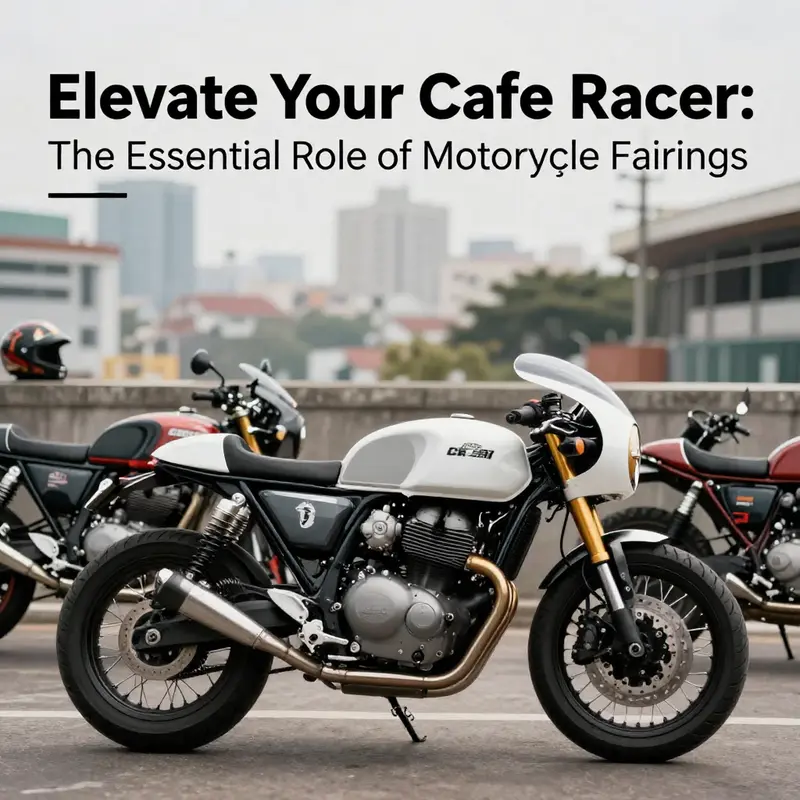
Motorcycle fairings are pivotal to the identity and performance of cafe racers, blending artful design with engineering excellence. Emerging in the 1960s, cafe racers resonate with speed and individuality, and motorcycle fairings serve as a vital element in this equation. Each chapter delves into aspects such as front fairing designs, material selection, performance impacts, and the balance of minimalism and functionality, helping business owners grasp how these components can enhance both vehicle aesthetics and rider experience.
The Front Fairing as Aero-Icon: Sculpting Speed and Style in Cafe Racer Design
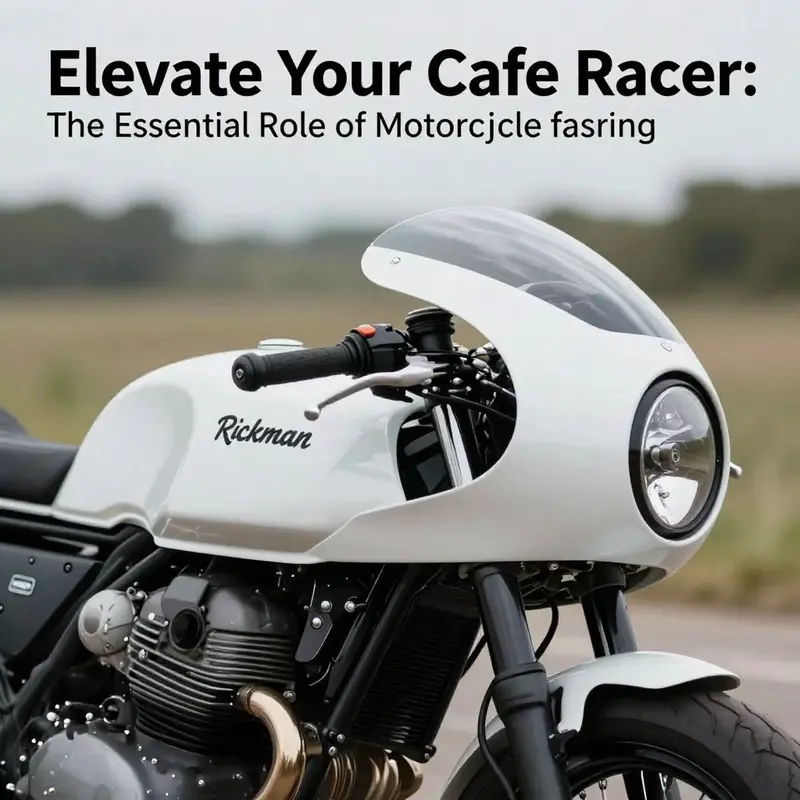
The front fairing of a cafe racer is more than a protective shell or a decorative flourish. It is the focal point where speed and personal expression converge, a sculpted line that defines the bike’s silhouette and dictates how wind interacts with the rider and the machine. In the 1960s, a movement took hold in Britain that prized a rider’s sense of possibility as much as the machine’s potential to outpace it. From that origin, the front fairing emerged not merely as an accessory but as a statement: a leash on air that tames turbulence, a shield for the cockpit, and a symbol of a philosophy that equates speed with a clean, confident equilibrium between rider, road, and machine. The modern cafe racer front fairing carries that heritage forward, even as it absorbs new materials, new manufacturing processes, and new expectations for daily riding and weekend blasts alike. Its design speaks in a language of continuity and restraint. It is low and purposeful, hugging the line between a full aerodynamic envelope and a naked, intimate bike that invites the rider to lean into the wind rather than fight it.
Aesthetics and form sit at the core of the front fairing’s appeal. The skyline it creates—sharp, narrowed at the nose, and closely aligned with the headlight assembly—establishes the aggressive, forward-leaning stance that defines cafe racers. This look is inseparable from how the bike feels when it is in motion. The fairing trims the bike’s profile, turning it into a single, unified motion rather than a stack of components wired together for function alone. The result is a visual cadence: a line that starts at the bike’s tip and runs along the tank and seat, ending where the rider’s hips and shoulders meet the air. The goal is a balance between retro-inspired charm and contemporary clarity, a marriage of old-school charm with modern engineering. In this sense, the front fairing is the aero-icon of cafe racer design, a visually striking element that also serves a practical purpose.
Functionally, the front fairing does far more than provide a cosmetic lift. It orchestrates airflow to reduce drag, a factor that directly influences stability at higher speeds and efficiency during long rides. By guiding air toward the sides and away from the rider’s upper body, it helps minimize wind pressure on the helmet and shoulders. This pressure can sap riding comfort and, over longer sessions, provoke fatigue. A well-conceived fairing also reduces air buffeting around the cockpit, creating steadier steering inputs and a calmer front end. The result is a machine that feels more composed when the road turns turbulent or when gusts sweep across an urban boulevard. Beyond comfort, the fairing protects sensitive front-end components—the instrument cluster, headlight hardware, and the upper portion of the engine bay—from debris and weather when the weather turns unkind or when winter sun pairs with wet roads. In short, the front fairing is a practical frontline that strengthens reliability as much as it does the bike’s visual personality.
Materials and design options reflect a bridge between durability and the lean, minimalist philosophy that defines cafe racer culture. Today’s cafe racer front fairings are commonly crafted from high-strength ABS plastics or composite materials. These choices offer a precise fit while resisting impact and weather exposure. A small, curved windshield or a frameless screen is typical, providing enough wind protection to uphold comfort without visually overwhelming the clean, unbroken line of the front of the bike. The tail end of the fairing—where it blends into the handlebars and forks—receives careful shaping to avoid adding unnecessary bulk or altering the bike’s narrow, aggressive profile. The use of light, strong materials means riders can opt for a fairing that shields the front end without inflating weight, which would otherwise dampen the nimble handling that cafe racers prize.
From a manufacturing and supply perspective, the evolution of front fairings has been shaped by regional hubs that can deliver rapid prototyping and scalable mass production. Regions such as Guangdong and Zhejiang in China have become notable sources for cafe racer front fairings, capable of producing a broad range of shapes, finishes, and fittings. The ability to tailor a fairing to a specific model or to a universal fitment system makes it feasible for riders to preserve factory aesthetics while injecting a strong retro-sport vibe. This flexibility is crucial for a scene that values both authenticity and customization. The modern market thus invites a spectrum of approaches—from precisely engineered, model-specific fairings that lock into a bike’s original geometry to modular, universal options that let owners craft a personal look without sacrificing too much of the clean, purposeful stance that defines cafe racers.
Customization forms a vital thread in the cafe racer narrative, and the front fairing sits at the heart of that conversation. For riders seeking a blend of heritage and personal flair, universal front fairings—often paired with retro-styled headlight housings—offer a practical path to customization. These pieces enable a rider to shape the bike’s face, adjust its degree of coverage, and tune the stance to match personal ergonomics. The aesthetic payoff is immediate: a bike that looks as if it has been carved to fit the rider’s own sense of speed and style. At the same time, proper fitment remains essential. A well-chosen fairing must align with the motorcycle’s frame, fork rake, and seat height; otherwise, even the most striking visual can betray itself through misalignment, added weight, or interference with control inputs. The art lies in harmonizing these variables so the front fairing looks like a natural extension of the bike’s body rather than an add-on signifying a separate agenda.
The design integration of the front fairing is where engineering meets riding experience. When a fairing becomes part of a broader posture—lower handlebars, higher pegs, and a compact seat—its impact is felt in body position and aerodynamics. The rider’s line of sight, head position, and wind path all shift in response to the fairing’s curvature and its relationship with the headlight housing. The result is a cohesive riding posture that emphasizes agility and quickness over long-haul comfort. Yet the fairing’s role in comfort should not be underestimated. For city riding and short tours, a well-conceived fairing can dramatically reduce fatigue by smoothing air forces encountered at the rider’s chest and helmet. It helps maintain consistent airflow across the torso, reducing the sense of being buffeted by crosswinds. In turn, this steadiness translates into more precise steering, quicker throttle response, and a more confident riding feel when lanes shift or the road narrows.
With all these dimensions in mind, riders often weigh the choice between a full fairing and a partial, or even a minimal, fairing approach. A full fairing can yield substantial gains in aero efficiency and weather protection, while a minimalist or no-fairing approach strongly signals the bike’s pure street-racing spirit. The frontier between these options is a design conversation about priorities: how much protection is desired, how much weight is acceptable, and how deeply the rider wants the cafe racer’s signature line to define the bike’s face. The front fairing is the hinge on which that conversation turns. When chosen thoughtfully, it supports a cohesive aesthetic and a refined aerodynamic behavior, turning a motorcycle into a traveling sculpture that performs with the same elegance it looks to convey.
For readers exploring how fairings can harmonize with modern performance while respecting classic cues, a useful point of reference can be found in the way some contemporary projects integrate model-specific and universal options to preserve the iconic silhouette without stifling modern capabilities. In this spirit, consider how a dedicated front fairing can be paired with a bike’s standard instrumentation and lighting to produce a luminous, focused cockpit. The fairing should frame the headlight assembly in a way that emphasizes symmetry, while leaving enough room for essential instruments to be legible and accessible at a glance. The goal is not to crown the rider with an exaggerated shield, but to shape a protective company for the rider’s field of view and the machine’s air dynamic. A well-considered front fairing becomes part of the rider’s interface with the road, a structural element that makes every twist, bump, and straightaway feel intentional and connected to a broader philosophy of speed.
The cafe racer story is inseparable from the practice of customization, and the front fairing is often the most visible testimony of a rider’s design philosophy. It speaks to patience and craft, to the idea that speed is best pursued with intention. It invites a dialogue between the bike and the rider about how much air resistance to concede and how much aesthetic drama to reveal. The front fairing, then, is not a mere accessory but a contributor to the bike’s living performance envelope. It makes a promise: with the right shape, material, and fit, wind can become a collaborator rather than an adversary, and the bike can deliver its speed in a way that feels as much about control as it does about velocity. This is the heart of cafe racer design—where wind, weight, stance, and line converge to create a machine that looks ready to carve the air as much as it is built to ride it.
For readers seeking concrete connections to the broader ecosystem of fairings, a nuanced example can be found in the way various fairing families are marketed and discussed online. The practical realities of fitment, the availability of universal options, and the balance between aesthetics and protection all come into play when selecting a front fairing that aligns with a bike’s identity. When a rider explores options, they will often encounter a spectrum of shapes, from slim, aggressively pointed noses to more rounded shells that protect the hands and forearms as much as the chest. Each choice informs the bike’s personality and performance in equal measure. A front fairing, in this sense, is a design instrument as much as a protective shield, capable of turning a lightweight, quick-steering machine into a traveling statement that echoes decades of cafe racer history while delivering contemporary comfort and control.
To illustrate how fairings interact with a bike’s overall architecture, consider the way a front fairing can harmonize with a modern frame’s geometry and a rider’s ergonomic setup. Some riders optimize fitment to retain a compact silhouette while enabling a comfortable reach to the handlebars and the ability to see the instrument cluster clearly. Others push for a slightly taller windscreen to lift the air around the chest, trading a touch of top-end aggression for more stable midrange comfort. In all cases, the front fairing remains the single most influential element in shaping the bike’s front-end character, dictating how the machine communicates with the road and how a rider experiences the ride on every kilometer traveled. This is why the choice of front fairing deserves thoughtful consideration as part of the broader cafe racer project, rather than a late-stage add-on that merely completes the look.
BMW S1000RR fairings serve here as a practical reference point within the broader discussion. While the specific model and its performance envelope differ from classic cafe racers, the underlying principle remains: fairings must be integrated with the bike’s personality and riding goals. The right front fairing connects to the machine’s frame, its lines, and its riding stance to create a coherent, expressive silhouette that is more than the sum of its parts. In this sense, the front fairing acts as a bridge between heritage and modern engineering, a conduit through which speed, form, and rider experience intersect.
External resource: https://www.motorcyclefairing.com/types-of-motorcycle-fairings/
Materials in Motion: cafe racer fairings
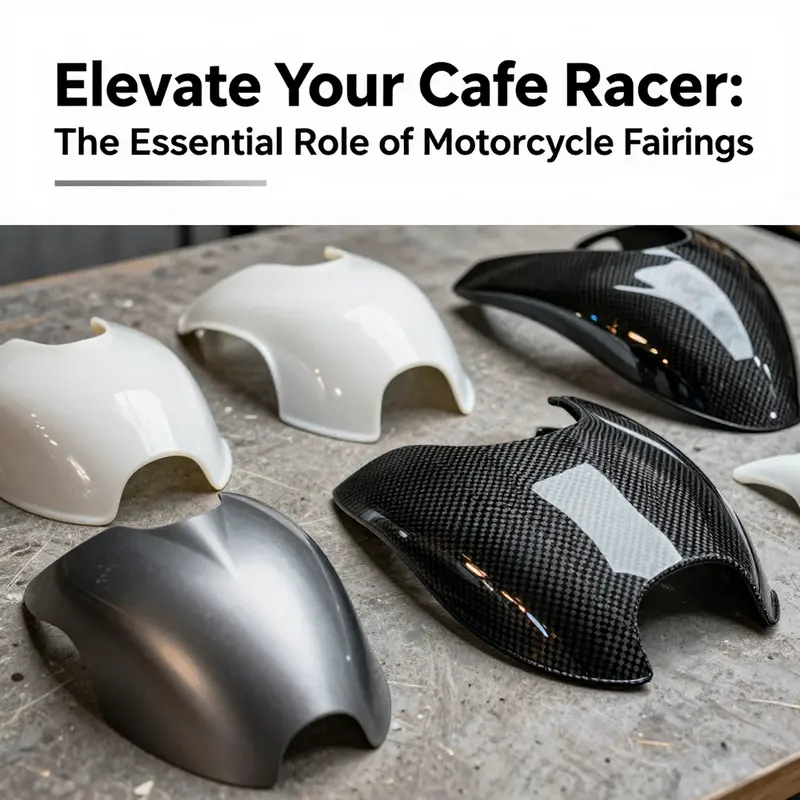
The cafe racer fairing is as much a statement as a component, blending aesthetic intent with engineering practicality. Material choice directly influences weight, stiffness, impact resistance, and how air navigates around rider and machine. A concise look at common substrates helps clarify the trade-offs designers face in pursuit of the classic silhouette.
Fiberglass, often labeled GFK, remains a balanced choice for shaping complex curves with a forgiving hand. It offers a favorable weight-to-stiffness ratio, is relatively easy to repair, and supports a traditional, hand-finished look that many builders prize. Its formability makes it well-suited to the smooth lines and subtle tapering that define the cafe racer ethos.
High-grade ABS plastic delivers repeatable tolerances and scalable production without sacrificing essential aesthetics. ABS is robust, holds tight tolerances for cleaner wind channels, and tolerates the rigors of daily riding or volume production. Color stability and surface finish are among ABS’s strong suits, helping achieve a factory-like appearance on customized shells.
Thermoformed polycarbonate stands out for transparency, impact resistance, and a modern edge. When a build calls for translucent panels or integrated lighting accents, polycarbonate delivers structural integrity while maintaining a refined, high-tech feel. It can be heavier than fiberglass in some applications, so weight budgeting is important.
Aluminum, whether hand-formed or pressed, conveys a tactile, industrial aesthetic with formidable rigidity and fatigue resistance. Aluminum shells can achieve razor-sharp edges and durable finishes, but this comes with added weight and fabrication complexity. The metal option suits builds aiming for a robust, long-term shell with a distinctly mechanical character.
Ultimately, the best material depends on the riding context, production goals, and the desired balance between weight, stiffness, and durability. The fairing should complement the bike’s geometry, the rider’s posture, and endurance in sun and weather, while aging gracefully and inviting continued personalization.
Shaping Speed: How Fairings Mold Aero, Comfort, and Character in the Cafe Racer
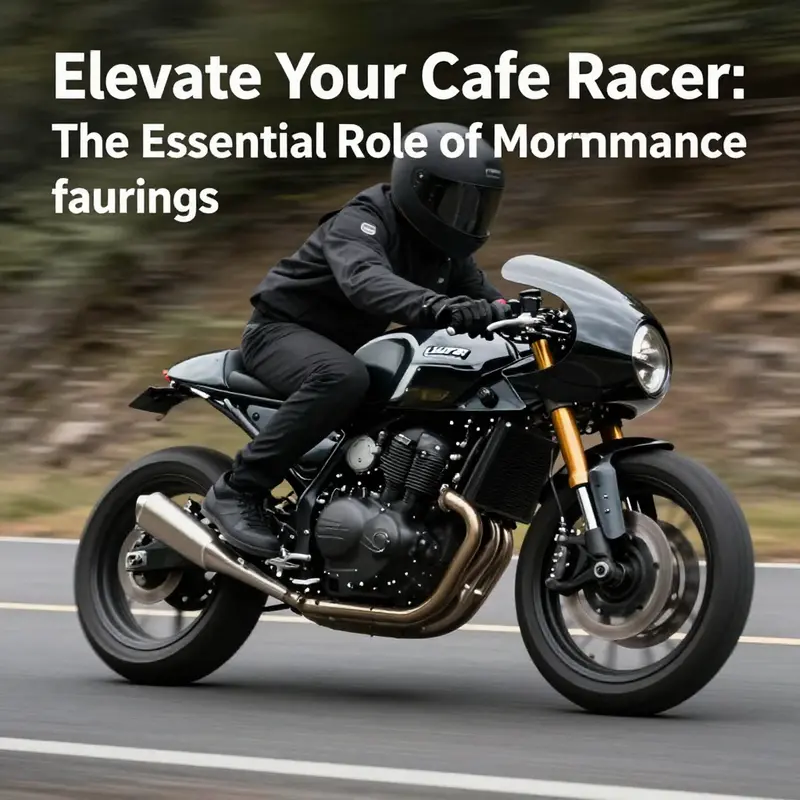
The cafe racer tradition is a study in contrasts: speed and simplicity, aggression and restraint, a vehicle built as much for personal statement as for on‑track timing. In this world, the fairing is more than a cosmetic flourish. It represents a deliberate negotiation between the dream of wind‑honed performance and the tangible realities of riding a machine that is, at its core, meant to feel light, responsive, and alive to the rider’s input. The fairing’s role, in that sense, sits at the crossroads of form and function. It is not simply a shield against weather or a shield against wind; it is a shaping instrument, guiding how a bike moves through air and how a rider perceives that movement. The minimal front fairing, characteristic of traditional cafe racers, embodies the idea that speed is a function of both the machine’s silhouette and the rider’s posture. Yet the same silhouette, when extended into a carefully chosen piece of bodywork, can broaden the bike’s practical envelope without erasing the essence of the original look. The result is a synthesis where aero performance, rider comfort, and aesthetic clarity exist not as separate goals but as a single, living objective: to make a bike feel faster than it is and more responsive than it should be while preserving the soulful lines that define the cafe racer’s identity.
Aerodynamics, at its core, is about managing air to reduce drag and control flow. Fairings act as conduits for airflow, guiding wind to minimize turbulent wake behind the rider and around the engine. Even a modest windscreen or a petite upper fairing can reshape the air’s pressure distribution along the rider’s torso and shoulders, translating into noticeable benefits at highway speeds or during long stints where fatigue compounds the effect of wind pressure. The practical upshot is improved stability and reduced headwind drag, which in turn can support better fuel economy and a steadier ride. When a rider sits in a slightly more tucked posture, the fairing’s interaction with the air becomes a dialogue—how the rider’s intent is reflected in the flow, and how the flow, in turn, respects the rider’s stance. In the cafe racer’s world, where acceleration and nimbleness matter, this dialogue matters as much as raw top speed. The right fairing can make the bike feel more planted, more controllable, and more capable of last‑mile cruising without turning the ride into an endurance test.
The material choices and construction methods behind fairings amplify their aerodynamic effect while shaping how they influence handling and practicality. High‑strength ABS plastic remains a common backbone for many aftermarket and factory-inspired fairings because it tolerates the stresses of road use, resists impact to a reasonable degree, and supports clean, sharp lines that echo the cafe racer ethos. Transparent or smoked glass accents can be integrated without compromising visibility, which is essential in urban riding where a rider’s line of sight and peripheral awareness matter as much as the wind’s force. The interplay of form and fabric—so to speak—matters here: light, precise curves that hug the bike’s profile can reduce drag without adding unnecessary weight or bulk. It is not merely about dressing the bike in a glossy shell; it is about engineering that shell to work with the bike’s chassis, suspension, and rider position to deliver a coherent aerodynamic package.
Of course, there are trade‑offs to this design philosophy. The cafe racer ethos—minimalism—advocates for reducing clutter and preserving a lightweight, agile feel. When a bike wears a full or aggressively styled fairing, the added mass is not just the weight of the plastic; it is a handful of additional surface area that interacts with the air, a larger moment arm in a corner, and a new target for gusts at speed. In practical terms, that can manifest as a slight dip in acceleration responsiveness or a different feel through the steering when the fairing is heavy or poorly integrated. The rider might also notice a difference in how wind pressure shifts their balance at various speeds, or how the fairing’s presence alters the bike’s feedback through the handlebars. For some, the visual payoff—the clean, sprint‑ready line that a fairing lends to the machine—justifies these compromises. For others, the appeal lies in a lighter touch, a smaller shield, or even a completely fairing‑less avatar that keeps the bike’s original character intact. This tension is not a failing but a feature of cafe racer customization: a spectrum where riders select degree of protection, visibility, and staccato responsiveness in harmony with personal philosophy and intended use.
Modern interpretations of cafe racers frequently embrace a hybrid approach. Rather than a full‑torpedo fairing that changes the bike’s silhouette entirely, designers and builders favor partial or integrated fairings. Small windshields, sport‑leaning upper cowls, or flowing belly pans can deliver wind protection and airflow management while preserving the nimble, uncluttered feel that defines the classic look. Such solutions are not merely about shielding the rider; they are about shaping the rider’s experience. A rider who spends hours on the road benefits from a more comfortable head and shoulder position, which reduces fatigue and can improve concentration. At the same time, a well‑designed partial fairing respects the bike’s geometry and the rider’s line of sight, preserving the minimalist aesthetic that is inseparable from cafe racer legitimacy. The result is a bike that handles with a swagger more akin to a purpose‑built sport machine, yet carries the intimate, human scale of a street‑ready motorcycle.
Material options, finish quality, and compatibility considerations all feed into this ongoing balancing act. ABS blends offer a robust framework for shaping the bike’s air pocket and for resisting road debris that could otherwise mar a vintage‑style finish. Smoked or clear accents give riders tactical choices for visibility and style without blurring the bike’s lines. Beyond the visuals, the choice of a fairing or the decision to go without one has a direct line to ride quality. For long rides, the wind’s impact on the head, neck, and shoulders can be the difference between a comfortable experience and a period of stiffness. The fairing, properly chosen and precisely mounted, mitigates that wind load, distributing it in a way that the rider’s posture can accommodate rather than fight. The overall effect is not simply a speed advantage; it is an increase in riding confidence and endurance, allowing a rider to stay alert and engaged rather than tensing under wind pressure.
The broader performance conversation must also consider the bike’s dynamics when fairings enter the picture. A well‑integrated fairing can shift the weight distribution and alter the center of gravity in subtle but meaningful ways. The visual weight, if not matched to the chassis, can make a bike feel spiritually heavier or more lethargic in quick direction changes. Conversely, a thoughtfully designed partial fairing can preserve, or even enhance, the bike’s nimbleness, supporting quicker steering inputs and more stable mid‑range behavior. Because cafe racers prize agility and a direct connection to the road, the design emphasis tends toward a seamless blend rather than a dramatic mechanical upgrade. This is where the builder’s eye matters most: the line flow, the fairing’s mounting points, and how the air’s pressure field interacts with the rider’s own position and weight distribution. It is a choreography rather than a blunt instrument of speed.
For riders who seek to anchor their project in the heritage of the cafe racer while embracing contemporary performance, a practical approach is to view fairings as a modular extension of the bike’s character rather than a fixed alteration of its personality. A fairing should be chosen with an eye toward how it complements the bike’s existing geometry, how it integrates with the seat and tank silhouette, and how it interacts with a rider’s preferred stance. The goal is not to erase the bike’s lines but to guide them—softly, precisely—so that airflow and rider comfort align with the bike’s natural dynamics. In this sense, fairings become a means of personalizing speed, not simply a way to dress a machine. The iteration process—from selecting a minimal shield to fabricating a tailored, integrated fairing solution—reveals a philosophy of riding that honors both the cafe racer’s lineage and the rider’s modern expectations of comfort, control, and consistency across miles.
For readers curious to see how fairings fit within the broader ecosystem of cafe racer customization, one practical pathway is to explore a catalog that reflects the varied scope of fairing styles available for sport and street configurations. Within that ecosystem, consider the Honda fairings catalog as a case study in how a manufacturer or aftermarket provider translates a legacy silhouette into modular, ride‑ready components. This resource demonstrates how a contemporary fairing can honor retro aesthetics while delivering predictable aero performance and dependable fitment across a range of models, illustrating the careful compatibility work that makes a cafe racer feel cohesive rather than cobbled together. See the catalog here: Honda fairings.
The conversation around cafe racer fairings naturally extends into the regulatory and safety realm, where standards and guidelines shape how air flows around a rider and how protective features interact with the machine. While the immediate focus of UNECE Regulation No. 22 is helmet and protective equipment performance, the document underscores a broader truth: aerodynamic design is inseparable from rider safety. A well‑designed fairing contributes to rider protection by smoothing airflow, reducing buffeting, and limiting fatigue‑related mishaps that can arise from poor wind management. These safety considerations inform the choices riders and builders make when selecting partial or full fairings, emphasizing that elegance and efficiency should never come at the expense of stability and control. The fairing’s effect on the overall experience—how it quiets the wind, how it channels air around the rider, and how it preserves—or enhances—riding confidence at speed—becomes a practical extension of safety, as much a feature as any protective gear worn on the rider’s body.
As the cafe racer scene continues to evolve, the fairing’s role remains a dynamic one. It invites riders to think not only about speed but about the conditions in which that speed will be pursued. It invites builders to balance retro lines with modern tolerances for impact resistance, corrosion resistance, and ease of maintenance. It invites designers to craft a continuum of options—from the most restrained, minimalist approach to more integrated, shielded configurations—that still honors the core ethos of the cafe racer: a machine that feels intimate, unforced, and ready to sing through a winding road. In this sense, the fairing is less a aftermarket add‑on and more a partner in the bike’s ongoing evolution—one that preserves the rider’s connection to the road while quietly extending the envelope of what’s possible when air, machine, and rider are in harmony. And that is precisely where the cafe racer’s legacy lives on: in a form that looks lean and timeless, yet behaves with a refined, modern confidence on every mile.
External resource: https://www.unece.org/transport/documents/2026/22/en
Between Speed and Silence: The Subtle Architecture of Cafe Racer Fairings
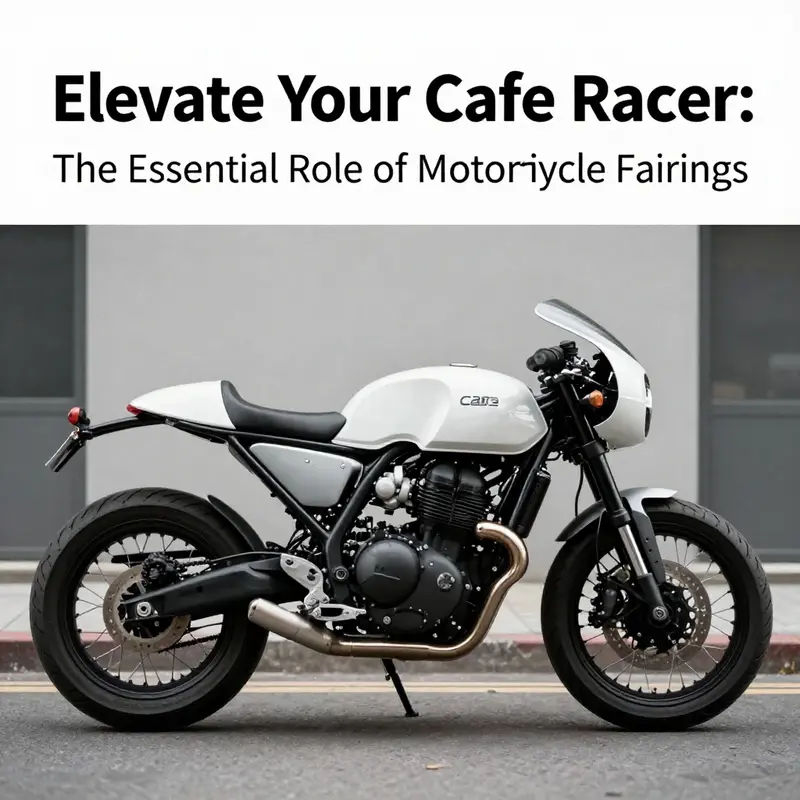
The cafe racer is more than a motorcycle tuned for a fleeting duel with the horizon; it is a manifesto of restraint and precision. In this light, fairings emerge not as bulky armor but as a carefully shaped extension of the bike’s core purpose: to slice through air with as little disturbance as possible while preserving the rider’s connection to the machine. Minimalism in cafe racer fairings is a deliberate choice, a philosophy that treats form as a function of speed, balance, and rider experience. The result is a silhouette that looks fast even when the bike is stationary, a visual cue that the machine’s aerodynamics have been sculpted with intent rather than ornament. The original cafe racer ethos—speed for short, focused bursts between cafes—still reverberates in today’s aftermarket and custom builds. Yet the modern conversation around fairings goes beyond nostalgia: it centers on practical aerodynamics, weight reduction, and a cockpit that remains rider-centric rather than machine-dominant.
A front fairing in this design vocabulary is typically minimalist, low, and relentlessly streamlined. Its primary job is to guide the air in a way that reduces drag and limits turbulence at speed, not to shield the rider from every gust. This is where the balance between aesthetics and function becomes most visible. A small, well-formed fairing can channel airflow efficiently around the front end, directing gusts away from the rider’s helmet and shoulders. It can also minimize wind noise and vibration, enhancing clarity in the rider’s perception of the road. The resulting improvement in riding comfort is not a mere side benefit; it is a practical consequence that supports longer sessions, even as the rider absorbs less fatigue from wind pressure. When the wind is less aggressive at the torso, the rider can maintain focus on technique, line, and throttle control, which in turn contributes to safer, more precise riding even as speed climbs.
Material choice plays a consequential role in this equation. Modern cafe racer fairings commonly rely on high-strength ABS plastic or composite materials. These choices offer a blend of lightness, rigidity, and impact resistance that suits the short, spirited riding that cafe racers often embody. The surface treatment—whether smoked or clear glass—adds another layer of consideration. Smoked finishes soften the lines and reduce glare, which can improve visibility of the front edge and give the bike a more cohesive, retro-modern look. Clear finishes, by contrast, reveal the fairing’s structure and the radii that define its aerodynamics, emphasizing the craft behind the design. In both cases, the material integrity matters most when the bike is pressed into windy conditions, at highway speeds, or on undulating terrain where air currents interact with the bike’s profile in complex ways. Here, the fairing becomes a living interface: it is not merely decorative; it is a hydrodynamic element, a small hull that meets air as a partner rather than an adversary.
Outliving the purely cosmetic impulse, the minimalist fairing’s geometry matters as much as its visual appeal. The lines that cradle the rider’s line of sight often harmonize with the bike’s overall silhouette, from the headstock to the fuel tank and seat. The intent is not to cover the rider but to tuck the machine into a unified shape that reduces drag while preserving access to essential controls and instrumentation. A well-integrated fairing respects the bike’s geometry—its rake, trail, and chassis stiffness—so that the rider still feels connected to the front wheel’s input. The outcome is a cockpit that breathes with the bike, a place where wind pressure is managed rather than fought. Designers and builders who embrace this philosophy understand that every curve carries a reason: a deeper chine here, a sharper downturn there, a taper that keeps airflow attaching to the surface rather than separating in broad, buffeting flaps. The rider’s helmet and the bike’s forward momentum create a single, cohesive stream, and that stream is what allows sustained high-speed riding to feel more controllable and less fatiguing.
In the cafe racer community, the conversation around fairings oscillates between two poles: complete or near-complete coverings used on some modern sport-inspired builds, and a spectrum of minimal or even absent fairings that celebrate the original street-racer spirit. The first path offers greater weather protection and perhaps more consistent aerodynamic performance in certain conditions, but it can alter the bike’s character by imposing a taller, more enclosed frontal profile. The second path keeps the spirit of restraint intact—relying on small front sections, exposed forks, and a lean crouched riding position to preserve the sense that the bike is a tool forged for a quick, precise sprint rather than a long-range machine. It is in this tension that a significant portion of cafe racer aesthetics finds its voice: a dialogue between modern engineering possibilities and a living tradition of minimal, purposeful design. This is not a rejection of performance; it is a refined approach to performance that foregrounds rider feedback, weight distribution, and the tactile feel of wind on the body as vital indicators of how the bike behaves at speed.
To understand the full spectrum of options, consider how a front fairing’s size and shape influence air flow around the front wheel and the radiator, where cooling needs must be balanced against drag. A smaller fairing reduces frontal area and often reduces weight, which in turn can yield quicker front-end response and more agile steering. However, the rider’s comfort and engine cooling must remain viable. The careful designer negotiates these constraints with a sense of proportion that treats the fairing as a system element rather than a standalone accessory. The design choice extends to the fairing’s edge treatment and the transitions into the tank, seat, and downtubes. When the eye follows the fairing’s contour, it can read a narrative about how the bike will behave in crosswinds, how smoothly the air will reattach after parting at the fairing’s edge, and how long a rider might sustain a comfortable posture without fatigue. These considerations matter because they translate into a more predictable ride, a smoother power delivery, and a more confident cornering experience at speed.
Within this design language, an important thread is how the cafe racer aesthetic aligns with broader contemporary trends toward lighter, more transparent machine bodies. The move toward naked bikes and retro-inspired silhouettes reflects a societal shift in which the rider’s skill and the mechanical relationship take center stage. In this context, the fairing functions less as a shield and more as a sculpted signature—a visible articulation of the rider’s intent and the bike’s mechanical soul. The resulting bikes are legible to an observer: you can tell at a glance whether a machine was built for a precise, fast ride or for leisurely cruising. The fairing’s minimalism helps preserve that legibility, allowing the rider’s posture, the seat height, and the instrument cluster to convey the bike’s purpose with fewer visual distractions. It is a quiet approach, but it is not passive; it communicates a deliberate choice about what the rider trades for speed and what is kept for the sake of tactile control and feedback.
For builders who want to explore a broader ecosystem of options without losing the cafe racer’s core identity, a few practical paths emerge. One can pursue a modular, lightweight front fairing that can be removed or reconfigured for events or particular rides, maintaining the flexibility that has always driven cafe racer culture. Another avenue is to study the relationships between fairing shape, weight, and rider position to optimize wind management for different body sizes and riding styles. The education of taste—knowing when restraint serves performance and when a touch more exposure sharpens the riding experience—remains a central discipline. In this sense, minimal fairings are both a design decision and a philosophy: less coverage does not imply less engineering; it signals a discipline in which every curve, every mounting point, and every material choice must justify its place in the aerodynamic ecosystem.
As you consider how to approach fairing selection or custom work, remember that even in a category that prizes restraint, there is room for informed personalization. A lightweight front section can be color-matched to echo the bike’s lines, or it can be finished to contrast dramatically, highlighting the aerodynamics as a crafted art rather than a mere component. For enthusiasts who want to visualize the broader landscape, a curated category like BMW fairings offers a window into how manufacturers and builders apply the same minimalist principle across different models and brands. The essence remains consistent: the fairing should serve the rider’s connection to the machine while contributing to the bike’s visual identity. The cafe racer, at its best, becomes a dialogue between wind, weight, and will—an instrument not just for moving through space but for shaping the rider’s experience of speed itself.
Ultimately, the minimalism of cafe racer fairings is not a rejection of protection or technology. It is a statement about priorities: speed, sentiment, and the rider’s sense of agency. It is about making the wind a collaborator rather than a nuisance, about letting the bike’s mechanics speak clearly through the shell that covers them. In this way, the fairing becomes a quiet engineer, a collaborator in the rider’s pursuit of balance and precision. As the discipline continues to evolve, the cafe racer remains a living laboratory where style and function meet, where restraint yields performance, and where the romance of speed is tempered by the careful, almost sculptural, physics of a well-made front section. For readers who want to dive deeper into the broader ecosystem of aftermarket fairings, a reference point can be found in the wider spectrum of brand-specific categories, which illustrate how minimalism travels across model lines while preserving the core cafe racer ethos. BMW fairings provide a practical lens for understanding how designers approach front-end forms in a range of machines.
External resource: To situate cafe racer fairings within a broader cultural understanding of the aesthetic and its enduring appeal, see the discussion in Bike Exif about what defines a cafe racer and why the style endures as a symbol of speed and personal expression. https://bikeexif.com/2024/03/07/what-is-a-cafe-racer-and-why-are-they-so-popular/
Final thoughts
In conclusion, motorcycle fairings for cafe racers are not merely aesthetic embellishments; they are crucial components that enhance performance and rider comfort. Understanding the nuances of fairing design—from the essential front fairings to material selection and their impact on performance—can empower business owners to appreciate their value. Moreover, the principle of minimalism intertwined with functionality echoes the soul of the cafe racer movement, ensuring that these motorcycles remain not only a statement of style but also a triumph of engineering.