

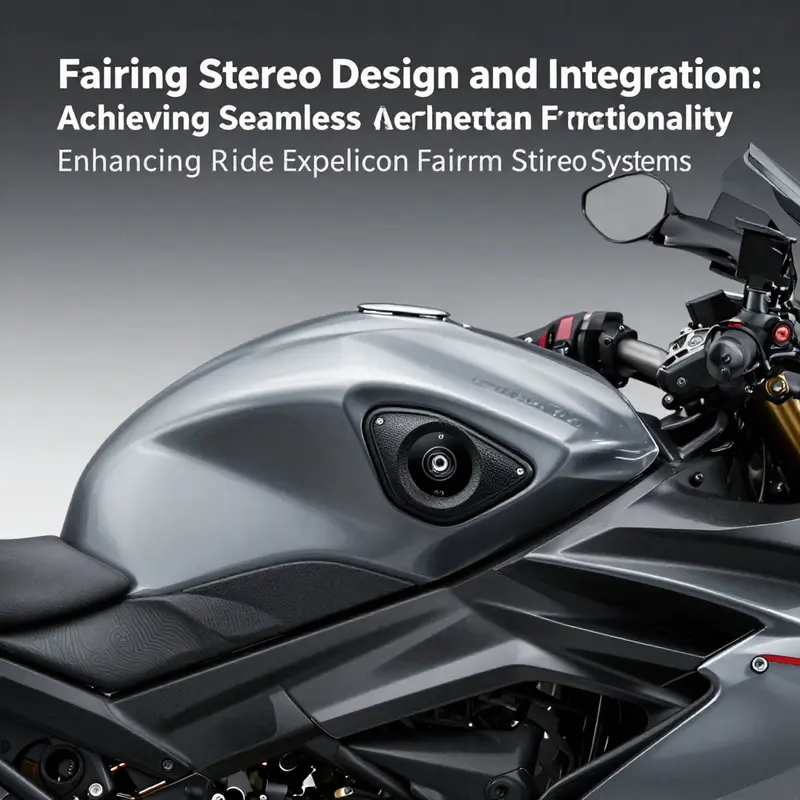
Motorcycle fairing stereo systems have revolutionized the way riders experience music on the road. By integrating audio components directly into the motorcycle’s fairing, manufacturers have not only enhanced sound quality but also maintained a sleek, aerodynamic profile. This article explores the design intricacies, acoustic challenges, market trends, and future innovations of motorcycle fairing stereo systems, providing business owners with insights into how they can tap into this growing market segment. Each chapter delves deeper into critical aspects of fairing stereo systems, making them a must-know for any business owner looking to innovate and attract buyers in the motorcycle audio industry.
null
null
Sound in the Wind: Mastering Acoustic Design for Integrated Fairing Stereo Systems

The idea of a stereo system tucked into a motorcycle fairing sounds like a natural extension of the riding experience, yet it sits at a surprisingly demanding intersection of engineering, ergonomics, and art. In the open air, wind, road, and engine noise compete with every note, every beat, and every cue from the audio source. The result is a sonic battlefield where the rider’s perception becomes the ultimate judge. This chapter explores how fairing-integrated audio systems rise to that challenge, not by simply cranking up volume, but by shaping sound for the rider’s cockpit, aligning with the bike’s geometry, and weathering the harsh realities of on-bike environments. What emerges is a narrative of careful material choices, precise speaker placement, and intelligent processing that together reframe “loud” into “clear and meaningful.”
Wind noise is not merely a ceiling for loudness; it is a dynamic partner that changes with speed, posture, and aerodynamics. When a motorcycle surges through air, the wind’s pressure couples with engine vibrations, frame flex, and even tire-road interactions. In such conditions, passive sound isolation becomes the first line of defense. High-quality enclosure materials, damping inserts, and carefully tuned internal resonances work in concert to reduce unwanted reflections and internal flutter. The goal is not to create a rigid, sealed chamber, but to establish a controlled acoustic environment where the rider’s cues—dialogue in a podcast, the warm timbre of a favorite track, or the crispness of a call from a connected device—emerge with fidelity. Suppliers and builders emphasize materials that minimize resonance while resisting heat, moisture, and flex. The fairing itself acts as a complex acoustic surface, and its geometry can be exploited to direct sound toward the rider rather than dissipating it outward into the wind.
Where wind is an external antagonist, the design response is a spectrum of strategies. One core approach centers on high-quality materials that pair with precisely machined enclosures. The enclosure isn’t a mere box; it’s a tuned cavity that shapes the frequency response, damps undesirable modes, and protects drivers from vibratory energy that would otherwise smear clarity. High-grade plastics, composites, and sealants are selected for their stability under sun, rain, and temperature swings. In practice, these materials enable a subtler conveyance of audio, where bass remains perceptible without becoming a rumble and vocals stay intelligible even as the bike roars forward. Crucially, engineers account for how the fairing’s internal air volume collaborates with the enclosure. The result is a line of drivers that project more directly toward the rider, minimizing energy lost to the surrounding air and the fairing’s inner shelves.
Speaker placement is the other half of the equation. Engineers and custom installers obsess over where, exactly, sound leaves the enclosure and how it propagates through the fairing’s curves. The aim is to erect a sonic pathway that meets the rider’s ears with minimal phase distortion and maximum intelligibility. In practice, this means flush-mounted or slightly recessed drivers that align with the rider’s seating posture and helmet position. The geometry of a bat-wing or fairing nose becomes a listening prism rather than a mere surface. A common design principle is to tilt drivers toward the rider’s head region while keeping them out of direct airflow to reduce turbulence-induced distortion. The effect is a coherent, front-focused soundstage that travels with the rider, rather than escaping into the wind. This approach also helps polarization of sound in a way that feels more natural, reducing the sensation of sound washing over the rider from all directions.
Beyond the hardware, directionality plays a crucial role. Directional audio technologies, when deployed, aim sound toward the rider while minimizing leakage into the surrounding air. The practical impact is not just louder sound, but more efficient use of power. By concentrating energy where it’s most appreciated, the system can maintain clarity at a lower overall wattage, which matters for both heat dissipation and the bike’s electrical load. The rider benefits from a more immediate, theater-like listening experience, where the stage feels intimate even as the wind howls just outside the cockpit. For touring riders, this means long-haul listening that remains fatigue-free—an outcome of consistent intelligibility rather than brutal loudness.
At the control edge, handlebar-integrated interfaces offer a conduit between rider intention and acoustic reality. Simple, tactile controls for volume, source selection, and track navigation help maintain listening quality without forcing the rider to fumble at high speeds. The goal is intuitive operation that aligns with the riding flow. When a rider leans into a bend or accelerates through a sweep, the audio system should stay in step with the moment, not fight it. In practice, this means minimizing glitched controls, ensuring robust Bluetooth connectivity for sources, and preventing unintended changes during vibration-rich passages.
The heart of modern fairing audio often includes a compact amplifier and, in more elaborate setups, a subwoofer housed within the fairing or in a nearby compartment. The amplifier parity with the drivers is critical: too little power leads to distortion under wind-load, while excess power can saturate the enclosure’s headroom and push the system into thermal limits. Subwoofers, when properly integrated, add a tactile dimension that can be surprisingly consistent on a long ride, offering warmth and depth that help music stay immersive rather than faint. The key is placement that respects heat flow, air channels, and the rider’s knee-line so that cooling and comfort remain uncompromised. Any subs or amps must be sheltered from rain and road spray, with sealed enclosures and moisture barriers that preserve performance across seasons and climates.
A growing strand of design thinking incorporates digital signal processing (DSP) to tailor audio output to the rider’s environment. DSP grants the ability to compensate for the fairing’s acoustics, wind noise dynamics, and speed-dependent changes in road noise. It can deliver adaptive tone curves, controlled dynamic range, and even directional scaling that keeps dialogue intelligible while preserving the musical essence of tracks. This level of processing is particularly valuable for touring teams or riders who swap weather and road conditions frequently, as it allows a single system to feel personalized across a broad spectrum of contexts. However, DSP is not a magic wand for all conditions. Noise from the wind and engine remains a formidable factor, and most systems still rely on a baseline approach: higher efficiency drivers, carefully sealed enclosures, and meticulous routing to prevent electrical interference and crosstalk.
To a rider eyeing a fairing-based audio upgrade, installation considerations become as important as the on-bike acoustics themselves. Durability and weather resistance are not afterthoughts; they are requirements. Sealed enclosures, weather-resistant finishes, and thermal management features are designed to keep critical electronics within safe temperature windows, ensuring consistent performance across hours of riding. Wiring routing demands respect for the bike’s structural integrity and serviceability. Cables should be shielded and routed away from heat sources, moving parts, and potential abrasion paths. Mounting hardware must endure vibration without loosening, and seals must preserve the integrity of both the audio system and the fairing’s weatherproofing.
Electrical capacity is another practical constraint. Upgrading a fairing with a stereo, amp, and possibly a subwoofer adds load to the electrical system. Designers and installers perform careful calculations to ensure that alternator output, battery capacity, and wiring gauge align with the added demand. In some cases, this work includes upgrading fuses or adding power distribution solutions to isolate the audio load from critical systems such as lights, indicators, and ignition. The most successful installations balance performance with reliability, ensuring that the audio experience remains constant whether the bike is idling in traffic or cruising at highway speed.
From the rider’s perspective, acoustics is as much about comfort as it is about fidelity. Long rides demand an audio system that remains clear and fatigue-free. Perceived loudness is a fusion of several factors—sound pressure level, spectral balance, and the ear’s own sensitivity at different frequencies under noisy conditions. A well-tuned system preserves vocal intelligibility in the presence of wind, then progressively reveals the warmth of a well-recorded vocal or the texture of acoustic instruments without forcing the listener to crank the volume to dangerous levels. In practice, riders discover that a well-integrated fairing stereo does not simply replace the wind’s intrusions with louder music; it establishes a musical dialogue that travels with the motorcycle rather than fighting against it.
In terms of aesthetic integration, the best fairing stereo installations respect the bike’s lines and materials. The most convincing outcomes look like a natural extension of the factory design: speakers flush with bodywork, grills that echo the fairing’s contours, and controls that fade into the cockpit’s tactile language. This coherence matters because it affects how riders perceive the system’s value. A visually integrated setup communicates confidence and durability, making the listening experience feel like a designed feature rather than a hastily added gadget. For riders who care about platform compatibility, exploring fairings across brands and models can be instructive. In the Honda fairings lineup, for example, there are options that reflect how a fairing’s shape and internal space influence acoustic design. See the Honda fairings section for CBR models. Honda fairings for CBR
As the industry continues to refine the balance between performance, weather resistance, and ease of installation, the conversation about motorcycle fairing stereo systems gravitates toward a few practical truths. First, loudness without clarity is a provisional fix; the longer-term payoff comes from controlled sound projection and harmonized audio processing. Second, the fairing is not a passive enclosure; it is an acoustically active participant shaped by geometry, materials, and mounting strategies. Third, the rider benefits most when the system blends into the bike’s digital ecosystem, offering simple source switching, reliable Bluetooth connectivity, and robust handling of wind-noise compensation without distracting the rider from the road ahead. Finally, the best systems acknowledge the rider’s hearing as a sensitive resource, encouraging listening at safe levels while delivering an immersive experience that respects both safety and enjoyment.
If a reader seeks broader context beyond the technicalities, the Harley-Davidson guide to motorcycle audio systems provides a comprehensive viewpoint on integration, performance, and installation considerations that resonate with modern fairing designs. It is a useful external reference for engineers and enthusiasts who want to ground their choices in established industry practices and real-world constraints. External resource: Harley-Davidson’s Guide to Motorcycle Audio Systems. https://www.h-d.com/en_us/motorcycle-audio-electronic-systems.html
In sum, the acoustic performance of a motorcycle fairing stereo system hinges on a disciplined synthesis of materials, enclosure design, speaker placement, directional delivery, and intelligent signal processing. The wind remains an adversary, but with thoughtful engineering, it becomes a driver of precision rather than a limiter of enjoyment. The rider’s cockpit, not the speaker cone alone, determines the listening experience. Through careful attention to the fairing’s geometry, robust weather sealing, and a balanced electrical architecture, audio can be both resilient and refined. The result is an elevated ride where sound supports the journey, comfort accompanies endurance, and entertainment travels as a natural extension of the motorcycle itself.
Sound on the Move: How Installation Kits and Custom Solutions Are Redefining the Motorcycle Fairing Stereo

Across the wind-drenched cockpit, the motorcycle fairing ceases to be merely a shield and becomes an acoustic chamber. The idea of a fairing stereo is not about cramming more speakers into tight spaces; it is about designing an integrated, purpose-built system that respects the bike’s aerodynamics while delivering intelligible, high-fidelity sound at speed. The fairing, long a canvas for rider comfort and weather protection, now hosts a carefully orchestrated ensemble of speakers, amplifiers, and sometimes subwoofers—enclosed, sealed, and tuned to survive the harsh realities of vibration, wind shear, and temperature swings. This evolution reflects a broader shift in motorcycling culture: riders increasingly demand a premium, factory-like audio experience that does not compromise safety, reliability, or the visual language of their machine.
A central challenge of fairing-mounted audio is the architectural constraint of the enclosure. Sound must emerge from a space engineered to deflect wind, dampen vibration, and protect sensitive electronics from rain and road spray. That means every component—speakers with weatherized surrounds, compact amplifiers, and enclosures designed for acoustics as much as weather resistance—must be chosen with an eye toward durability and clarity. The result is a soundstage that feels more organic than gimmicky. Instead of loud, flat tones fighting against rushing air, the system aims for a balanced spectrum that remains intelligible at highway speeds. In practice, this translates into engineering choices that treat the fairing as an acoustic ally rather than a passive shell. The result is not simply louder music, but clearer sound that preserves warmth and articulation, even as the ride intensifies.
To achieve this, many projects lean on installation kits that promise plug-and-play integration without compromising the bike’s original controls or electrical system. These kits are not merely a set of wires and brackets; they embody a philosophy of minimal disruption. A dash kit designed for a DIN radio, for example, is engineered to fit the contour of a fairing while preserving the rider’s access to switchgear and throttle-by-wire interfaces. The appeal is twofold: installation remains reversible, and the likelihood of wiring interference with critical bike functions is minimized. This trend toward modular, user-friendly solutions signals a maturing market where riders want fast, reliable upgrades that can be removed or swapped with little downtime. In this landscape, the installation kit becomes a bridge between aftermarket ambitions and factory-grade reliability, a way to harmonize modern electronics with classic riding ergonomics.
But the market’s appetite extends beyond universal solutions. A growing subset of riders seeks custom solutions tailored to specific models and riding styles. These are not one-size-fits-all packages; they are engineered for track days, long-distance touring, or, more generally, for riders who demand precise fit and performance. Custom routes often involve removing panels and reworking fairing interiors to accommodate larger or more efficient enclosures, tighter cable runs, and heat management strategies for amplifiers. The pursuit of fit and finish becomes a defining trait. A performance-oriented kit may offer a choice of finishes—raw, primer, or a color-matched option—to align with the bike’s aesthetics, while also simplifying access for maintenance. The emphasis on model specificity reflects a broader industry shift toward precision engineering. It’s not merely about adding sound; it’s about integrating an audio system that feels like a natural extension of the bike’s character and performance envelope.
The structural integrity of the fairing itself plays a crucial role in how effectively a stereo system can perform. As installation concepts move toward more sophisticated, modular components, suppliers increasingly offer support kits designed to reinforce the fairing’s mounting points and protect delicate electronics from engine guard interference or mounting load shifts. These kits acknowledge a simple truth: once you place speakers close to the rider’s head, the dynamics change. Vibration, heat, and vibration-induced resonance can color or blur the sound. A robust support system, paired with well-sealed enclosures, helps ensure that the acoustic gains are not compromised by the bike’s motion. This focus on structural fidelity also carries through to the hardware itself. Modular hardware, such as adaptable mounting brackets and spacer configurations, enables a precise, chassis-aware installation that accommodates the varying geometries of modern fairings while preserving the bike’s intended line and performance characteristics.
From an acoustic engineering perspective, the fairing environment is a microcosm of a tough listening room. Wind noise rises with speed, and the mixing of air pressure with engine and exhaust sounds creates a complex background. This is where technologies such as weather-sealed enclosures and, in higher-end systems, digital signal processing (DSP) come into play. DSP allows tone shaping, dynamic range control, and speed-based equalization to combat the changing noise profile as riding conditions shift. In practical terms, DSP can preserve vocal clarity in the midrange—the critical band for communication and navigation prompts—while keeping the bass tight and the highs free from harsh harshness. The goal is not only to increase volume but to improve intelligibility, which matters most to riders who rely on audio navigation cues or conversations with riding partners.
A realistic appreciation of fairing audio also requires attention to power and heat management. The electrical system on a motorcycle is a demanding guest for any aftermarket installation. Amplifiers and subwoofers draw additional current, and the fairing’s electrical pathway must be able to accommodate this load without affecting engine management, lighting, or charging performance. This necessitates careful power budgeting and, often, dedicated power supply paths with proper fusing and isolation to minimize electrical noise. Heat generation is another critical factor. In compact fairing cavities, heat can accumulate quickly, especially around amplifiers. Manufacturers increasingly design systems with thermal channels, vents, and heat sinks to maintain stable performance and extend component life. Wiring routes are carefully planned to avoid rubbing, pinching, or contact with hot surfaces, and to prevent interference with critical bike systems. The end result is a compact, efficient solution that remains reliable ride after ride, mile after mile.
A user experience that blends aesthetics with function guides the market’s trajectory. Installers and riders alike seek discreet integration that preserves the fairing’s sculptural lines. A well-executed installation reads like a factory feature: a clean silhouette with weatherproof seals and a flush-mounted look. The low-profile mounting of speakers is a good example. When speakers sit flush with the fairing surface, wind resistance remains minimal, and the visual integrity of the bike is preserved. The enclosure shape matters too; curved baffles and strategically placed ports can direct predominant sound toward the rider while minimizing reflections off the windshield or inner fairing walls. In practice this means that design judgments extend from acoustics to aesthetics, with the same effort put into the rugged beauty visible to the eye and the acoustic clarity heard by the ear.
Market maturity is evident in the level of documentation and compatibility information that accompanies these offerings. Riders increasingly expect precise fitment charts, wiring diagrams, and service notes that lay out clear steps for installation, maintenance, and troubleshooting. This clarity reduces uncertainty and supports a more confident upgrade path. For those exploring the latest options and model-specific paths, the catalog of 2023-new fairings offers a useful benchmark of how manufacturers and installers translate evolving rider demands into concrete products. See more in the 2023 new fairings category.
Ultimately, the fairing stereo story is about integrating multiple strands into a coherent, ride-ready system. It is not enough to have a speaker placed in a fairing; the entire chain—from power and audio processing to enclosure acoustics and environmental sealing—must be designed in concert. Installers who approach the project with a holistic mindset—careful power budgeting, heat dissipation, vibration damping, weather sealing, and cable management—toster the line between a clever aftermarket modification and a seamless, durable enhancement that looks and sounds like a natural extension of the motorcycle. This holistic approach also informs how riders select and evaluate installation kits. Rather than chasing the loudest headline, they look for those that promise preserveability, reversibility, and a clean integration that respects the bike’s original design language while elevating the acoustic experience.
The practical takeaway for riders considering a fairing stereo is that the installation kit is not a cosmetic add-on; it is the structural and electrical backbone of the system. The best kits enable a straightforward, reversible install that leaves the bike’s primary controls untouched, supports clean cable routing, and provides a chassis-friendly path for heat and vibration management. Custom solutions, when pursued thoughtfully, can deliver a level of fit and finish that rivals factory installations, with the added benefit of tailoring to a rider’s preferences and riding routine. In the end, the objective is a soundscape that travels with the rider—clear, balanced, and resilient—whether the journey is a weekend blast or a months-long tour.
For readers who want to explore model-aligned options while preserving the bike’s original control schema, the 2023 new fairings category provides a sense of how current offerings are mapping onto evolving rider needs. It illustrates the industry’s shift toward precision fitments and thorough documentation, reinforcing the idea that sound is as much a matter of engineering discipline as it is of speaker placement. The journey from concept to cockpit is a disciplined process of marrying enclosure physics, electrical integrity, and aesthetic continuity. The result is a fairing stereo that feels less like an aftermarket accessory and more like a natural, integrated system—one that respects the motorcycle as a dynamic machine and elevates the riding experience without compromising its core personality.
As fairing stereo solutions continue to mature, the emphasis will likely remain on compatibility, ease of installation, and robust performance under real-world conditions. Riders will increasingly expect options that offer seamless integration with existing handlebar controls and diagnostic interfaces, along with clear guidance on mounting, sealing, and maintenance. The market’s next phase may well bring more adaptive enclosures, smarter DSP profiles tuned to speed and riding context, and even more modular hardware that can be upgraded without a full teardown. The sonic upgrade becomes a statement about how riders value comfort, connectivity, and clarity on every mile of the road.
Internal link: For a broader view of compatible fairing platforms and model-specific fitment options, see the 2023 new fairings catalog here: 2023 new fairings.
External resource for deeper technical insight: for a comprehensive guide on tuning and DSP strategies in motorcycle audio, see the external resource here: External DSP tuning guide.
Smart Soundscapes on the Move: Innovations Redefining Motorcycle Fairing Stereo

The fairing of a modern motorcycle is undergoing a quiet revolution, transforming from a simple shield against wind into a sophisticated acoustic and information hub. This chapter explores how future fairing stereo systems will fuse advanced audio engineering with intelligent software, durable materials, and seamless connectivity to elevate rider experience while preserving safety and reliability on the road. The underlying idea is not merely louder or clearer sound, but a holistic approach where the soundscape, the rider’s interaction with data, and the bike’s mechanical realities converge into a cohesive, thoughtful system. In this vision, the fairing becomes an optimized enclosure for speakers, amplifiers, and digital processing, carefully engineered to withstand wind pressure, turbulence, rain, and the constant vibration that accompanies motion. The aim is to deliver a listening experience that remains sonically pristine across a wide range of speeds and environments, without sacrificing aerodynamics or electrical stability. To achieve this, manufacturers and researchers are turning to intelligence embedded directly in the fairing’s structure, leveraging its geometry to guide sound toward the rider while dampening reflections and flutter that can blur audio imaging. The result is a more intimate listening experience—sound that feels anchored to the rider rather than dispersed into the wind. The path forward is defined by real-time adaptability, smart interconnectivity, material innovation, and purposeful power management, all designed to work in concert with the bike’s dynamic behavior rather than in isolation.
A cornerstone of this evolution is AI-driven noise adaptation. Real-world riding presents a shifting laboratory of acoustics: steady highway wind howling at high speed, the roar of the engine and drivetrain during acceleration, tires humming on imperfect pavement, and dense urban noise from surrounding traffic. Traditional EQ adjustments can only approximate these conditions, often lagging behind the actual acoustic state. The next generation of fairing systems promises to sense ambient noise levels continuously and adjust their equalization in real time. Microphones placed in strategically chosen pockets of the fairing, combined with accelerometers and wind-pressure sensors, feed a lightweight on-board processor that analyzes sound pressure levels, spectral energy, and the impact of airflow on the speakers themselves. The resulting adaptive EQ is not a static profile but a fluid, ride-aware curve that shifts as speed, wind direction, and road texture change. The concept extends beyond simple loudness matching. It includes dynamic control of high-frequency content to preserve clarity of vocal accents and midrange precision for instrument tones, while bass management responds to the rider’s seated position and helmet type. The acoustic architecture benefits from the fairing’s own contours. The caveat has always been that a wind-ruffled front is a challenging speaker enclosure; yet with precise placement and digital correction, the fairing can become a guided sound channel. The drivers are mounted flush or subtly recessed to minimize drag and maximize directivity toward the rider’s ears. Sound is targeted rather than sprayed, reducing noise pollution to nearby riders and pedestrians and delivering higher perceived loudness with less electrical energy spent.
The practical benefits of AI-driven noise adaptation ripple into several layers of rider experience. The audio becomes more intelligible at highway speeds, where wind pressure can wash out midrange detail. The system can preserve vocal intelligibility for navigation prompts and phone calls, while still delivering the emotional punch of music or cinematic audio cues during a pace-out session. This is not a luxury feature restricted to premium builds; it represents a shift in how audio systems are designed for harsh environments, where the goal is to extract meaning from complexity rather than impose a uniform sound level. In this framework, DSP and machine-learning algorithms are not mere enhancements; they become core design tools that shape how the fairing, the rider, and the audio system work as a single ensemble. The fairing’s geometry informs the placement and orientation of speakers, while the software tunes the output to align with the rider’s typical posture and gear. In this sense, AI-driven adaptation is as much a matter of safety as enjoyment. Clear dialogue between navigator prompts and on-bike notifications emerges more reliably, reducing cognitive load by delivering essential information with precise timing and audible clarity. It is a subtle shift, but one that aligns with the broader goal of integrated, rider-centric design.
Beyond intelligent sound shaping, the future fairing stereo ecosystem embraces robust smart connectivity that extends the rider’s control surface far beyond a traditional dashboard. Modern multimedia displays are already expanding the boundaries of on-bike interaction by supporting wireless smartphone integration, such as Apple CarPlay and Android Auto. When these platforms are integrated with a fairing-mounted audio system, riders gain hands-free navigation, phone calls, music playback, and voice-activated commands that are accessible through handlebar-mounted controls or helmet-integrated interfaces. The promise is a seamless, distraction-minimizing loop: the rider speaks or taps a control and receives an immediate response from the bike’s infotainment system, which orchestrates audio playback, navigation updates, and incoming communications without forcing the rider to fumble for a device in the wind. As displays become more capable, the audio subsystem can leverage on-screen cues tied to the rider’s current route, weather conditions, or vehicle status. For example, a route recalculation alert could be delivered with a brief, intelligible phrase and a complementary haptic cue, while music playback remains uninterrupted. This integrated approach is not merely about convenience; it contributes to road safety by reducing the time the rider spends looking away from the road. The chain of interaction becomes a single, fluid continuum: screen, sound, and voice commands align with the rider’s natural behaviors, whether negotiating city streets or cruising along a coastal highway.
From the materials side, advancements in composites and embedded wiring are enabling lighter, more durable fairings that can house complex electronics without compromising aerodynamics or stiffness. Lightweight carbon- or glass-fiber-reinforced polymers with optimized layups provide the high stiffness-to-weight ratios necessary to resist vibration-induced micro-movements that degrade audio fidelity. At the same time, embedded wiring channels and resin matrix technologies simplify the routing of power and signal cables, reducing heat pockets and electrical interference with critical bike functions. Weather sealing has progressed from basic gaskets to precision-molded seals integrated into the fairing’s joints and speaker enclosures, ensuring that moisture and dust do not compromise performance. These structural enhancements are not cosmetic; they support sustained audio performance in rain, spray, or the damp conditions of early morning rides. The curb appeal of a seamless, factory-like integration remains a design objective, but now it is complemented by practical durability: materials that tolerate heat, UV exposure, and the constant flexing that comes with long-distance touring and aggressive riding alike. In parallel, energy efficiency has become a governance principle for the entire system. Class-D amplifiers, power-efficient DACs, and smart power management strategies ensure that audio and display units do not overburden the motorcycle’s electrical system. The goal is to strike a balance where higher fidelity does not come with proportionally higher draw on the battery. Engineers are exploring modular architectures that allow individual components to be powered down when they are not in use, while maintaining a coherent audio image for the rider. The combined effect is a system that sounds better, lasts longer on the road, and remains reliable under a wider range of environmental conditions.
A more integrated concept emerging from this convergence is the idea of a connected cockpit where the fairing stereo acts as a central information hub. Rather than viewing audio as a standalone feature, manufacturers are envisioning a cohesive interface in which audio, navigation, and vehicle telemetry are woven together into context-aware experiences. Imagine a scenario where incoming road hazard alerts from a connected GPS system are delivered with spatial audio cues that help the rider localize the source of the warning, or where a music playlist gracefully yields to a turn-by-turn cue without abrupt changes in volume. These experiences rely on synchronized DSP, precise speaker placement, and thoughtful calibration of audio level across speed ranges. The fairing’s acoustic model, shaped by its geometry and material choices, is an asset in these scenarios—sound can be directed toward the rider with controlled diffusion, preserving intelligibility even as the bike transitions from a protected pocket to an open wind zone. In practice, this entails a design philosophy that treats the fairing as an acoustic instrument rather than a simple enclosure. The result is a system that not only sounds good but also contributes to safer riding by supporting timely, efficient information transfer in dynamic environments.
Design feasibility hinges on careful attention to installation realities and maintainability. A future fairing stereo must be compatible with a broad spectrum of bike architectures, from sport-oriented fairings with tight tolerances to touring designs that require more space for power electronics and larger enclosures. The installation approach should minimize invasive modifications, preserving the bike’s resale value and warranty. It should also accommodate serviceability, with modular components that can be swapped or upgraded with minimal downtime. Heat management remains a critical constraint. Amplifiers and DSP chips generate heat under continuous operation, and the fairing can act as a heat sink if designed with this purpose in mind. Thermal pathways, venting strategies, and material choices must be co-optimized with acoustic performance. The goal is to prevent overheating, which can compromise sound quality or device longevity. Wiring routes should be clean, protected from abrasion, and shielded to prevent electromagnetic interference with critical bike systems. In this sense, the future fairing stereo is as much an exercise in mechanical engineering and electrical engineering as it is in acoustic design.
Riders who seek compatibility with a given bike are often oriented toward the broader ecosystem of fairings that fit their machine. For those browsing for a broader range of options, exploring compatible fairings can be a prudent step. One practical entry point is the collection of fairings designed for a well-known category, such as the fairings for BMW S1000RR. This category illustrates how manufacturers balance aesthetic integration with functional requirements, showing how speaker cavities, wiring channels, and sealing methods can be tailored to preserve the bike’s lines while accommodating audio hardware. Such options demonstrate that the integration work is not just about adding a speaker to a panel; it is about co-designing the entire fairing to support a high-fidelity, resilient audio system without compromising performance or form.
As these technologies mature, the broader motorcycle ecosystem is likely to see a shift toward intelligent, integrated solutions rather than isolated add-ons. The fairing stereo could become a central hub for information, entertainment, and safety features, with software updates expanding capabilities and learning from rider preferences. The result is a more personalized, responsive riding experience where audio quality, data accessibility, and connectivity harmonize with the bike’s physical and electronic architecture. This evolution aligns with a larger trajectory in mobility technology: devices that listen, learn, and adapt to the rider’s environment while maintaining a transparent and intuitive user interface. It is a future where the fairing stereo is not simply heard, but felt as a natural extension of the riding experience—clear, contextual, and confidently integrated into every mile ahead.
For readers pursuing deeper technical context on how multimedia motorcycle displays operate and fit into this evolving ecosystem, see the external resource that analyzes how these smart displays function and interact with audio systems: https://www.bikeandride.com/multimedia-smart-motorcycle-display-explained. This external reference complements the internal exploration of fairing audio by linking display technology with the broader concept of an integrated, rider-centric cockpit. As with the internal references guiding fairing design, the journey toward fully integrated audio and display systems continues to be iterative, collaborative, and driven by real riding conditions and rider feedback. The next chapters will examine specific design case studies and performance metrics that quantify how AI adaptation, connectivity, and material science translate into tangible improvements on the road.
Final thoughts
Motorcycle fairing stereo systems represent the next frontier in combining audio technology with motorcycling culture. For business owners, understanding the intricate design, acoustic challenges, market trends, and future innovations can drive successful product offerings. As consumers increasingly seek an enhanced riding experience, capitalizing on the growing demand for high-fidelity audio solutions will be key. Staying informed and adapting to these trends will position businesses for success within this dynamic segment of the market.