
Custom-made motorcycle fairings represent a significant niche in the motorcycle industry, offering aesthetic appeal and functional enhancements tailored to riders’ needs. These bespoke components are more than mere design elements; they embody a blend of innovation, style, and performance. With businesses increasingly recognizing the value of personalization in product offerings, understanding the design process, material choices, market trends, and quality control in manufacturing custom fairings is essential for success. This article delves into these key aspects, providing valuable insights for business owners navigating this specialized arena.
From Sketch to Wind: Crafting Custom Motorcycle Fairings
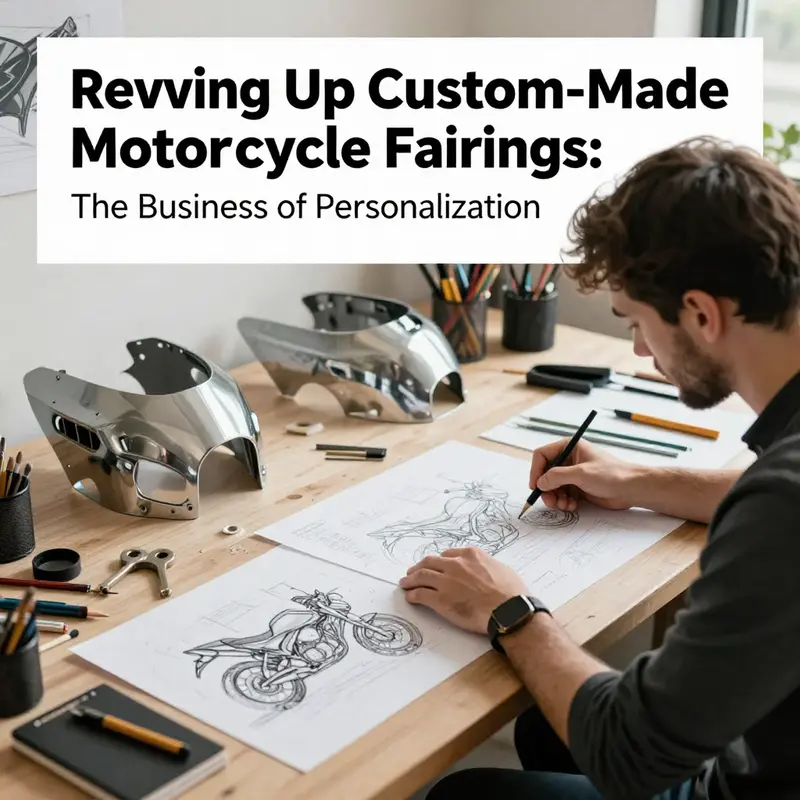
The design process behind custom-made motorcycle fairings is a quiet rebellion against the idea that parts must only fit a template. It is a dialogue between individuality and engineering, where a rider’s personal taste meets the physics of air, weight, and balance. The path from concept to the road is not a straight line but a carefully choreographed sequence of decisions that honor both aesthetics and performance. A well-made fairing is never merely a shell; it is a tuned component that can alter aerodynamics, rider comfort, and even the feel of the motorcycle at speed. To understand how this transformation happens, one can imagine the journey as a continuous thread weaving through vision, materials, form, and precision manufacturing, all the while maintaining a clear eye on integration with the bike’s chassis and existing hardware. In practice, designers and builders begin with a shared question: how can a rider express character without compromising handling, cooling, or safety?
Conceptualization is where imagination begins to take shape. The rider or designer starts with rough ideas, translating personal style into form through sketching and digital visualization. This stage often embraces a spectrum of themes—from spare, minimalist shapes to vibrant, themed narratives that might lean toward glittering finishes or bold graphics. Rather than a rigid blueprint, the early drawings serve as a language for experimentation. Digital rendering using CAD tools lets the team test proportions, line flow, and how the fairing will kiss the fuel tank, the handlebars, and the radiator area. The digital model becomes a living canvas, a three-dimensional plan that reveals how the new contours will interact with the bike’s frame, the rider’s line of sight, and the path of air around the rider’s body. The story that unfolds during concept work is crucial because it anchors every subsequent decision to a coherent visual and functional objective.
Material selection follows as a practical yet creative constraint that defines both the look and the performance envelope. Custom fairings rely on lightweight composites that can be shaped precisely and finished to a high standard. Carbon fiber offers unmatched stiffness and a sleek, high-tech appearance, while fiberglass provides a more forgiving, cost-effective option. High-impact plastics blend durability with ease of processing, making them attractive for more complex geometries or color-friendlier finishes. The choice among these materials is rarely about a single factor; it is a balance of weight, strength, cost, and the desired surface quality. A glittering finish or a vivid color like a modern hue can lift the whole design, but the finish must work in harmony with the underlying material and the curing process. In a global context, manufacturers in centralized hubs leverage advanced polymer processing to deliver both bespoke projects and bulk runs, enabling designers to test concepts rapidly while keeping a clear eye on scalability and consistency. Although the supply chain is sophisticated, it remains sensitive to the rider’s goals, which means the material choice is as much about performance targets as it is about the final aesthetic statement.
Prototyping then bridges the gap between idea and reality. A prototype—often produced with rapid methods such as 3D printing or hand-molded foam models—lets the team assess fit, clearance, and aerodynamics before committing to a mold. This stage is where digital ideas are tested in a physical form, enabling quick iterations. Prototypes reveal how mounting points align with the frame, where the surface relationships might cause interference with footpegs or exhaust routing, and how the air flows over and around the rider’s position. Aerodynamic testing, even in a simplified wind tunnel or computational fluid dynamics analysis, informs decisions about lip shapes, edge thickness, and venting. The goal is not to achieve perfection in the first pass but to learn enough to refine the concept in a controlled, economical way. Prototyping also acts as a visual and tactile proof of concept, convincing a rider that the final product will deliver both the look they crave and the performance they expect.
Fabrication is where the idea begins to harden into a real, ride-ready part. The molding process for composites involves laying up layers of material in precision-made molds, followed by a careful curing sequence that relies on heat, pressure, and time. The exact stack of plies and the orientation of fibers determine stiffness, impact resistance, and how the skin will respond to loads during dynamic riding. In a bespoke workflow, technicians may adjust fiber direction to optimize strength along critical stress paths, ensuring the fairing behaves predictably under gusts and at high speeds. The curing environment and mold design are essential to achieving a smooth surface and consistent thickness across complex geometries. This phase also considers integration with fasteners, weather seals, and mounting provisions that will survive years of vibration, temperature changes, and occasional off-road conditions. The result is a robust shell that not only looks the part but can bear the rigors of real-world riding.
Post-processing is where the hand of the craftsman becomes visible. Sanding, priming, and painting are traditional steps, but the stage is not merely cosmetic. It is where data-driven decisions about durability and environmental exposure meet artistic choices about texture and finish. Intricate graphics, glitter effects, or layered color schemes demand a steady hand and precise masking to achieve edge sharpness and color depth. The finish can be tailored to the rider’s climate and riding conditions—gloss for high visibility in daylight, or matte solutions that minimize glare without sacrificing depth. Clear coats must resist UV degradation and UV-stable pigments should be chosen for colorfast results. The craft extends to edge finishing, seam alignment, and the subtle radii that matter for handling and airflow. The post-processing stage thus converts a strong, well-designed shell into a visually compelling, durable surface that maintains its integrity after countless hours on the road.
Testing ties the entire chain together, rendering the design accountable to safety, function, and real-world performance. Structural testing confirms the fairing can withstand wind pressures and impact loads without compromising rider safety. Aerodynamic tests validate that the shapes produce the intended downforce, reduced drag, and stable rake under established speeds. Fit checks with the motorcycle frame verify clearances, turning radii, and visibility for the rider. In this integrated workflow, testing isn’t a final hurdle but an ongoing feedback loop that informs tweaks in geometry, materials, or mounting points. It is common to re-enter the prototyping or fabrication phases if results reveal issues with mounting, heat management, or interference with cooling ducts. A well-tested fairing earns rider confidence, ensuring that the aesthetic product does not come at the expense of safety or rideability.
The entire design and manufacturing ecosystem that supports custom fairings is underpinned by global sourcing and sophisticated infrastructure. Regions with mature polymer processing capabilities provide the baseline for consistent quality and scalable production. Lean manufacturing practices ensure that even bespoke projects can move from concept to prototype with efficiency, while still allowing for the iterative exploration that makes a truly personal product possible. In such settings, on-site quality control plays a critical role. Calipers, coordinate measuring machines, laser scanning, and other metrology tools help ensure that every mold, every lay-up, and every painted surface meets strict dimensional and finish tolerances. The combination of advanced equipment, skilled technicians, and strong supplier networks enables a maker to balance the speed of prototyping with the reliability of long-run production. The result is a pipeline that can adapt to one-off commissions while maintaining the repeatable quality expected of larger runs. This balance—creativity pressed into form, and form engineered for resilience—defines the modern practice of custom fairing design.
In practice, the design journey is rarely linear. A designer might begin with a vision for an aggressive silhouette, only to discover during prototyping that a slight curvature helps reduce buffeting at windward angles. The material choice may shift as performance targets evolve, with carbon fiber favored for stiffness in a high-end build, and fiberglass used to explore bold shapes more economically. The finishing layer can drive a rethink of the underlying resin system to preserve gloss or to host glitter or graphic schemes without compromising abrasion resistance. What remains constant is the need for seamless integration with the motorcycle’s geometry and the rider’s ergonomics. A well-conceived fairing respects the original bike’s balance, preserves access to essential maintenance points, and allows room for adjustments in windscreen height, leg guards, and venting schemes. Each stage informs the next, and the resulting product embodies a crafted balance between art and engineering rather than a mere assembly of parts.
The ecosystem surrounding custom fairings is global but locally expressive. Sourcing hubs in favorable regions provide the capacity and expertise needed to deliver both unique, one-off designs and small- to mid-scale runs. This model supports the diverse ambitions of riders who want something distinctly theirs while also addressing the demand from enthusiasts who seek limited editions or model-specific fitments. A practical outcome of this approach is the ability to prototype rapidly, iterate with feedback from riders, and refine a finish that stands up to UV exposure, abrasion, and the occasional abrasion from road debris. In this sense, the design and manufacturing pipeline is a living system—one that evolves with material science, manufacturing technology, and rider aspiration. The promise is not only a lighter, more aerodynamic outer shell but a form that feels like part of the bike’s identity, a personal statement worn by speed and control.
For readers who want to explore a concrete connection to model-specific variations and options while keeping the discussion grounded, the BMW fairings category provides a tangible reference point for how a designed system adapts to different frames, scales, and mounting conventions. See the BMW fairings section for a sense of how a design language translates across models and how modular approaches can preserve compatibility while expanding customization possibilities, all within a consistent manufacturing framework. BMW fairings illustrates how a focused catalog can support bespoke design while maintaining the precision needed for reliable fit and performance. The balance between a strong brand language and individual expression is the practical spirit behind many custom programs, and it speaks to the broader theme of making a fairing that both performs and communicates.
As the journey of a custom fairing nears its final act, it is useful to reflect on the broader context that makes all this possible. The shift toward lighter, stiffer, and more finish-ready composites has accelerated the pace at which riders can realize their visions. Automated processes in high-volume hubs coexist with careful, hands-on finishing in boutique shops, ensuring that even the most ambitious designs can be realized with consistent quality. The design process, from conceptual sketch to post-processed surface, is fundamentally about translating a personality into a physical form without compromising the motorcycle’s core performance envelope. The resulting fairing then becomes a partner in riding, shaping air, reducing drag, guiding wind around the rider, and helping to tune the character of the machine. In this light, custom fairings are less about decoration and more about intimate engineering—where art, physics, and rider identity converge on the road.
External reference: https://www.motorcyclefairings.com/custom-fairings-design-process/
Material Alchemy: How Fiberglass, Carbon Fiber, and More Shape Custom Motorcycle Fairings
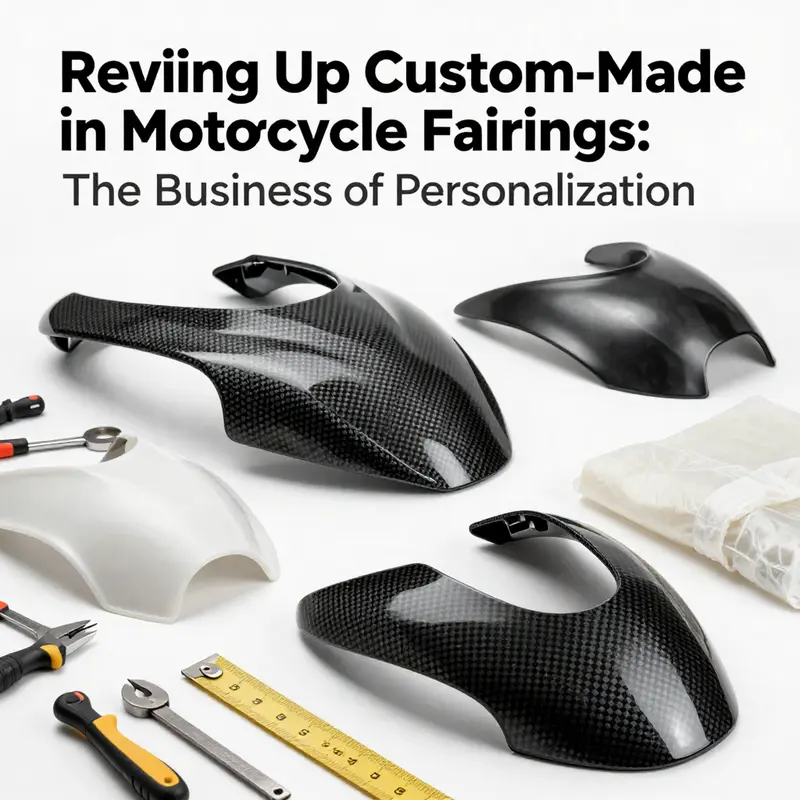
Every custom fairing project begins with a conversation between form and function, a negotiation between what looks stunning and how weight, stiffness, and aerodynamics respond to the rider’s needs. Materials are not merely raw inputs; they are active participants in a bike’s personality. They decide how a curve will hold its line at high speed, how much feedback a rider feels through the handlebars and pegs, and how easily a shape can be swapped as tastes shift or as a different model demands new geometry. In the world of custom-made fairings, material choice is both a technical decision and a design statement. The craftsperson who selects fiberglass, ABS, polycarbonate, carbon fiber, or aluminum is not simply choosing a price point; they are selecting a set of properties that will govern stiffness, weight distribution, impact resistance, finish quality, and, ultimately, the rider’s experience on road or track.
Fiberglass stands as a foundational material in many custom builds because it balances rigidity with formability. Glass fibers, locked inside a resin matrix, allow for complex aerodynamic shapes that would be challenging with solid plastics alone. The rigidity of fiberglass is a strong ally when a fairing must maintain a precise profile at high air speeds. It resists flexing, so the fairing does not buffet or flutter under load, which matters for stability at the edge of traction limits. Finishing fiberglass fairings is a skilled craft in itself. Gel coats and paints are used to seal and protect the surface, and the resin system can be tuned to improve moisture resistance and UV stability. Yet fiberglass comes with caveats. It is heavier than carbon fiber and, when it does fail under sharp impacts, the fracture patterns can require careful repair to restore true aeroform. For riders dialing in race protocols or endurance setups, those repairs may be worth the trade-off for reliable, tunable stiffness and predictable handling through a range of temperatures and pressures.
ABS plastic has emerged as the default choice for many factory and aftermarket street fairings, and its popularity in custom builds mirrors its practical strengths. ABS is lightweight relative to fiberglass, and it responds well to high-volume molding techniques that keep costs down while preserving serviceability. For riders who log daily miles or navigate urban rhythm, ABS offers a quiet resilience. It accepts fast, efficient repairs and panel replacements, inviting straightforward color matching and finish work. The material’s stiffness is not on par with fiberglass in the harshest track conditions, so seasoned builders often reserve ABS for fairings intended for daily riders or for combinations where the bulk of the load-bearing shape is in other materials. The ease of molding ABS supports ambitious surface geometry with fewer tooling constraints, enabling bolder curves without exploding tooling budgets. In this sense, ABS is the pragmatic choice for those who want expressive form without escalating costs or technical complexity.
Polycarbonate, with its hallmark impact resistance, is a nuance-heavy option in the fairing designer’s toolkit. This material shines in components where bright light and potential impacts intersect—protective visors and windshields are classic examples, and there are certain sections of a fairing where polycarbonate’s clarity and toughness are advantageous. For full fairings, polycarbonate remains less common than fiberglass or carbon fiber due to weight and processing considerations, but it can be an excellent choice for protective inserts, wind-shedding features, and windowed sections that demand visibility without compromising integrity. In practice, polycarbonate is often used in hybrid builds, where a polycarbonate module sits behind a glassy or painted exterior that benefits from superior impact resistance in key zones.
Carbon fiber composites represent the apex of weight-conscious performance in the fairing world. When designers talk about “high strength-to-weight,” carbon fiber embodies that promise in a material that responds to even the smallest shaping nuance with a noticeable difference in ride feel. In racing applications and high-end custom builds, carbon fiber reduces unsprung weight and improves acceleration, braking response, and steering precision by shaving weight from the upper bodywork. The flip side is cost and manufacturing complexity. Carbon fiber requires specialized layups, precise resin infusion, and careful curing to avoid microcracking or blank spots that could undermine strength. The aesthetic payoff—deep, lustrous finishes and the freedom to produce ultra-sleek profiles—pairs with a performance narrative that many riders in premium segments find compelling. Finished carbon fairings can be coated with clear finishes to retain the natural weave or colored for a chosen hue, enabling a level of visual depth that is difficult to match with other materials.
Aluminum is less often the centerpiece of a full fairing but plays a notable supporting role in modern custom builds. When used strategically for substructures, brackets, or light ribbing, aluminum offers excellent stiffness with good fatigue resistance and predictable thermal behavior. It handles fasteners and interfaces with other materials well, and its machinability can simplify custom mounting solutions for windshields, vents, or underfairing components. While aluminum generally does not lend itself to the same degree of intricate shaping seen with carbon fiber or fiberglass, it remains valuable for elements that must bear load or connect disparate panels with precision.
In true practice, most builders adopt multi-material strategies, combining the strengths of different inputs to tailor a fairing’s overall performance. A typical approach might involve a fiberglass or carbon fiber skin with an ABS inner layer for impact absorption and a light aluminum subframe for mounting accuracy. This multi-layer approach can maximize stiffness where it’s needed, absorb energy in a controlled fashion on impact, and still deliver a finish that meets both aesthetic and durability expectations. The result is a tailored response: a fairing that holds its line through a high-drag sweep, but that can still survive a casual drop with minimal damage and straightforward repair.
The method by which a fairing takes shape is just as important as the material itself. The layup process, resin choice, and curing regimen determine not only final weight and stiffness but the tolerance window builders must respect to fit across model lines and production variations. Advanced processes such as resin transfer molding or vacuum-assisted resin infusion can produce very consistent thicknesses and stronger interfacial bonds between plies. For high-utility or track-focused builds, these processes reduce the risk of delamination under heat and vibration. Quality control becomes part of the design language: calipers, coordinate measuring machines, and laser scanning are often integrated into the workflow to verify that each panel adheres to the intended geometry. The modern fairing shop thus reads like a small precision workshop where art and engineering converge, and where every parameter—thickness, resin ratio, fiber orientation—affects the ultimate feel of the machine when a rider thrusts into the wind.
Finish and surface treatment play a surprisingly large role in how these materials perform in real-world conditions. Gel coats and high-build primers seal porous fibers and provide a uniform canvas for color and graphics. Clear coats must resist UV degradation, yellowing, and micro-scratching; the more critical the rider’s exposure to long days on the highway or weekend track days, the more attention is paid to long-lasting surface integrity. Aesthetics—whether satin, gloss, metallic, or glitter-infused finishes—are not only about appearance. The finish layer also contributes to weather resistance, abrasion resistance, and the perception of weight. A light-reflective paint or a deep, nearly translucent lacquer over carbon can alter the way the fairing reads in shadow or direct sun, changing perceived speed and silhouette as the bike moves through air.
The conversation about weight, stiffness, and aesthetics naturally leads to aerodynamics. Each combination of material and construction technique alters the fairing’s mass distribution, center of gravity, and surface compliance. Lightweight carbon frames are not just about stripped weight; they also affect how the wing-like shapes respond to changes in pressure as speed rises. Add venting or shaping features that direct airflow toward or away from critical junctions, and the rider’s experience becomes a matter of refined balance. A fairing designed with vented panels can help expel boundary layer air, reduce drag, and improve cooling at the engine intakes. An adjustable windscreen, while technically a separate component, interacts with the surrounding fairing’s geometry to modulate turbulence, rider comfort, and front-end feedback. Materials thus enable a practical, testable platform for iterative design, where even small adjustments to a weave pattern or a laminate sequence can deliver measurable gains in performance and rider feel.
Beyond the shop floor, the market factors that shape material choices matter a great deal. China, with its expansive manufacturing clusters in regions that focus on polymer processing and complex composites, has become a global hub for custom fairings. The supply chains here enable rapid prototyping and scalable production, with on-site quality controls and teams dedicated to R&D that push material applications forward. For buyers, the picture is not simply price and lead time; it includes performance metrics and reliability signals, such as how quickly suppliers respond to inquiries, how consistent their delivery is, and how long they have proven parts for model-specific applications. Buyers increasingly seek suppliers that can deliver a blend of speed, accuracy, and durability—an alignment of timing, fit, and finish that makes it possible to iterate through multiple designs in a single season while keeping costs manageable. In this landscape, the choice of material also communicates a rider’s intent: whether the bike is built for outright speed, for street comfort with a touch of track-ready stiffness, or for a showpiece with extraordinary aesthetics.
For those exploring the broader catalog, a quick tour of the marketplace reveals how these material decisions coexist with a catalog of shapes and finishes. A robust fairing program will offer full fairing kits as well as lower and upper rear sections, with customization possible across a spectrum of resins, fibers, and thicknesses. The balance between cost, performance, and appearance is no longer a single decision but a matrix that designers and riders navigate together. When a customer leans toward carbon fiber for a first fairing, the shop may propose a layered approach—an outer carbon skin for the finish and a fiberglass core to resist impact with manageable repair costs, all mounted to a lightweight aluminum subframe for precision alignment. If a rider prioritizes cost, a fiberglass shell with an ABS inner liner can deliver a strong, serviceable result that still holds excellent optical clarity with the right paint and clear coats.
Aesthetics, too, is a language of material choice. The possibility to embed glitter or micro-particle accents within a clear coat, or to achieve a high-gloss or matte finish, allows builders to create a look that matches a rider’s personal statement. The interplay between color, texture, and weave is not merely cosmetic; it contributes to how the surface performs under light, how scratch resistance is perceived, and how easily the surface can be repaired after a road or track encounter. The most successful custom fairings harmonize these elements: the chosen material provides the structural backbone, the surface treatment reinforces durability and personality, and the geometry itself supports a seamless integration with the bike’s lines and ergonomics. The result is not simply a panel; it is a carefully tuned system that influences handling, feedback, and rhythm on the ride.
To navigate this landscape with confidence, buyers and builders increasingly rely on comprehensive supplier evaluations that go beyond certifications. While ISO and other quality marks matter, practical performance data—such as response times to inquiries (often measured in hours), customer satisfaction ratings, and demonstrated track- or model-specific performance—are crucial signals. This pragmatic focus helps ensure that the partner chosen will sustain quality across repeated runs and seasonal cycles, a critical factor when custom fairings are not just a one-off but a long-term platform for identity and capability. The supply chain thus becomes part of the design process: where a panel is cut, how it is finished, and how rapidly a new variant can be introduced to the line. These considerations, combined with material science, define the modern lifecycle of custom fairings, from initial sketch to finished piece mounted on the bike.
For readers who want a navigable entry into this landscape, there is a path that keeps the focus on material depth while offering a way to explore broader options: a credible, structured catalog of parts and a carefully curated supplier network. One can start with a 2023 new catalog that highlights contemporary geometry and material choices, then see how those options translate into actual builds across different rider profiles. The emphasis remains on how materials govern not only the look, but the ride—the way a fairing communicates wind pressure, how it interfaces with the rider’s posture, and how it contributes to a muggy summer day on a twisty road or a cool morning on a long commute. The craft of material selection is thus not a theoretical exercise; it is the practical fulcrum upon which comfort, speed, and reliability pivot in the world of custom-made fairings.
If the reader wishes to see a broader family of options and to explore a catalog that expands the conversation beyond a single project, the following internal link can serve as a convenient gateway: 2023 new fairing options. This category page offers a snapshot of how manufacturers and workshops are framing new shapes, new finishes, and new material blends in a single season, without being tied to a specific model or brand. It is a reminder that material alchemy in the fairing space is as much about experimentation as it is about tradition, and that the right combination of glass, polymer, and carbon can yield a fairing that feels tailored to the rider’s posture, riding style, and the geometry of the motorcycle itself.
External resources provide a practical map for the careful buyer who wants to couple design with dependable sourcing. For a comprehensive guide to supplier evaluation and sourcing strategies in this niche, see the Motorcycle Fairing Supplier Guide. It offers structured criteria for assessing performance, communication, and quality control across a range of manufacturing partners, so riders and builders can approach customization with a clear-eyed plan. Motorcycle Fairing Supplier Guide.
Riding the Curve: Market Trends Shaping Custom-Made Motorcycle Fairings
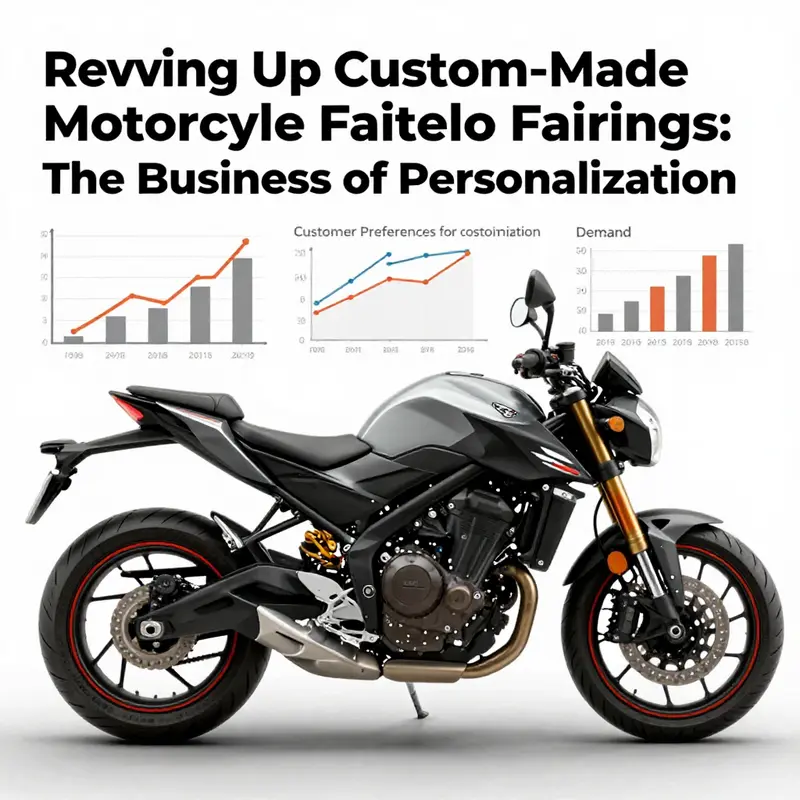
The market for custom-made motorcycle fairings is riding a powerful wave of growth, driven by riders who crave personalization, optimized aerodynamics, and tailored riding experiences. As of 2025, the global motorcycle fairing market registered a value of approximately 15.3 billion dollars and is projected to continue its ascent at a robust compound annual growth rate of about 10 percent from 2026 through 2033. This expansion crosses the boundaries of mass production and specialty, reflecting a broader shift in how riders perceive customization: not as a cosmetic add-on, but as a purposeful component that enhances performance, comfort, and the overall riding experience. The numbers tell a story of convergence between style and function, where materials science, manufacturing technology, and collaborative engineering converge to deliver parts that complement a bike’s chassis, weight distribution, and airflow management with a precision that was once the domain of race teams. In this environment, the fairing becomes more than a shell; it is a strategic element of the motorcycle’s identity and performance envelope.
The drivers behind this momentum are many and interrelated. Advances in materials science have expanded the toolbox available to designers and fabricators. Lightweight composites, fiberglass-reinforced plastics, and newer, high-performance resins enable the creation of complex, sculpted shapes that optimize airflow while preserving or even enhancing rider comfort. These materials allow for thinner sections in high-load zones, strategically placed venting, and curved surfaces that minimize turbulence without compromising strength. The result is not simply a visually striking surface but a component that reduces drag, stabilizes lift, and can contribute to more stable handling at high speed. For riders who push their machines toward peak performance, even fractional gains in aerodynamics translate into meaningful differences in acceleration, stability, and fuel efficiency over a long ride or a race day.
Manufacturing technologies are following suit, accelerating the pace of prototyping and enabling small-batch production that previously would have required large capital investments. CNC machining, precision 3D printing, and high-resolution iterative molding are now standard tools in the custom fairing shop. These capabilities shorten development cycles from concept to finished part, allowing designers to test fitments against a bike’s frame geometry, mounting points, and interference with other components in quick succession. Rapid iteration is particularly valuable as riders demand bespoke features—such as vented leg fairings for cooler airflow or adjustable windshields that can be tailored to rider height and posture—without compromising the integrity of the mounting system or the aesthetics of the line. In this context, the fairing evolves from a static cover into an engineered interface that interacts with the rider and the bike’s powertrain, suspension, and chassis dynamics.
Market segmentation in this space reflects a dual trajectory: broad-based customization for enthusiasts seeking distinct looks and performance-minded builds that demand precision engineering and reliability. In many markets, the United States serves as a substantial growth horizon, where demand for bespoke aesthetics and functional upgrades continues to rise. This is complemented by an international ecosystem that prizes both scale and craft. The proliferation of specialized suppliers—ranging from integrators who assemble full fairing kits to boutique studios that craft lower fairings, upper rear fairings, and bespoke touchpoints—offers riders a spectrum of choices. The objective is not merely a more attractive shell but a holistic upgrade kit that harmonizes with the motorcycle’s aerodynamics, balance, and rider ergonomics. Only with this integrated approach does a fairing justify its place in a rider’s investment, standing as a performance improvement and a personal statement in equal measure.
One of the strongest strategic trends shaping this market is the shift toward strategic sourcing from specialized suppliers, particularly in regions where advanced polymer processing and export-oriented manufacturing clusters have matured. China, for example, has emerged as a global hub for custom fairing production due to its developed value chains, capable fabrication ecosystems, and on-site quality control capabilities. In such environments, buyers can access engineered finishes and aerodynamic components at scale while maintaining the option to customize details such as surface texture, paint, and internal channels. However, this sourcing approach also brings considerations around certification and compliance. While some suppliers maintain strict ISO standards across their operations, many smaller players rely on performance-based metrics rather than formal certifications alone. This makes supplier selection a more dynamic exercise, focusing on real-world outcomes—how well a part meets design tolerances, how material consistency holds up under thermal and UV exposure, and how reliably a supplier can deliver complex, model-specific parts on tight timelines. When a buyer evaluates a supplier, several indicators rise to the top: the ability to deliver complex, model-specific geometry, the consistency of materials used across batches, and the speed with which a supplier can respond to design changes or sampling requests. In a market where both mass-market and boutique configurations exist, these indicators are as important as price.
As collaboration becomes more central to success, the industry is witnessing a shift toward integrated fairing solutions that are designed to fit a given chassis or frame concept. The rise of custom frame builders and performance-oriented riders has created demand for fairings that align precisely with unique geometry, mounting points, and cable routing. Manufacturers increasingly work closely with frame fabricators, using precision fixtures, tube benders, and alignment jigs to ensure that every piece slots into the bike with exacting accuracy. The goal is seamless assembly and a clean, cohesive silhouette that enhances airflow without introducing gaps or misalignment that could compromise performance or rider protection. This collaborative model shortens development cycles and reduces the risk of fitment issues during installation, a crucial factor for both OEMs and independent distributors who must maintain quick delivery times without sacrificing quality.
In practical terms, this focus on integrated design translates into fairings that are engineered as a system rather than as isolated panels. Vented leg fairings become more than decorative features; they are strategically placed to manage boundary layer separation, reduce drag in critical zones, and direct airflow toward cooling channels or behind the rider’s knees where turbulence is most pronounced. Adjustable windshields, another example of this trend, require precise tolerances to retain their position during high-speed rides and to maintain optical clarity under all weather conditions. The market’s emphasis on real-world performance means fairings are increasingly treated as powertrain and rider-comfort components—parts that must perform consistently under a range of temperatures, humidity levels, and riding styles.
This evolution in product design also reflects a broader democratization of customization. Advancements in manufacturing technology and more agile supply chains have lowered barriers to entry for boutique brands and individual builders who once operated on a strictly artisanal model. The result is a marketplace where high-end, performance-focused fairings coexist with accessible, visually distinctive options. Material innovations play a key role here: lightweight composites and advanced plastics enable complex geometries that reduce weight and improve aerodynamics, while surface finishes—from matte to gloss, glittering accents to vibrant color palettes—allow riders to express personality without compromising performance. The balance between aesthetics and function has become a defining characteristic of modern fairing design, underscoring the idea that a well-crafted fairing should enhance the overall riding experience as much as it enhances the machine’s appearance.
To illustrate how practitioners think about this balance, consider the concept of an integrated, model-specific kit that pairs a full fairing assembly with tailored accessories and mounting hardware. A well-executed kit reduces installation time, ensures compatibility with existing components, and minimizes the risk of vibration or flutter at speed. The most successful providers offer not only the parts but also engineering guidance, fitment checks, and post-delivery support to address any mechanical or cosmetic issues. This level of service matters because the riding community increasingly views customization as a long-term partnership rather than a one-off purchase. Riders expect enduring quality and predictable performance, especially when the investment extends beyond the initial hardware into protective coatings, UV stabilization, and warranty coverage. The market’s trajectory—driven by material science, production technologies, and structured collaboration—suggests that the fairing will remain a central piece of the motorcycle’s identity, a key lever for performance, comfort, and personalization.
For readers seeking a concrete touchstone in how these dynamics manifest in a category context, a practical reference can be found in the broader product category pages that curate fairing options by platform and model family. See the BMW fairings category for an example of how a major category can be organized around chassis compatibility, dimensioning, and accessory ecosystems, illustrating how suppliers align their offerings with a rider’s vision while maintaining rigorous standards of fit and finish. BMW fairings category. This example helps explain why a well-designed, model-specific kit can reduce lifecycle costs and improve the probability of achieving a satisfying, long-term customization.
The market’s growth and its strategic evolution—from material selection to supplier networks and collaborative design—point to a future in which custom-made fairings are not merely aesthetic upgrades but essential parts of a high-performance, tailored riding experience. As more riders seek to harmonize form and function, manufacturers will continue to push the boundaries of what is possible with aerodynamics, airflow management, and rider ergonomics. They will also refine their approaches to sourcing and quality assurance, balancing the allure of rapid prototyping and lower costs with the accountability that comes from delivering parts that meet exacting standards under pressure. In this environment, customization becomes a measurable, repeatable process—a disciplined blend of artistry, engineering, and supply chain acumen. The ongoing investment in materials, tooling, and measurement technologies will keep driving down lead times while expanding the range of design possibilities. Riders will benefit from more options that deliver not only striking looks but solid, real-world performance gains that hold up over time.
External resource: Grand View Research offers a comprehensive analysis of market size, drivers, and forecasts for the motorcycle fairing segment, providing broader context for the growth dynamics described here. Access the full market trends report at https://www.grandviewresearch.com/industry-analysis/motorcycle-fairing-market.
From Mold to Merit: Precision Quality Control and Strategic Sourcing for Custom Made Motorcycle Fairings
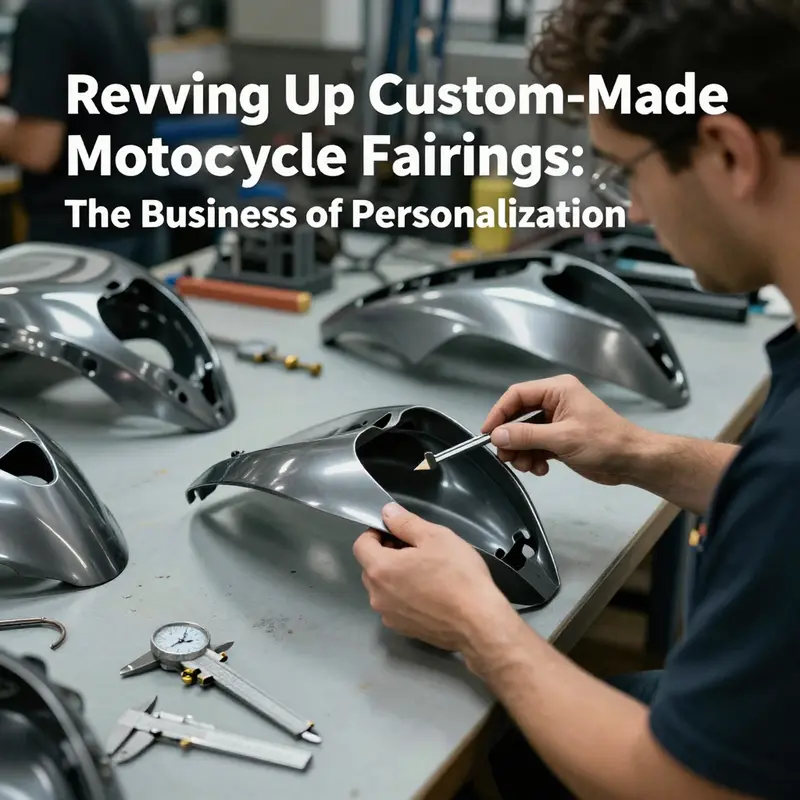
Quality control is not a single test but a discipline that threads through every stage of making custom motorcycle fairings. From the first sketch to the final shipment, every decision shapes fit, finish, and function. When riders demand aesthetics that turn heads and performance that holds up under wind pressure, the parts must prove themselves at the most granular levels: tolerances, surface integrity, resin distribution, and long-term durability. That is why sourcing and quality assurance are inseparable parts of the design process. They are the quiet engineers behind the visible glow of a well-made set of fairings. The modern marketplace recognizes this link clearly. Buyers no longer settle for a glossy render and a low price; they seek partners who can translate a concept into a consistently precise product that behaves as well in the wind tunnel as it does on the showroom floor. In this light, the global supply chain, with China at its core, becomes not just a supplier network but a collaborative ecosystem where engineering rigor, manufacturing discipline, and reliable logistics converge.
China’s role as the dominant hub for custom motorcycle fairings rests on a confluence of capabilities. In provinces like Guangdong, Zhejiang, and Fujian, there are clusters of manufacturers that offer end-to-end capacity—from design and rapid prototyping to high-volume production. These regions benefit from mature polymer processing ecosystems, skilled labor, and well-established export channels. They can support everything from one-off prototypes that test a unique carbon-fiber weave to full production runs for boutique brands that demand consistent quality alongside customization. The value proposition extends beyond cost. It encompasses speed, repeatability, and traceability—elements that are non-negotiable when a rider is counting on a fairing to deliver not just style but structural integrity in demanding riding conditions.
For a buyer seeking to bring a custom concept to life, the choice of partner begins with capability. A supplier’s ability to work with advanced materials—carbon fiber, fiberglass composites, and high-performance resins—often marks the difference between a part that looks good and a part that performs well under race-style loading. Vacuum infusion and autoclave curing are more than fancy terms; they are disciplined processes that minimize resin pooling and air voids, producing parts that are lighter, stiffer, and more durable. These fabrication techniques, prevalent in specialized corridors such as Ruian in Zhejiang, align with the expectations of riders who demand aggressive aesthetics without compromising safety or longevity. When a manufacturer can demonstrate repeatable, science-backed results from these processes, they offer a level of predictability that is invaluable in a market where warranties and after-sales service heavily influence brand trust.
Yet technology alone does not determine success. The quality equation is equally about process discipline and communication. A robust supplier evaluation framework helps ensure that a partner is not merely capable of producing a fancy part but can sustain long-term collaborations with OEMs and aftermarket brands. Responsiveness matters as much as rigidity in a spec. A supplier that can acknowledge a design change quickly, adjust tooling mid-cycle, or recalibrate a resin system in response to a new paint finish demonstrates that they understand the end-to-end implications of design-for-manufacturability (DFM). DFM is not a one-off worksheet; it is an ongoing conversation that reduces risk during transition from concept to production. Early DFM reviews can prevent costly rework, shorten lead times, and improve overall yield by aligning design intent with manufacturing realities.
In practice, the sourcing journey begins with rigorous supplier screening. Buyers are advised to look beyond certifications alone. While ISO credentials and quality management systems signal baseline competence, they do not guarantee performance in a specific project context. The most effective evaluators combine certifications with verifiable data on performance metrics: response time, on-time delivery rates, and customer satisfaction scores. A supplier who can provide a transparent track record across multiple model-specific projects—proof of consistent fit, paint adhesion, panel alignment, and post-processing quality—offers a stronger foundation for a long-term relationship. Real-world procurement data from B2B marketplaces and industry guides corroborates this approach, highlighting suppliers with strong export logistics, clear quality documentation, and demonstrable capacity to scale from prototypes to mass production while meeting tight tolerances.
Within this landscape, the role of testing becomes central. Pre-shipment inspections are not a formality but a final checkpoint that confirms conformance to both the product design and the brand’s quality standard. Inspections typically cover critical dimensions with calipers, and, for higher-precision parts, sometimes employ coordinate measuring machines (CMMs) or laser scanning to verify geometry against the CAD model. Material testing—UV resistance for colored surfaces, impact strength for outer shells, and environmental aging assessments—helps ensure that a fairing will resist sun exposure, road debris, and the occasional crash impact without dramatic degradation. The emphasis on material behavior is particularly important for carbon-fiber and fiberglass composites, where resin-rich regions and fiber orientation directly affect stiffness, fatigue resistance, and paint adhesion. A well-documented test regimen also reduces the risk of warranty claims and elevates customer satisfaction by providing defensible data on performance and durability.
The supplier’s quality assurance plan should also be visible in its process documentation. Buyers should request a comprehensive production master file that includes process flow diagrams, control plans, raw-material traceability, and even dye-assembly instructions for colored or graphics-laden finishes. The value of such documentation becomes evident when a brand introduces a new color family, a new graphic motif, or a new upper or lower fairing configuration. With clear change-control procedures, the supplier can implement design tweaks without cascading disruption through the production line. In turn, brands gain confidence to iterate quickly, a capability that is increasingly necessary in a market that rewards fresh looks and evolving aerodynamics while maintaining reliability.
Once the right partner is selected, the relationship must be managed with the same rigor applied to engineering. Transparent communication is essential. Buyers should establish regular cadence for status updates, including sample approvals, prototype feedback, and pre-production run validations. This cadence is particularly valuable when the project involves complex finish work or multi-material assemblies where surface prep, primer compatibility, and painting sequences must be tightly coordinated with resin systems and core materials. The goal is to preserve intent throughout the entire process—from initial concept to the first production batch and beyond. Providers who can demonstrate a track record of reliable, on-time delivery, especially in projects that require vertical integration—where composite layup, tooling, painting, and assembly occur under one roof—often present the most efficient path to scale without sacrificing quality.
A practical approach to supplier selection focuses on several key criteria. First, assess the factory’s polymer processing capabilities. A supplier should be comfortable with carbon-fiber prepregs, prepreg layups for high-temperature resin systems, and the handling of complex geometries that demand precise mold-release schedules. Second, evaluate their composite fabrication workflow for evidence of controlled infusion, consistent resin flow, and uniform curing. Third, investigate their approach to color and graphics. Finishes that require multiple layers, metallics, or translucent effects demand meticulous paint adhesion strategies and topcoat compatibility with UV inhibitors. Fourth, examine their QC culture: are there on-site quality control personnel, calibrated metrology tools, and a documented calibration schedule for all measurement devices? Finally, verify their export-readiness: the ability to package consistently for international shipment, provide proper labeling, and maintain traceability for all components used in a fairing kit.
In practice, buyers can operationalize this framework by requesting specific proofs of capability. A technical dossier can include material data sheets, infusion parameters, cure cycles, and cure-temperature histories. A typical pre-production package might feature a small batch of test panels that represent the intended geometry and finish, followed by a full dimensional report and a paint-adhesion test. These deliverables establish a baseline for ongoing production quality and create a reference point for future upgrades or color changes. The importance of these documents cannot be overstated. They reduce ambiguity, accelerate remediation when issues arise, and help both sides maintain alignment across evolving requirements.
Logistics and supply chain resilience also shape the sourcing decision. Buyers increasingly weigh export logistics, lead times, and the supplier’s ability to scale. Regional hubs, such as those in southern China’s coastal corridors, offer efficient freight options and established distribution networks. The advantage is not merely speed but visibility—real-time updates on manufacturing progress and shipment status reduce uncertainty for downstream brands and dealers. In an environment where a single delay can ripple through a production schedule, the ability to forecast reliably and communicate early is as valuable as any technical specification. For brands with global footprints, this means choosing partners who can provide end-to-end traceability—from raw material lot codes to final batch numbers on packaging. The overarching aim is to minimize the risk of mis-ships, mislabeling, or misalignment of parts with model-year updates, all of which can erode customer trust and damage a brand’s reputation for reliability.
The broader ecosystem that supports custom fairings also rewards suppliers who invest in continuous improvement. Firms that maintain a pulse on the latest composites technology, paint systems, and finishing techniques tend to deliver longer-lasting finishes that resist sun fading and micro-abrasion from road grit. When combined with a robust quality culture, these advantages translate into lower warranty costs, higher post-sales satisfaction, and stronger brand equity. In turn, buyers are rewarded with partners who can grow with them—whether a project is a small, highly customized installment or a multi-year program featuring several model platforms and finishes. The result is not simply a set of fairings that fits the bike; it is a carefully engineered, repeatable system that preserves aerodynamics, aesthetics, and ride quality across seasons and miles.
For readers seeking practical starting points, consider approaching sourcing not as a price game but as a collaborative design-and-manufacture partnership. Begin with a clear specification that outlines geometry, material selection, surface finish, and intended operating environment. Request a concise, organized QA plan and a detailed production timeline. Seek evidence of successful model-specific collaborations, including references or case studies that demonstrate consistent outcomes. Encourage early design-for-manufacturing reviews to flatten the learning curve and reduce time-to-market. And finally, insist on measurable performance data and a transparent communication framework that keeps stakeholders informed at every milestone. When a fairing project embodies this disciplined approach, the result is a product that not only looks sharp but behaves predictably under real-world riding conditions and across the inevitable ups and downs of supply chains.
To illustrate how this philosophy translates into practice, consider a model where a rider seeks a carbon-fiber upper rear fairing with a subtle, high-gloss finish and a color that shifts with light. A factory with strong DFM capability can validate that the chosen weave orientation aligns with the expected load paths and that the infusion process will yield uniform resin distribution at the edges and curves. The same partner can provide a validated paint plan with UV-stable clear coats and a documented cure schedule that ensures the topcoat adheres to the cured surface without microcracking. If the project includes a lower fairing with vent openings, the supplier should also show how the venting system integrates with the air flow model and how mold tools accommodate both the structural shell and the finish layer without compromising fit in the mounting points. In this scenario, the supplier’s value lies not just in producing a fairing that looks good but in delivering a system whose mechanical behavior, surface integrity, and color stability hold up under the rider’s expectations.
As buyers navigate the global landscape, a balanced emphasis on both technical capability and operational reliability yields the most durable partnerships. The path to success is not a single clever trick but a disciplined discipline: rigorous supplier qualification, transparent process documentation, precise manufacturing controls, and a proactive stance on quality assurance that scales with design ambition. When these elements come together, custom-made fairings become more than cosmetic upgrades; they become engineered components that improve aerodynamics, rider comfort, and confidence. The market rewards this combination with better lead times, fewer post-sale issues, and a stronger sense of trust between brand and customer. For those who want to explore model-specific options while maintaining that rigorous standard, the field offers many avenues to learn and verify the capabilities of potential suppliers. A practical next step could be examining a dedicated catalog that centers on the categories most relevant to your project, such as dedicated fairings for a particular platform or a region’s capable composite specialists, and then pairing that view with a supplier’s QA dossier to verify alignment before committing to a production agreement. As the process unfolds, the goal remains constant: a seamless translation from creative intent to durable, high-precision parts that perform as reliably as they look.
Internal link reference: For a model-focused look at fairings, see the dedicated page that showcases a broad range of fairings options within a brand-agnostic category. This resource helps illustrate how fit, finish, and detailing harden into a reproducible product across multiple platforms. fairings for BMW S1000RR.
External resource: https://www.alibaba.com/showroom/motorcycle-fairing-supplier.html
Final thoughts
In summary, custom-made motorcycle fairings offer significant opportunities for businesses willing to embrace personalization and innovation. Understanding the complexities of the design process, selecting appropriate materials, staying attuned to market trends, and implementing effective quality control measures will empower business owners to thrive in this dynamic sector. With the motorcycle community increasingly prioritizing unique designs and superior performance, investing in the development of custom fairings could yield substantial returns and foster customer loyalty in a competitive market.